Where can I get cheap gas?

Everybody is feeling the pinch of high gas prices.  Many are beginning to realize this isn’t a temporary thing.
What to do?  How about relocating to a place where we think long-term about all aspects of our lives, including the true cost of energy to our lifestyle, our peace of mind, as well as our pocket book?

I recently purchased a plug-in electric vehicle that I am outfitting with solar panels.  I like infinite MPG and $0.00/gallon.  In our rural location, we live only about two miles from a small town that supplies most of our daily needs.  A few more miles down the road is a wonderful University that supplies most of our social, intellectual and cultural needs.  All within easy commuting distance with our electric vehicle that cost under $5,000 equipped with solar.

What about the other energy costs in your life?  We are one of very few truly green communities that is working through all aspects of life after cheap oil and our damaged environment.  Our “green rebate” on the purchase of a lot puts money back in your pocket to help you install solar energy or a rainwater catchment system like the 7,500 gallon one we put on our house that makes us water self-sufficient.

Our community organic garden employs an organic coach that will help you learn to compost, improve the quality of the soil on your own mini-farm and ultimately reach the peace of mind that only comes from being truly self-sufficient.

Our unique combination of vision, philosophy, natural beauty and green expertise make this the perfect place to live an abundant, self-sufficient life in spite of a confusing, complex and distressed world.

Give me a call or come visit us to see how we are preparing our little village to live peacefully, a community in harmony with nature.

Educating a Community to become self-sustaining

I just viewed a youtube video that I suggest everyone take a look at along with the many other wonderful videos produced by peak moment.
http://www.youtube.com/watch?v=ajqgOCxGEAo&sdig=1

Here at the village, we continue to stay focused on building a self-sustaining community.  Part of that effort is reaching out to the surrounding rural community that is rich in sustainable resources and culture.

I think independence day should be symbolic of our need to become resourcefully independent of our brittle, oil dependent world.  On the evenings of July 4th and 5th, we will be screening some educational videos on how to become self-sustaining and engaging folks in conversation about proactive measures we can and are taking here at the village.

If you are interested in coming, send me an email or give me a call.

Amphitheater, Community & Movie Reviews

As some of you know, I’m an unabashed movie lover. I got my start when I worked for Blockbuster Video years ago doing international development in places like Japan, Brazil and Thailand.

Since then I have built several home theaters, one with a small stage. From that experience I learned the power of having an active venue that brings people together for expression, entertainment and education. We regularly invited friends with their families to enjoy a movie and some light refreshments or a barbecue. It frequently amazed and delighted me when, as the adults enjoyed some light conversation and prepared the food, the kids would disappear into the basement only to reappear an hour or so later. They would announce that they had put together a skit and wanted us all to come down to the theater to watch them perform. What a joy that was! That experience brought us all so much closer together.

We began to actively plan our social visits by choosing a short play in advance and doing reader’s theater with our friends. It was easy, required no memorization, but brought out new sides of our friends that we hadn’t seen and it brought us closer together. Similarly, enjoying a stimulating movie together followed by some discussion created links of mutual understanding.

That’s why, as we work to build a close-knit community at the Village, the first thing we built is the landscaping for the amphitheater and a simple stage.

When we have enough people resident on the property to assure some oversight, we will install the large movie screen that we have already acquired and set it up with low power FM broadcast, a projector and media player. Meanwhile, we will temporarily use our smaller 12′ screen on an as-needed basis at the amphitheater and in our home, that now boasts a comfortable home theater. We have a standing offer for Movie night at the Millers pending RSVP.

As for content, like just about everything else in our lives, we enjoy being a bit eclectic. Recently I have felt a sense of responsibility to share and educate others about the need to live a sustainable life.

Here are a couple of recommendations for documentaries I have recently viewed that I think do an excellent job of speaking to two of the four important elements of sustainability that are part of our mission, renewable energy and food. You can rent these from Netflix (my current favorite source).

They are:

* The Future of Food: a sobering look at the industrialization and control of our food chain. This one will make you want to start your own garden – soon.

* Car of the Future: A humorous approach hosted by Click and Clack, the tappet brothers of NPR “Car Talk” fame with an optimistic view of what is achievable and already achieved.

How To Multiply Your Good Works For The Planet: Share!

Q: How can I save energy and money around the house and also help the climate?
A: Switch to compact fluorescent lightbulbs.

Q: But how can I do more than that, and have more fun too?
A: Start an eating co-op! Host a sewing circle! Join a car-sharing group! Share stuff!

Many of us are examining our lives to find ways we can reduce our impact on the overheating, overfished, eroded, paved and poisoned planet. Of course there are lots of little things we each can do that will make a small change in our individual footprint, and those are good places to start. But we’re realizing that we’ve reached a time when big changes are called for–and lots of them.

Are we up to it? Well, the good news is that many of the changes we need to make will also improve our quality of life. They don’t mean more drudgery and boredom–they mean more companionship, support, freedom, and downright fun. I’m talking, of course, about joining our lives with other people: about community.

More and more people now understand that community and cooperation are a central part of the way forward to a healthier planet and a thriving society. Our communities are even getting positive coverage in places like USA Today and US News & World Report.

Quoted from Communities Magazine

Arts and the University at Sewanee

University of the South

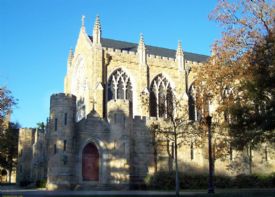
Sewanee Cathedral

Here’s a link to an article posted in today’s The Tennesseean, Nashville’s paper.
http://www.tennessean.com/apps/pbcs.dll/article?AID=/20080427/FEATURES0502/804270306

It highlights how wonderful it is to have the University (locals call it simply “Sewanee” or as it says in the article, the domain) nearby.

Several of you have mentioned the importance of a local arts community like the one around Asheville, NC. The article alludes to several artists in and around the domain, but there are many more tucked away in the nooks and crannies of the larger “mountain community” that includes the towns of Sewanee, Monteagle and Tracy City where we are located.

In case you are wondering about the connection with our name, the Village on Sewanee Creek is some 20 minutes drive from the town and campus of Sewanee. We derive our name from Sewanee Creek that flows through our Village. I added “the Village” to our name completely unaware of the use of the term as it applies to the domain. I just wanted to capture in our name my intense interest in building a strong local, integrated and self-sustaining community. I think the word village best expresses this ideal.

Tennessee Mountain Community

I’m intensely committed to BUILDING a close-knit, self-sustaining community of like-minded, intelligent and resourceful people within the Village on Sewanee Creek.

But there is a sustainable mountain community surrounding the Village proper already in existence.  It is filled with highly resourceful people who already know how to live joyfully in good times and hard times in harmony with nature and people.  Let me tick off just some of the resources that surround us here.
– Band Saw Mill within 1/2 mile.
– Free Range Cattle within 1 mile.
– Free Range Chickens within 1/4 mile producing free range eggs.
– Bees that produce local honey
– Worm Farm (one of 3 largest in the US) produces worm casting compost for organic gardening (not to mention fishing worms)
– Many small and medium acreage farmers and a well-organized web based farmers market selling everything from organic soap to indigenous herbs and ornamental shrubs to organically grown vegetables and delivering them to your door.
– Greenhouse within 1.5 miles producing sprouts for flowers and vegetables.
– Many skilled craftsmen in masonry, timber frame and traditional construction.  Strong Mennonite community in nearby Altamont.
– An artist community within about 2 miles that features experts in welding, glass blowing and pottery.
– Two mid-sized supermarkets, 2 dollar stores and a home improvement center 5 minutes away for every day shopping.
– Outstanding educational and cultural institutions that span Kindergarten to University within 20 minutes.

As we build the Village, it’s good to know that a larger wonderful village already envelops us.  There is a certain peace of mind being anchored in such a community.  We are truly blessed to be in this part of the Tennessee Mountains.

The “New Ruralism”

Whenever I have thought I had an original idea, there are always a bunch of folks out there thinking the same thing.  I used to be discouraged when this happened.  But I have come to understand that it’s just a confirmation that I’m on the right track.  It just means that it’s the right time for certain things to coalesce in a certain way, so they do, and I’m in tune at the same time other thinking people are.

I just discovered there’s a word for what we’re doing at the Village.  It’s called “the New Ruralism”.  The word was apparently coined at about the same time I began developing the Village on Sewanee Creek.

There is another major trend called “New Urbanism”, that I discovered had a lot in common with what we are doing.  It’s all about old fashioned small town neighborhoods with fairly high population density so that everyone can walk everywhere, surrounded by green space.  It’s a major trend.

Read more of my BLOG and you’ll see that we are all about developing a close knit community connected by foot trails, planned activities and amenities that bring people together surrounded by nature.  But there’s a big difference.  We’re not about high density.  While the old-time neighborhood community is important to people who come here, they want some elbow room.  They want to connect directly with the land.  That’s why our lots are bigger, ranging on the small side from an acre and a half to 8+ acres in the current phase.  It’s also why we will have a community garden with an organic coach to help people develop skills and connect with the land while they connect with their neighbors.   But each lot will be large enough so that villagers can take their new skills back to their own place and apply them privately on a larger scale.  There’s a time for community and there’s space for seclusion.  Most of us need a good mix of both.

Here’s how one white paper defines this phenomenon.
“New Urbanism promotes community through planning that mandates the interaction of neighbors designed to recapture the sense of community that was once the defining characteristic of American small town life. The small home sites and close proximity of homes stimulate a sense of community.”
“In a New Ruralism setting, participation in community activities is more by choice with privacy options carefully preserved. Larger home sites, often separated by nature preserves or agricultural land, provide a buffer between neighbors. Here the front porch is a place to scan the vastness of your domain.” It “provides an opportunity for community of like-minded neighbors, but only as desired.”

… And I thought I was being so original when I required large covered porches in our covenants!

Interested in learning more about the New Ruralism?  Just Google it.  There’s a lot written about it even though there aren’t many places actually doing it yet.  It’s nice to confirm that we’re on the right track and that there is a handy label for what we’re doing.

“Intentional Community” or just an “Old-Fashioned Neighborhood”?

Much has been written about the “Intentional Community” or “Eco Village” where like-minded altruistic people band together to create an idyllic, Utopian lifestyle. We intend to enjoy an abundant community lifestyle without the pitfalls.

Despite best intentions, about 90% of these social experiments fail for different reasons including: – Unclear Vision or Mission – Common Ownership of assets that creates a crucible of conflict. – Insufficient resources to accomplish community goals. – Consensus government without the skills required to manage conflict or reach consensus. – Unrealistic expectations of a life of simple ease, basking in nature’s glory while leisurely tending a communal garden. History records that most IC’s never get off the ground, quickly crumbling into internal bickering and cynicism. See http://ic.org for some thought provoking insight.

The Villagers of Sewanee Creek believe there’s a better model of Intentional Community that simply harks back to an old, proven institution, one that survived the test of time before our unsustainable modern lifestyle of extreme suburban mobility isolated us from one another and blew it apart. Read the rest of my BLOG and you will see that there are many elements of Intentional Community which we share.

So, what’s different about our model from unsuccessful IC’s and why does it work? In the Old Fashioned Neighborhood Model:

  • The burden of common ownership or shared livelihood is not imposed on its members. In its place a good measure of independence with private property ownership keeps everyone accountable for their own life.
  • It is not a commune of social dropouts, lacking the financial resources to function in the real world. There is a cost of independent ownership that provides a necessary screen.
  • Only critical assets that would be unsustainable or impractical to hold individually are held in common. –
  • Group Participation in community activities is optional, although encouraged. It is no longer a burden, but a joyful choice.
  • A conscious effort is made to organize healthy activities using the assets of the Village. The clubhouse is, therefore, not eye candy built to make the development look nice. It has a purpose and is in constant use.
  • The community garden is in place and functioning at the outset so that as people move here, community assets are already actively in use in a scalable fashion.
  • Those who desire privacy and personal space (and who doesn’t at times?) are welcome to as much of it as they like. For those who are ready for something other than isolation, it’s ready and waiting.
  • It would be tempting to call this an “active adult community” also a popular model for retiring baby boomers, except that the Village strives to attract people who are (1) diverse in age, (2) diverse and accomplished in their talents and interests, and (3) want to interact with others to enrich their life experiences in diverse ways; and they take personal responsibility to make that happen. Hence, it is not a specialized golf community although there are wonderful golf courses nearby. Take the word “Adult” out and it’s closer to what we are. We are an “Active Community” with a purpose.

Hmmm… Maybe we are a hybrid, an “active  eco-community“? What’s the glue that holds the Village together differently from your typical suburban neighborhood? – People who choose to live here are attracted to the village because of shared values,  their love of nature, including the earth and all living things. People with those values tend to care about other people as well. They are the kind of people who go out of their way to help each other.

People choose to live here because of a clear, articulated vision that emphasizes the importance of community – caring for other people. They like people. They understand that life is enriched by sharing with other people. They seek to learn from others who have something to share and they enjoy teaching from the wealth of life experiences they have accumulated. They are the kind of folks who might intentionally linger on their front porch at dusk not to miss a neighbor strolling by. They also take comfort that, in a pinch, their neighbors would go out of their way to help, just as they would. And they know that’s not an idle promise because people who live here have first made the effort to be independent with things like renewable energy so that they have the personal resources to give back and become interdependent. I call that “provident living“. Subtle things, you might think. But then, the best things in life aren’t forced, but are the natural outcome of making wise choices about simple things that are often overlooked.

People will be either the problem or the solution. And I guess that brings us back to the word “intentional“. I believe good people of good intent in the right environment are the solution. Call us what you like. We are simply, the Village on Sewanee Creek.

Is There a Prepared Community Out There?

Pick up today’s newspaper and you will likely be hit with news of surging grain prices, “peak oil”, changing weather patterns, flooding, drought, economy woes, terrorist threats, war….  Bummer!  So, toss the newspaper and just hunker down, right?

At the Village we see a bigger picture.  “Being prepared” for life at The Village on Sewanee Creek is made into a full, joyous lifestyle.  This “intentional community” plan is based on sustainability, self-reliance, and unity in a drop-dead gorgeous piece of nature in Tennessee where 500 of the 750 acres is set aside for a nature preserve, shared by Village neighbors.

Why Tennessee?  While the Village could have been founded anywhere, there’s a certain allure about a state that has:
–  no income taxes,
–  low property taxes,
–  low cost of living,
–  lush, green woodlands,
–  rocky bluffs overlooking canyons and streams,
–  and a diverse culture from “mountain folks” who know how to live simply to academia.  (The ivy league University of the South is nearby with its rich cultural offerings).

Sustainable living at The Village is an old-fashioned concept with insightful new applications on four levels:

Energy:  10% of the purchase price of a lot up to $10,000 is rebated for building with alternative energy such as solar, geo-thermal or wind.

Food:  A community garden is maintained with help from a horticulturist and an organic gardening coach.

Water:  Rain water collection systems are encouraged and the rebate offered may also be applied here.  Most food storage would be useless without water.  Many who have rainwater collection systems are able to be completely independent of municipal water for both household and garden use, even during drought years.  Municipal water lines are still available, of course.

Community:  The most important thing that distinguishes the Village on Sewanee Creek is the sense of community.  Hiking and biking trails wander through pristine woodlands and past waterfalls through the 500 acre nature preserve.  A community garden brings neighbors together in America’s favorite pastime, gardening.  On the cleared bluff is a common area with breath taking views of the canyon and the mountains beyond.  An outdoor pavilion and barbecues will welcome you for a picnic or to watch a spectacular sunset, or even to linger for an outdoor movie.  A natural rock amphitheater surrounds a stage and large screen where family movies are shown against the backdrop of a starlit sky.

Located between Chattanooga and Nashville, the 750 acre Village on Sewanee Creek is placed in a rural setting, with shopping, restaurants, etc. an easy 5-25 minutes away.

Whether you’re looking for your primary residence in a prepared community, a beautifully located retirement or vacation retreat, or a second home safe haven, The Village on Sewanee Creek is an ideal choice.  Prices for a two acre lot start in the low $30’s.  One-of-a-kind home sites feature stunning bluff views, creeks and magnificent waterfalls.

I have seen the world from many angles having spent 30 years as an executive in international business.  I’ve worked in over fifty countries and have seen the way societies all over the world function, noting the ever decreasing self-reliance of our own.  My experience with and love for people, cultures and places around the globe were instrumental in developing a unique philosophy on the development of a diverse, healthy, intelligent, intentional community in harmony with people and nature.

All in all, It’s not just prepared living.  It’s joyful living.

The Self-Sustaining EcoVillage

The press is beginning to wake up to something known as Peak Oil.  Check out today’s Wall Street Journal for a feature article.

Yes, it’s time to wake up and get serious about achieving energy independence on a national scale for many reasons including our economic health, the health of the planet, the human cost of fighting over the remaining fossil fuels, to name a few.

But while we work with civic leaders to change things on a macro level, I’ve always believed that real change must start with me, where I can make an immediate and meaningful impact.  In the short term, my peace of mind and well-being depend on things I can do right now.

That’s why I’m building a community of people who are ready to enjoy an abundant lifestyle and to commit to an old-fashioned concept – a self-sustaining village.

Our mission is to become self-sustaining on four levels:

* Water
* Food
* Energy
* Community

I don’t believe the gloom and doom model is in the cards for those who think and act now.  Life should be sweet.  Send me an email if you would like to explore what life can be.

Four Mild Seasons in the Tennessee Mountains

It’s winter on the Cumberland Plateau – one of my favorite seasons.  Sheer, craggy cliffs, shielded from view by the summer canopy have appeared along the bluff, framed by verdant hemlocks and pines.    With leaves off the trees, one can appreciate the rolling topography on the plateau top.  Winter rains have filled the creeks and the waterfalls roar their approval.  Rocks and trees flaunt dazzling green moss and ferns carpet the ground.

Our mild winter temperatures normally range from the low 40s to 60s, but this weeks cold snap will assure that the insect population in summer will be sparse and pleasant.  As temperatures return to normal it will be a wonderful time to explore nature’s wonders in the Village 500-acre common preserve.  Nearby Fiery Gizzard and Savage Gulf are famous hikes in these parts, but they’ve got nothing on Sewanee Creek Gulf and they aren’t part of a sustainable community.

Bring your hiking boots and let us know when you’re coming.  We love another excuse to host our friends on a hike through nature.

SCCA Presentation – Self-Sufficient Communities and Personal Responsibility

Climate change and yes, drought are big issues here on the mountain as well as elsewhere through the South this summer.  What to do about it?  You could:
1.  Wring your hands
2.  Pray for rain
3.  Complain to the government about lack of planning
4.  Sue a neighboring community or State over water rights
5.  Take matters into your own hands and become self-sufficient.

My choices are #2 and #5.  I spoke to the South Cumberland Community Association on how individuals and communities can become water self-sustaining.  We are doing it with a 7,500 gallon rainwater catchment system.

Life’s Abundance

“Wealth is the ability to fully experience life.
What is called genius is the abundance of life and health.”
—- Henry David Thoreau

“Green”, “Sustainable” Definition

I found this great definition on Audubon International’s Website and was pleasantly surprised to find that their definition emphasizes Community as well as natural preservation.

“Central to achieving our environmental mission is the concept of sustainability.  That is: using resources in a manner that meets our present needs without compromising the ability of future generations to meet their own needs.  To do so, we must foster thriving human communities rooted in ecological integrity, economic strength, and social and cultural integration.”

“Total sustainability cannot happen overnight, of course, but must depend on many small steps, collaborative and individual efforts, and political and social will.  The principles offer guidance for taking those steps and beginning a journey toward a more sustainable future.”

Our Mission at the Village on Sewanee Creek is to become a Self-Sustaining Community.

Provident, Self-Sustaining Community Living

I like the word “Provident”. It is seldom used or understood but captures much of the philosophy that drives the Village on Sewanee Creek.  Dictionary.com defines provident as
1.    having or showing foresight; providing carefully for the future.
2.    characterized by or proceeding from foresight: provident care.
3.    mindful in making provision (usually fol. by of).
4.    economical; frugal; thrifty.

Provident people live an enriched life independent of their level of wealth.  Their lives are full because they have an uncommon appreciation of truly valuable things – relationships, natural beauty, peace of mind, joy of life.  While they are often abundantly blessed financially, they would be equally happy in a financial crisis or living in modest circumstances because they are prepared, mentally, physically and spiritually for life’s ups and downs.  Life is not about ostentatious living driven by overwhelming debt  – the “keeping up with the Jones-es” syndrome.

Provident people build networks of provident friends by first being the kind of enriching person that others want to surround themselves with.  They are, in turn, enriched.  Imagine living in a community of friends who are talented, resourceful, loving and delight in sharing.  Because of their provident nature, they are prepared to weather any crisis.  The footprint of their lives is a net positive to the entire environment.

I live here in the Village and have a personal interest and commitment to building a provident, self-sustaining Community.  I have held these values from my college days when I was inspired by Henry David Thoreau’s “On Walden Pond”.  I’m not a hippie, a vigilante, a conspiracy theorist, a reactionary or extremist of any kind.  I just like good, talented people who love living abundantly in harmony with nature and other good people.

Care to join us?

Green, Sustainable Development Incentives

The other day my wife and I were discussing the importance of sustainable, green conservation and construction in the Village.  We have already dedicated about 500 acres or 2/3 of the development to a nature preserve, but we agreed that we need to do more.

Here’s the plan:
1.  We have organized an advisory board of green experts to help us better define and drive green development.
2.  The first item on the board’s agenda will be to enhance the Village Covenants with construction standards for energy conservation, etc.
3.  We will rebate 10% of the lot purchase price up to $10,000 for installation of approved sustainable systems including solar water heating, solar energy, wind energy and rain water collection.  Installation must be completed within 12 months of closing.

Community Organic Garden

The Village is a GREEN DEVELOPMENT committed to developing a SENSE OF COMMUNITY.

An excellent way to promote both values is by providing a community garden space.  Here’s how it works.

1.  We efficiently do the heavy lifting by tilling the ground of the entire plot.
2.  At the beginning of the growing season, each Villager claims and stakes out a portion to tend.
3.  We provide a knowledgeable organic gardening coach to help select the herbs and vegetables that will do well in the garden, organically control insects, water and improve the soil.
4.  Villagers enjoy developing close relationships, working side by side and sharing their know-how and produce.

the Village on Sewanee Creek is a place where People and Nature are in Harmony.  A by-product of this environment is a sense of peace, security and self-sufficiency.

Private Cisterns – A solution whose time has come

Everybody is concerned about and feeling the effects of climate change.  The entire South is currently suffocating in all-time record breaking heat and we are in the second year of an equally record-breaking drought.

It has become popular to support carbon emissions reducing initiatives.  It’s wonderful that people are waking up to the damage we are doing to our planet, but I believe there are things we can do right now that will have a much greater impact on weather change related to the water cycles and will reduce one’s dependence on costly government built infrastructure.

Water is increasingly being channeled into large reservoirs to supply large urban environments and, more and more, bottled by big corporations.  Doesn’t it seem scandalous that you pay more per gallon for bottled water, a free commodity that falls from the sky, than you pay for gasoline?  It may not seem so expensive because you don’t drink as much water as your car uses and bottled water ends up buried as just one item in your grocery bill.  And it has become common knowledge that bottled water is no more pure than what comes from the tap.  But most important of all is the environmental cost of bottling and shipping all that water.

On the top of the Cumberland Plateau, water is especially precious.  There are a number of large developments that have come to a halt here because their proposed water demands outstrip the supply.  Some large, well financed developers continue to promote their product despite the fact that they offer no guaranteed municipal water supply.   Homeowners may be forced to rely on wells that are unreliable or yield water laden with iron or sulpher.

The Village does not have this problem.  We have ample municipal drinking water and plenty of water pressure for fire protection.  But, why waste it when there is such great need everywhere?  By installing a simple cistern that efficiently collects rain water from your roof, filters and stores it for later use you can insulate yourself from drought by providing a pure, reliable source of water without the risk of unknown added chemicals.

Cisterns also preserve the amount of water that is retained near the source, where it falls.  It only makes sense that keeping the distribution of water more evenly spread instead of concentrating it in cities is closer to what nature intends.  As the water is used locally, it is released into the environment to evaporate and return to the water cycle, thus keeping moisture in areas that are otherwise being dried up.

There are a number of good web pages out there that explain how to build a cistern amazingly low costs that can supply a family for extended periods of drought.  Having a cistern AND a good back-up municipal water supply is the best of both worlds.

As weather change, extreme heat, cold and drought become an undeniable reality, I think that’s what one might call a no-brainer investment, a great insurance policy, and simply intelligent living.

I’ll be putting a cistern in at my place.  How about you?

The Bluff Lots are Ready

Today, I am announcing the pre-sale of seven additional lots in a new phase (1B) at the Village.

Each of these bluff lots is truly spectacular.  Deep woods, old growth trees, bluff views.  Two of them feature waterfalls and one-of-a-kind Indian Rock houses.  They range in size from 5 to 8.5 acres.  All have direct access to the 500-acre wild, private preserve in Sewanee Creek Canyon.

Several of you have said you were waiting for the bluff property to come on the market.  Well, it is here.

A recent acquisition of land adjacent to Browns Hollow Road makes it possible to reconfigure the plat and immediately offer these large beautiful estate lots.  The new phase 1B lots are located at the western end of the development.

You can view an overlay of the village in 3 dimensions on actual satellite photos using Google Earth.  You will be able to see any lot from space or from a low angle deep in the canyon, explore the bluff line or zoom in on the amphitheater.  Email me for the Village GoogleEarth Map and if you need help installing the Google Earth viewer.  I will be happy to walk you through the installation.

PS:  Any of you who do not yet have and would like access to my private website, filled with additional photos, downloadable files and interactive discussions may request a password by email.  The private site is for people who are seriously interested in learning more and participating with the Villagers who are actively shaping our community.  You will find there the most recent pdf file plat (too huge to email).  You will also find a virtual community of people who are interested in living in harmony with people and nature and a self-sufficient lifestyle.

Ground Breaking: 1st House in the Village

I am pleased to announce ground breaking for the first house in the Village on Sewanee Creek.  And the best news is that my family and I will be living in it.  Developer residence is an important feature that distinguishes our community.  It means that the developer deeply cares about quality of life values beyond profit.  We are committed to developing a sense of community at the Village and backing that commitment with our money and our lives.

Our home in the village will be built with fine craftsmanship in a rustic style.  It will incorporate:
– an in-home movie theater with a 12 foot wide screen and loft balcony seating,
– flexible, multi-use room design and
– an oufuro (Japanese style two-stage bath)
– High r-factor chemical free insulation
– Large South Facing windows for Passive Solar Heat
to name a few of its thoughtful features.
It is nestled in the woods between two creeks that run together.  While it is modest in size (just over 1,400 square feet inside), it is efficient in design and will  accommodate good sized groups for entertaining both inside and outside on its two full-length covered porches.