Sustainable Living Progress Report

Progress Update

OK, so I have been really bad about posting updates lately. That’s because I’ve been working hard on projects and I’m dog-tired at the end of each day.  The good news is that we’re moving forward with lots of cool stuff here.

Thanks to my wife, the greenhouse is planted and lots of little sprouts are poking their heads up. The weather has gotten warm enough to shut down the greenhouse furnace for now. Daytime temps are in the 70’s and greenhouse temp’s are in the 80’s and 90’s. We still need to install the shade cloth for the summer. Should be arriving this week.

We have engaged a land company on several projects. A huge track-hoe is now sitting on the property ready to begin work this week expanding the retention pond where we plan to raise cattails to be distilled for alcohol fuel and retain water for irrigation.

Chuck is making good progress on the wood gasifier that will also make fuel for the stationary generator installation. This green electricity generating system will also become an economic mainstay for producing a valuable product in the Village.  Chuck is part of the larger community web of folks dedicated to being self-sufficient. When you visit, you should make time to meet him. He’s an amazing resource and an amazing guy!

We have finished grading a large pad for a workshop / storage building. I’m excited about this prototype project because we will be using 40′ X 8′ shipping containers as the green building blocks. These large steel containers are built for ocean shipping conditions. Therefore, strong enough to handle hurricanes but inexpensive because there are millions of these things piled up at sea ports needing to be salvaged. I plan to face the sides of them with oak slab paneling – a FREE byproduct of local saw mills and insulate them with recycled insulation from the many commercial chicken houses that have closed near here. We will install roof trusses with a pitched steel roof and, once again install tanks to collect rainwater for irrigation. The shop will be heated in winter from the same outdoor wood furnace that will heat the greenhouse and two other homes. So, when we’re done, we’ll have a state-of-the-art green facility that costs not a lot more than our sweat equity and has an attractive, rustic look to boot.

Now for the part that really gets my creative juices going. We have purchased three of these containers – two for the shop and a third one that will be used to hosue the screen and backstage at the amphitheater. By this year’s third annual July 4th event we hope the amphitheater will be fully and permanently functional. The stage container will also house electronic sound equipment, a small kitchen and serve as a multipurpose community center.

My brother has been here for the past month working on his house and helping with all these projects. It’s great to have like-minded people who you love focused together on the same goals and having fun at it.

It seems that the worse the economy gets the better it is for the people in the Village.

We look forward to seeing all of you soon.

Yes, You Can … be free and independent… and we can help

A recent visitor shared with us his desire to make a break from dependence on an unstable world… quickly followed by a confession of fear of plunging into the unknown.  Is it just an illusion for old hippies who live in communes?

We took a walk past our thundering waterfall, then to our garden that provided about 80% of all our food last summer.  I showed him our newly planted orchard and  greenhouse that will easily quadruple our growing capacity and our 7,500 gallon cistern that provides water security.  I showed him several projects I’m working on to make us energy self-sufficient.  Then we talked numbers, how all of this plus our modest, sustainable home (built for less than $80 per square foot) were all completed at minimal cost and how being debt free and self-sustaining on our family plot of land has brought us such peace of mind.

Like most white collar workers from a corporate background, I lacked the backwoods skills necessary to be truly self-sustaining.  So, like most people, I was afraid of the unknown.  Was it really possible to live well outside the tenuous infrastructure that is crumbling around us?  Could I do it?  After two years of joyful work, learning and doing, I can answer unequivocally, YES !!!

Still dreaming but afraid to make the leap?  Our concept is of a community where intelligent people with a strong work ethic and family values independently own their own property but work and play together to build solid relationships on top of an unconquerable desire to be free and self-sufficient.

Having proved that it is possible, we’re here to help you achieve the same peace of mind.  Come take a look.  Like they say at Home Depot,

YOU CAN DO IT.  WE CAN HELP!

An Abundant, Low-Impact Christmas

Back again after a relaxing Christmas holiday. This was perhaps our most low-impact Christmas ever. We just vegged in our cozy home with the sounds of the babbling brook just outside our back door while we worked together assembling a big puzzle. I’m not usually one for puzzles as they seem like a waste of potentially productive time. But sometimes that’s just what we need as background to slow-flowing, deep conversation with those we love most.

Our absence of focus on things commercial was periodically interrupted all Christmas morning as we took turns asking each other,
“well, should we take a break to open presents?”
Followed quickly by, “Naah, there’s no hurry”.
I think that puzzle strangely resembled our compost pile in that it slowly created rich soil for discussion with our teen-age daughter. I had no time left for blogging, gardening or anything else. Without a doubt, it was the highest and best use of my time for the holidays.

I want to recommend some of the gifts I received, particularly two sets of wonderful books. This morning I’ve been absorbed in Bill Mollison’s seminal work, Permaculture Design Manual. I’m also looking forward to consuming Dave Jacke’s Edible Forest Gardens (both for knowledge and the fruits). Both are huge repositories of knowledge on sustainable living. These are the gifts that truly keep giving for a lifetime.

I just got a call from a new friend who flew in to Nashville last night and is on her way for a visit to the Village. We have carried on a delightful correspondence and are looking forward to welcoming her into our family for a couple of days.

We hope your Christmas has been as relaxing and peaceful as ours. God has surely blessed us with all we need and much much more. We live in marvelous times.

Neighborhood Rules for a Sustainable Lifestyle

From time to time I receive an email with lots of great questions. This one needs to be shared.
_____________________________________________________________________________________________________

Grant,
Thanks for the information on the lots and prices. There are a lot of things we like about your development – it’s clear you’ve put a lot of time and thought into it.

We have in common some concerns about the economy and what will happen over the next few years, and we’re very interested in finding a community which has some of these concerns in common and a commitment to a degree of sustainability and self-reliance. Separately, I’ll email you a couple articles on the economy / future predictions which you may find interesting.

My wife and I have a few questions – I’ve numbered them for reference, the number does not signify a priority:

1. What is the threshold to quality for the “Green” discount?   That is, is there a list of specific things one must do to a home?
Currently there are three types of green installation that would qualify. They are Wind power, Solar power and Rain Water Collection System. One of my objectives in offering this rebate is that our efforts in this direction be very visible as an example to educate and encourage others. Hence the choice of these. From a quality perspective, they must function for their intended purpose. Proof that electricity is generated in the projected amounts and stored in a manner to provide a meaningful contribution to your sustainability. You may either contract with an approved professional for installation, in which case the rebate may be applied against the total installed cost or do the work yourself, in which case the rebate will apply only against materials. The project must be completed within one year of purchase.

2. Is there a build deadline – a date by which one must build, after you’ve purchased a lot?
There is no build deadline, only Green Rebate deadline.

3. I see there is a common garden area, but it appears that all forms of fencing is prohibited on an individual lot. We’d like a place where we can have our herb garden for the kitchen and a small vegetable garden on our own lot … and that would mean fencing of some type to keep the rabbits and deer out. Is that a possibility, or is the no-fencing rule absolute?
I need to clarify the covenants. The no-fence rule is meant to apply only to opaque privacy fences. We want to have an open community that invites interaction between neighbors and minimizes barriers. Fences for other purposes (pet or livestock containment, garden protection, etc) are fine.  You will find that anything that makes good common sense for the establishment of a sustainable lifestyle will be encouraged here. The primary principle that will govern all rules is the golden rule with an emphasis on personal liberty to use your land in the most productive manner for the pursuit of happiness and your well being.

4. Similar to fencing question above and related to the goals of sustainability and self-reliance, we’d also like a place that would allow a small chicken coop … I can understand that on lots of an acre or two, neighbors may object to a rooster – that’s the one that creates the early morning noise, but not so the hens. Recently, even large communities like Raleigh and Durham have affirmed that homes with small yards can have – in Durham up to 10 hens, but no rooster … I don’t recall for sure what the Raleigh rule was. What are your thoughts on this?
We encourage small-scale farm production of all types. I keep rabbits on my property. I intend to build a chicken coop as well. Just haven’t gotten to that project yet. There are many small farmers in the extended community who raise chickens, beef, pigs, bees, etc., so as yet, I have relied on my neighbors for these commodities. Personally, I have no problem with roosters either since I am usually up before the roosters are. I think we will leave that up to the vote of the community as to whether we should impose a rooster rule in the future.   At this point there is none.

5. Also, our southern woods are infested with ticks … we’d like to have the freedom to have a few guinea hens to run loose during the day and gobble up the ticks … they are far better at tick control than any other creature – – and that also fits with our mutual dislike of chemicals and sprays.
Guinea hens are not only great for controlling ticks, they are excellent watch “dogs” as well. Highly encouraged.

6. The annual HOA fee is set at $600 … what additional fees / assessment do you envision (i.e., amount and frequency)? From heading a couple HOAs in the past, I can understand that you can’t be precise about predicting the future, but what’s your best guess at this point in time?
We have actually reduced the HOA fee to $300 and as yet have not collected it from any homeowners. At this point, we do not maintain expensive improvements like a lodge or a pool, so our costs are minimal. The trails that connect each lot and the 500 acre nature preserve and the entry sign area do require maintenance, but so far I have carried those costs either from my own pocket or my own labor. The future will be, as you say, difficult to predict. However, I believe there will be sustainability projects that the HOA will want to take on where it will make sense to share the costs as opposed to tackling them as individual families. For example, it might make sense for the HOA to own a tractor to cultivate the community garden and to purchase fuel for it. Some of us have also talked about how much fun it might be to have a zip line system for access and enhanced appreciation of the canyon nature preserve. These commitments will be taken on by common vote of the community. I am careful not to impose costs that reduce sustainability or become a burden to Villagers.

7. How many total lots do you expect to put on the market (i.e., how many neighboring families will be in this community when fully populated)?
There are 30 lots in phase 1. Approximately the same in phase 2. Several families have purchased two adjoining lots. I encourage people to build multiple homes on their lots for extended family where they have enough land, as I plan to do for my children and aging mother. So the total population is difficult to predict. This said, we carefully chose this area for the quality of people who surround the village. They tend to be hard-working, resourceful, honest, open people. I view them as an extension and a vital part of our sustainable community.  We differ from many gated, closed communities in that we strive to maintain excellent, close relationships with our indigenous neighbors. We hope to be of great value to them as they are to us.

Discussing Alcohol as Fuel leads to THANKSGIVING

Today, I am thankful for many things, including my friends, both at the village and my online friends.   Below is an excerpt from a discussion on our private website, “The Friends of Sewanee Creek”.

ALCOHOL AS AN ALTERNATIVE FUEL
Added By:     Jeanne On Fri, 11/21/2008 11:59:22 am
Category:     Sustainability, Sustainable Energy
Share Your Thoughts *      (See attachments)

Clayton – Mon, 11/24/2008 09:09:32 am
It is already used as an additive in some gasoline brands. Usually about 10%. Currently, it requires more gallons of alcohol to get the same mileage as gasoline

Clayton – Mon, 11/24/2008 09:20:16 am
“Top Fuel” dragsters have used methanol for many years!

Chuck – Mon, 11/24/2008 09:45:45 am
The IRL indy cars have used it for 35/40 years

Steven – Tue, 11/25/2008 10:09:43 am
I have been reading about using alcohol as a fuel a lot lately.I used to be into racing and was around some vehicles that used it. The fuel system had to be heavily modified and the best I remember there had to be considerably more fuel “dumped” into the engine as compared to gasoline.

Chuck – Tue, 11/25/2008 12:26:43 pm
You are so right

Clayton – Wed, 11/26/2008 09:51:03 am
Let’s face it, gasoline is still the most efficient fuel for cars and trucks. It provides the most energy per volume than any other fuels that are mass produced and widely available. This doesn’t mean we shouldn’t keep looking for and exploring alternatives. It does mean that gas is the best we have for now.

Grant Miller – Wed, 11/26/2008 11:40:30 am
Yes, that’s true of pretty much all the conveniences we take for granted. After two years of focusing on becoming self-sufficient, I can attest that it sure is a lot easier to breeze through Publix for convenience foods than to raise it yourself. It’s easier to flip a switch to use electricity from the grid than to make your own (no matter how you do it). It’s easier and more efficient to depend on the water utility than to collect your own water. As simple a task as it is, keeping my gutters clean (so the water in my cistern is pure) requires continuous awareness and vigilance. That goes for virtually everything necessary to live independently.

Our life style, up to now, has been blessed with unprecedented ease and efficiency. Our world has been on a never ending quest for the holy grail of ultimate convenience. My entire career in food service and convenience retailing at 7-Eleven has been all about that quest. Everything we take for granted has been refined and automated to the nth degree. A fragile consumptive market founded on luxury and greed has assured that efficiency rules.

One can literally pass through life without any thought at all, dependent on the work, inventiveness and thought of others. Perhaps that is why children are so addicted to mind-numbing video games that require no work or thought, only quick digital reflexes, and people struggle to find meaning in life.

My wife and I have reached a deep appreciation for our pioneer ancestors who had to make everything they used. Yet we aren’t even close to what they had to do just to survive. We still enjoy many wonderful modern conveniences they lacked that make our lives incomparably easy. Living as we do now is still a choice.

After all that, I can echo your comment, Clay.  “It is worth it“.   I know how panicky I would be right now if it weren’t for the work we have done over the past couple of years and continue to do. The feeling of peace, knowing that come-what-may, you can cope comfortably is truly priceless. The pure joy of total freedom to wake up every day and do what I want to do because I am independent is heady stuff.

As I approach the thanksgiving holiday, I can’t remember a time in my life when I have felt a deeper sense of gratitude for my blessings than right now. Perhaps that’s because the self-sufficient lifestyle, like no other, requires a level of mindfulness and work that gifts one with a true understanding of the value of one’s blessings. Living close to nature assures that one also understands the true source. I am grateful to God for everything He has blessed us with. I stand on His shoulders for EVERYTHING that I have, starting with the very dirt I work in to raise my food. It is ALL a free gift from Him. My cup runneth over. I am blessed beyond measure.

May you all have a truly blessed thanksgiving.

Top 9 Antidotes for hard times

While there is some really good news happening at grass-roots levels with thinking people, there is plenty to be concerned about and to prepare for. I always try to stay positive in my communications.  Sometimes, that is only possible because I’m feeling well prepared and getting more independent every day.

Prepared for what? Read the articles in the link below.
http://www.lifeaftertheoilcrash.net/BreakingNews.html

So, how have I prepared?  My private website, “the friends of Sewanee Creek” chronicles that preparation over the past two years. A long time ago, on our forum, I outlined what I consider to be the key elements of preparedness.

Recently I was told by a prospective Villager that what attracted him to the Village is our “authentic” marketing. I think anyone who visits and witnesses how we have focused our resources will plainly see that our interests are in sustainability over green window-dressing. That’s intentional.

We want neighbors who are intelligent, aware, resourceful and ready to contribute within a community that is ready to roll up their shirtsleeves and create real value – together. I don’t think that happens with slick marketing that glosses over the challenges with an appeal to a cushy, yuppie-luxury lifestyle. We have found from experience that our marketing message doesn’t appeal to the masses whose primary objective is ease and comfort and are in denial about what has already happened in our world. That’s a good thing.

Authentic? You bet. Here’s what my family have accomplished over the past two years:
I started with the absolute essentials to sustain life.
1. WATER:
Secured an independent and renewable water supply using rain water catchment.
2. FOOD:
Secured our independent year-round food supply. We set up an intensive garden, improved the soil, began organic composting, implemented a renewable, independent irrigation system, planted, worked and learned how. Built rabbit hutches and began raising rabbits. Bottom line, we raised about 80% of what we ate this summer in addition to canning and preserving a substantial amount for the winter. We are now completing a greenhouse, roughly twice the size of our garden. This winter, our objective is to learn how to raise all the food we need to sustain our family year round.
3. SHELTER:
Built a comfortable, sustainable home right-sized for our needs that incorporates passive solar heating, good insulation, multiple redundant heat sources and potable, independent water supply.
4. FINANCIAL INDEPENDENCE:
Financially secured our home and personal land and all personal assets, free and clear of all debt.  Paid off all bank debt on personal property.
5. ENERGY / TRANSPORTATION
Secured renewable transportation. Purchased an all-electric plug-in vehicle that provides adequate transportation between our home and Tracy City.
6. ENERGY / HEAT & ELECTRICITY
Planning to build and implement low-cost renewable, energy solutions for home and greenhouse heat and electricity generation.
7. COMMUNITY / EXTENDED FAMILY:
Educated my extended family about impending failures of global finance, energy and food supply, social disintegration and opportunities of sustainable living. This resulted in a commitment to gathering of family and co-investment in renewable assets and permaculture living.
8. COMMUNITY / THE MOUNTAIN:
Developed relationships with resourceful people who live a sustainable life style in the larger community to provide opportunities for trade of skills, information and other critical resources.
9. COMMUNITY / THE VILLAGE:
Planned, developed and facilitated government planning approvals for the Village. Built key facilities to promote Villager interaction and appreciation of natural assets – the amphitheater, community garden and trails.

Reduced costs on property and slashed prices to attract the right kind of self-sufficient, independent and responsible people to our community at the lowest possible, sustainable cost.

My family and I are at peace with our preparedness and action plans for the future. It has taken more than two years of concentrated effort to achieve that. Most days if you visit, you will find my wife and I personally on the land working with our own hands, learning, building and growing. It’s a big change in lifestyle from that of a senior executive. It is not without its challenges, but we love it. We have a sense of personal connection and accomplishment with what we are building, not to mention the thrill of living in close connection with the beauty and rhythms of nature.

Are you comfortable about your future? If you are one of the intelligent, resourceful and aware people, not in denial, ready to go to work, aware that it will take time, work and the help of other like-minded people, but confident of your own ability and drive to live sustainably, please don’t delay another day. The time to prepare is now.

Having made the transition, having done it, we can confidently help you make the transition too.

Learning to live the Not-So-Big Lifestyle

At the Village, we are focused on sustainable, green living, which can mean considerable downsizing. My wife and I went from a 5,000 square foot house to a 1,400 square foot house. I designed it myself and although there are a few things I would change about it,  we love our little house in the woods.

We find that we have an increased sense of ownership of things that count instead of being owned by our stuff.

Today, I ran across an article that does a nice job of discussing the changes in mentality and lifestyle that are required to make that shift. It points out that this doesn’t necessarily mean downsizing as it much as it means right-sizing the house of your dreams to your real needs.

Here’s a link in case you would like to read this article. I think it pretty fairly summarizes a philosophy that was intuitive to me.

http://www.motherearthnews.com/Green-Homes/Not-So-Big-House.aspx?utm_medium=email&utm_source=iPost&page=4

Finding Peace in the midst of Turmoil

In my last post, I struck an upbeat note in anticipation of impending turmoil.  Since then, as expected, global financial markets have commenced melt-down in earnest.  Jobs are evaporating quickly and the news is filled with panicked people.
The short-term good news is the relief we are seeing in commodity prices including food, oil and even precious metals like gold.  Longer term, anyone who understands economics can see that we are headed for hyper-inflation.  Our dollar will buy less and less and prices will increase rapidly.  Many think we have already entered an unannounced depression.
Meanwhile, we are enjoying a continued sense of peace and joy in the Village.  How can that be so?  It comes from knowing that no matter what else is happening in the rest of the world, we live in a natural paradise with all of our needs provided for.  We continue to work towards complete self-sustainability within a community of people who are committed to working and playing together.

It’s not too late to find peace in the mountains at the Village on Sewanee Creek.

Optimist’s view of Peak Oil – The new oil end game

One of the great advantages of living in an intentional community like the village is that you join with can-do people who, instead of just wringing their hands about world conditions, are actively engaged in solving problems. That’s a good feeling, you learn a lot and it’s fun.

Examples:
1. This summer, we lived about 80% on the food we grew in our garden and are planning to extend that winning streak through the winter with a green house.
2. We’re working on a green energy system that utilizes our unique local resources to power our home in the woods where wind and solar aren’t good options.
3. Our rain water collection system now gives us the option of living independent of public water. Our water is soft, pure without chemicals and free.

This week, confidence in our financial systems took a major hit with the Lehman Brothers bankruptcy, AIG bailout, stock market roller coaster ride, etc.

Here is a TED talk that gives us lots of reasons for optimism about the potential for future world stability on many levels, including financial, ecological, social, and geo-political.
Take a look at this video for an injection of optimism.

http://www.ted.com/index.php/talks/amory_lovins_on_winning_the_oil_endgame.html

PS: For those of you who don’t have the capital to tackle the world’s large-scale problems, but are not satisfied with sitting at the sidelines, join us in the village. We’re working on personal sustainability with some very encouraging results.

Where can I get cheap gas?

Everybody is feeling the pinch of high gas prices.  Many are beginning to realize this isn’t a temporary thing.
What to do?  How about relocating to a place where we think long-term about all aspects of our lives, including the true cost of energy to our lifestyle, our peace of mind, as well as our pocket book?

I recently purchased a plug-in electric vehicle that I am outfitting with solar panels.  I like infinite MPG and $0.00/gallon.  In our rural location, we live only about two miles from a small town that supplies most of our daily needs.  A few more miles down the road is a wonderful University that supplies most of our social, intellectual and cultural needs.  All within easy commuting distance with our electric vehicle that cost under $5,000 equipped with solar.

What about the other energy costs in your life?  We are one of very few truly green communities that is working through all aspects of life after cheap oil and our damaged environment.  Our “green rebate” on the purchase of a lot puts money back in your pocket to help you install solar energy or a rainwater catchment system like the 7,500 gallon one we put on our house that makes us water self-sufficient.

Our community organic garden employs an organic coach that will help you learn to compost, improve the quality of the soil on your own mini-farm and ultimately reach the peace of mind that only comes from being truly self-sufficient.

Our unique combination of vision, philosophy, natural beauty and green expertise make this the perfect place to live an abundant, self-sufficient life in spite of a confusing, complex and distressed world.

Give me a call or come visit us to see how we are preparing our little village to live peacefully, a community in harmony with nature.

Educating a Community to become self-sustaining

I just viewed a youtube video that I suggest everyone take a look at along with the many other wonderful videos produced by peak moment.
http://www.youtube.com/watch?v=ajqgOCxGEAo&sdig=1

Here at the village, we continue to stay focused on building a self-sustaining community.  Part of that effort is reaching out to the surrounding rural community that is rich in sustainable resources and culture.

I think independence day should be symbolic of our need to become resourcefully independent of our brittle, oil dependent world.  On the evenings of July 4th and 5th, we will be screening some educational videos on how to become self-sustaining and engaging folks in conversation about proactive measures we can and are taking here at the village.

If you are interested in coming, send me an email or give me a call.

Amphitheater, Community & Movie Reviews

As some of you know, I’m an unabashed movie lover. I got my start when I worked for Blockbuster Video years ago doing international development in places like Japan, Brazil and Thailand.

Since then I have built several home theaters, one with a small stage. From that experience I learned the power of having an active venue that brings people together for expression, entertainment and education. We regularly invited friends with their families to enjoy a movie and some light refreshments or a barbecue. It frequently amazed and delighted me when, as the adults enjoyed some light conversation and prepared the food, the kids would disappear into the basement only to reappear an hour or so later. They would announce that they had put together a skit and wanted us all to come down to the theater to watch them perform. What a joy that was! That experience brought us all so much closer together.

We began to actively plan our social visits by choosing a short play in advance and doing reader’s theater with our friends. It was easy, required no memorization, but brought out new sides of our friends that we hadn’t seen and it brought us closer together. Similarly, enjoying a stimulating movie together followed by some discussion created links of mutual understanding.

That’s why, as we work to build a close-knit community at the Village, the first thing we built is the landscaping for the amphitheater and a simple stage.

When we have enough people resident on the property to assure some oversight, we will install the large movie screen that we have already acquired and set it up with low power FM broadcast, a projector and media player. Meanwhile, we will temporarily use our smaller 12′ screen on an as-needed basis at the amphitheater and in our home, that now boasts a comfortable home theater. We have a standing offer for Movie night at the Millers pending RSVP.

As for content, like just about everything else in our lives, we enjoy being a bit eclectic. Recently I have felt a sense of responsibility to share and educate others about the need to live a sustainable life.

Here are a couple of recommendations for documentaries I have recently viewed that I think do an excellent job of speaking to two of the four important elements of sustainability that are part of our mission, renewable energy and food. You can rent these from Netflix (my current favorite source).

They are:

* The Future of Food: a sobering look at the industrialization and control of our food chain. This one will make you want to start your own garden – soon.

* Car of the Future: A humorous approach hosted by Click and Clack, the tappet brothers of NPR “Car Talk” fame with an optimistic view of what is achievable and already achieved.

How To Multiply Your Good Works For The Planet: Share!

Q: How can I save energy and money around the house and also help the climate?
A: Switch to compact fluorescent lightbulbs.

Q: But how can I do more than that, and have more fun too?
A: Start an eating co-op! Host a sewing circle! Join a car-sharing group! Share stuff!

Many of us are examining our lives to find ways we can reduce our impact on the overheating, overfished, eroded, paved and poisoned planet. Of course there are lots of little things we each can do that will make a small change in our individual footprint, and those are good places to start. But we’re realizing that we’ve reached a time when big changes are called for–and lots of them.

Are we up to it? Well, the good news is that many of the changes we need to make will also improve our quality of life. They don’t mean more drudgery and boredom–they mean more companionship, support, freedom, and downright fun. I’m talking, of course, about joining our lives with other people: about community.

More and more people now understand that community and cooperation are a central part of the way forward to a healthier planet and a thriving society. Our communities are even getting positive coverage in places like USA Today and US News & World Report.

Quoted from Communities Magazine

Arts and the University at Sewanee

University of the South

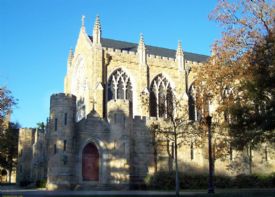
Sewanee Cathedral

Here’s a link to an article posted in today’s The Tennesseean, Nashville’s paper.
http://www.tennessean.com/apps/pbcs.dll/article?AID=/20080427/FEATURES0502/804270306

It highlights how wonderful it is to have the University (locals call it simply “Sewanee” or as it says in the article, the domain) nearby.

Several of you have mentioned the importance of a local arts community like the one around Asheville, NC. The article alludes to several artists in and around the domain, but there are many more tucked away in the nooks and crannies of the larger “mountain community” that includes the towns of Sewanee, Monteagle and Tracy City where we are located.

In case you are wondering about the connection with our name, the Village on Sewanee Creek is some 20 minutes drive from the town and campus of Sewanee. We derive our name from Sewanee Creek that flows through our Village. I added “the Village” to our name completely unaware of the use of the term as it applies to the domain. I just wanted to capture in our name my intense interest in building a strong local, integrated and self-sustaining community. I think the word village best expresses this ideal.

Tennessee Mountain Community

I’m intensely committed to BUILDING a close-knit, self-sustaining community of like-minded, intelligent and resourceful people within the Village on Sewanee Creek.

But there is a sustainable mountain community surrounding the Village proper already in existence.  It is filled with highly resourceful people who already know how to live joyfully in good times and hard times in harmony with nature and people.  Let me tick off just some of the resources that surround us here.
– Band Saw Mill within 1/2 mile.
– Free Range Cattle within 1 mile.
– Free Range Chickens within 1/4 mile producing free range eggs.
– Bees that produce local honey
– Worm Farm (one of 3 largest in the US) produces worm casting compost for organic gardening (not to mention fishing worms)
– Many small and medium acreage farmers and a well-organized web based farmers market selling everything from organic soap to indigenous herbs and ornamental shrubs to organically grown vegetables and delivering them to your door.
– Greenhouse within 1.5 miles producing sprouts for flowers and vegetables.
– Many skilled craftsmen in masonry, timber frame and traditional construction.  Strong Mennonite community in nearby Altamont.
– An artist community within about 2 miles that features experts in welding, glass blowing and pottery.
– Two mid-sized supermarkets, 2 dollar stores and a home improvement center 5 minutes away for every day shopping.
– Outstanding educational and cultural institutions that span Kindergarten to University within 20 minutes.

As we build the Village, it’s good to know that a larger wonderful village already envelops us.  There is a certain peace of mind being anchored in such a community.  We are truly blessed to be in this part of the Tennessee Mountains.

The “New Ruralism”

Whenever I have thought I had an original idea, there are always a bunch of folks out there thinking the same thing.  I used to be discouraged when this happened.  But I have come to understand that it’s just a confirmation that I’m on the right track.  It just means that it’s the right time for certain things to coalesce in a certain way, so they do, and I’m in tune at the same time other thinking people are.

I just discovered there’s a word for what we’re doing at the Village.  It’s called “the New Ruralism”.  The word was apparently coined at about the same time I began developing the Village on Sewanee Creek.

There is another major trend called “New Urbanism”, that I discovered had a lot in common with what we are doing.  It’s all about old fashioned small town neighborhoods with fairly high population density so that everyone can walk everywhere, surrounded by green space.  It’s a major trend.

Read more of my BLOG and you’ll see that we are all about developing a close knit community connected by foot trails, planned activities and amenities that bring people together surrounded by nature.  But there’s a big difference.  We’re not about high density.  While the old-time neighborhood community is important to people who come here, they want some elbow room.  They want to connect directly with the land.  That’s why our lots are bigger, ranging on the small side from an acre and a half to 8+ acres in the current phase.  It’s also why we will have a community garden with an organic coach to help people develop skills and connect with the land while they connect with their neighbors.   But each lot will be large enough so that villagers can take their new skills back to their own place and apply them privately on a larger scale.  There’s a time for community and there’s space for seclusion.  Most of us need a good mix of both.

Here’s how one white paper defines this phenomenon.
“New Urbanism promotes community through planning that mandates the interaction of neighbors designed to recapture the sense of community that was once the defining characteristic of American small town life. The small home sites and close proximity of homes stimulate a sense of community.”
“In a New Ruralism setting, participation in community activities is more by choice with privacy options carefully preserved. Larger home sites, often separated by nature preserves or agricultural land, provide a buffer between neighbors. Here the front porch is a place to scan the vastness of your domain.” It “provides an opportunity for community of like-minded neighbors, but only as desired.”

… And I thought I was being so original when I required large covered porches in our covenants!

Interested in learning more about the New Ruralism?  Just Google it.  There’s a lot written about it even though there aren’t many places actually doing it yet.  It’s nice to confirm that we’re on the right track and that there is a handy label for what we’re doing.

“Intentional Community” or just an “Old-Fashioned Neighborhood”?

Much has been written about the “Intentional Community” or “Eco Village” where like-minded altruistic people band together to create an idyllic, Utopian lifestyle. We intend to enjoy an abundant community lifestyle without the pitfalls.

Despite best intentions, about 90% of these social experiments fail for different reasons including: – Unclear Vision or Mission – Common Ownership of assets that creates a crucible of conflict. – Insufficient resources to accomplish community goals. – Consensus government without the skills required to manage conflict or reach consensus. – Unrealistic expectations of a life of simple ease, basking in nature’s glory while leisurely tending a communal garden. History records that most IC’s never get off the ground, quickly crumbling into internal bickering and cynicism. See http://ic.org for some thought provoking insight.

The Villagers of Sewanee Creek believe there’s a better model of Intentional Community that simply harks back to an old, proven institution, one that survived the test of time before our unsustainable modern lifestyle of extreme suburban mobility isolated us from one another and blew it apart. Read the rest of my BLOG and you will see that there are many elements of Intentional Community which we share.

So, what’s different about our model from unsuccessful IC’s and why does it work? In the Old Fashioned Neighborhood Model:

  • The burden of common ownership or shared livelihood is not imposed on its members. In its place a good measure of independence with private property ownership keeps everyone accountable for their own life.
  • It is not a commune of social dropouts, lacking the financial resources to function in the real world. There is a cost of independent ownership that provides a necessary screen.
  • Only critical assets that would be unsustainable or impractical to hold individually are held in common. –
  • Group Participation in community activities is optional, although encouraged. It is no longer a burden, but a joyful choice.
  • A conscious effort is made to organize healthy activities using the assets of the Village. The clubhouse is, therefore, not eye candy built to make the development look nice. It has a purpose and is in constant use.
  • The community garden is in place and functioning at the outset so that as people move here, community assets are already actively in use in a scalable fashion.
  • Those who desire privacy and personal space (and who doesn’t at times?) are welcome to as much of it as they like. For those who are ready for something other than isolation, it’s ready and waiting.
  • It would be tempting to call this an “active adult community” also a popular model for retiring baby boomers, except that the Village strives to attract people who are (1) diverse in age, (2) diverse and accomplished in their talents and interests, and (3) want to interact with others to enrich their life experiences in diverse ways; and they take personal responsibility to make that happen. Hence, it is not a specialized golf community although there are wonderful golf courses nearby. Take the word “Adult” out and it’s closer to what we are. We are an “Active Community” with a purpose.

Hmmm… Maybe we are a hybrid, an “active  eco-community“? What’s the glue that holds the Village together differently from your typical suburban neighborhood? – People who choose to live here are attracted to the village because of shared values,  their love of nature, including the earth and all living things. People with those values tend to care about other people as well. They are the kind of people who go out of their way to help each other.

People choose to live here because of a clear, articulated vision that emphasizes the importance of community – caring for other people. They like people. They understand that life is enriched by sharing with other people. They seek to learn from others who have something to share and they enjoy teaching from the wealth of life experiences they have accumulated. They are the kind of folks who might intentionally linger on their front porch at dusk not to miss a neighbor strolling by. They also take comfort that, in a pinch, their neighbors would go out of their way to help, just as they would. And they know that’s not an idle promise because people who live here have first made the effort to be independent with things like renewable energy so that they have the personal resources to give back and become interdependent. I call that “provident living“. Subtle things, you might think. But then, the best things in life aren’t forced, but are the natural outcome of making wise choices about simple things that are often overlooked.

People will be either the problem or the solution. And I guess that brings us back to the word “intentional“. I believe good people of good intent in the right environment are the solution. Call us what you like. We are simply, the Village on Sewanee Creek.

Is There a Prepared Community Out There?

Pick up today’s newspaper and you will likely be hit with news of surging grain prices, “peak oil”, changing weather patterns, flooding, drought, economy woes, terrorist threats, war….  Bummer!  So, toss the newspaper and just hunker down, right?

At the Village we see a bigger picture.  “Being prepared” for life at The Village on Sewanee Creek is made into a full, joyous lifestyle.  This “intentional community” plan is based on sustainability, self-reliance, and unity in a drop-dead gorgeous piece of nature in Tennessee where 500 of the 750 acres is set aside for a nature preserve, shared by Village neighbors.

Why Tennessee?  While the Village could have been founded anywhere, there’s a certain allure about a state that has:
–  no income taxes,
–  low property taxes,
–  low cost of living,
–  lush, green woodlands,
–  rocky bluffs overlooking canyons and streams,
–  and a diverse culture from “mountain folks” who know how to live simply to academia.  (The ivy league University of the South is nearby with its rich cultural offerings).

Sustainable living at The Village is an old-fashioned concept with insightful new applications on four levels:

Energy:  10% of the purchase price of a lot up to $10,000 is rebated for building with alternative energy such as solar, geo-thermal or wind.

Food:  A community garden is maintained with help from a horticulturist and an organic gardening coach.

Water:  Rain water collection systems are encouraged and the rebate offered may also be applied here.  Most food storage would be useless without water.  Many who have rainwater collection systems are able to be completely independent of municipal water for both household and garden use, even during drought years.  Municipal water lines are still available, of course.

Community:  The most important thing that distinguishes the Village on Sewanee Creek is the sense of community.  Hiking and biking trails wander through pristine woodlands and past waterfalls through the 500 acre nature preserve.  A community garden brings neighbors together in America’s favorite pastime, gardening.  On the cleared bluff is a common area with breath taking views of the canyon and the mountains beyond.  An outdoor pavilion and barbecues will welcome you for a picnic or to watch a spectacular sunset, or even to linger for an outdoor movie.  A natural rock amphitheater surrounds a stage and large screen where family movies are shown against the backdrop of a starlit sky.

Located between Chattanooga and Nashville, the 750 acre Village on Sewanee Creek is placed in a rural setting, with shopping, restaurants, etc. an easy 5-25 minutes away.

Whether you’re looking for your primary residence in a prepared community, a beautifully located retirement or vacation retreat, or a second home safe haven, The Village on Sewanee Creek is an ideal choice.  Prices for a two acre lot start in the low $30’s.  One-of-a-kind home sites feature stunning bluff views, creeks and magnificent waterfalls.

I have seen the world from many angles having spent 30 years as an executive in international business.  I’ve worked in over fifty countries and have seen the way societies all over the world function, noting the ever decreasing self-reliance of our own.  My experience with and love for people, cultures and places around the globe were instrumental in developing a unique philosophy on the development of a diverse, healthy, intelligent, intentional community in harmony with people and nature.

All in all, It’s not just prepared living.  It’s joyful living.

The Self-Sustaining EcoVillage

The press is beginning to wake up to something known as Peak Oil.  Check out today’s Wall Street Journal for a feature article.

Yes, it’s time to wake up and get serious about achieving energy independence on a national scale for many reasons including our economic health, the health of the planet, the human cost of fighting over the remaining fossil fuels, to name a few.

But while we work with civic leaders to change things on a macro level, I’ve always believed that real change must start with me, where I can make an immediate and meaningful impact.  In the short term, my peace of mind and well-being depend on things I can do right now.

That’s why I’m building a community of people who are ready to enjoy an abundant lifestyle and to commit to an old-fashioned concept – a self-sustaining village.

Our mission is to become self-sustaining on four levels:

* Water
* Food
* Energy
* Community

I don’t believe the gloom and doom model is in the cards for those who think and act now.  Life should be sweet.  Send me an email if you would like to explore what life can be.

Four Mild Seasons in the Tennessee Mountains

It’s winter on the Cumberland Plateau – one of my favorite seasons.  Sheer, craggy cliffs, shielded from view by the summer canopy have appeared along the bluff, framed by verdant hemlocks and pines.    With leaves off the trees, one can appreciate the rolling topography on the plateau top.  Winter rains have filled the creeks and the waterfalls roar their approval.  Rocks and trees flaunt dazzling green moss and ferns carpet the ground.

Our mild winter temperatures normally range from the low 40s to 60s, but this weeks cold snap will assure that the insect population in summer will be sparse and pleasant.  As temperatures return to normal it will be a wonderful time to explore nature’s wonders in the Village 500-acre common preserve.  Nearby Fiery Gizzard and Savage Gulf are famous hikes in these parts, but they’ve got nothing on Sewanee Creek Gulf and they aren’t part of a sustainable community.

Bring your hiking boots and let us know when you’re coming.  We love another excuse to host our friends on a hike through nature.