Yesterday was a great day!

Our kids are home at the Village. 

Over the past few weeks we took an epic car trip from Tennessee to San Diego and back, stopping to see our older kids in Wichita and Mesa, Arizona along the way.  We met our son, Jonathan, who was finishing his truly epic 4,000 mile charity bicycle ride from Virginia Beach down the East Coast to Florida and across the USA to San Diego.  http://nuttyputtycyclers.com/updates

While in San Diego, we enjoyed seeing old friends and family and meeting new ones.  I downed the biggest burger of my life at Hodads in Ocean Beach and relived memories of my youth surfing.

On the return, we routed through Provo, Utah where we picked up our daughter from BYU and drove straight through, no stops, rotating drivers.

Whew!!!  We’re home.  We miraculously missed the Eastern severe cold and snow that happened while we were enjoying 85 degree weather in San Diego.  And, we dodged another bullet, returning home as Southern California is being drenched in record breaking rain.

Yesterday brought us all back down to earth as we were priviledged to help pass out huge boxes of food to the needy at the Grundy County Food Bank.  I had the best job, walking customers to their cars, pulling large carts bearing food and re-packing it into their cars.  It gave me the chance to listen to their stories.  One very elderly lady made my day when she told me how grateful she was to all the volunteers who made life possible for her.  Another younger woman with three kids had recently found housing.  She is a registered nurse who had been rendered homeless after a car accident that left her incapacitated, unable to work. 

As I worked, the thought occurred to me how wonderful is this country we live in!  Even where there is great poverty, I witnessed plenty, where great quantities of food were contributed from abundance by local merchants (including Walmart and many smaller contributors) and many local citizens turned out to assist in its distribution.  Each of some 300 families left with enough food for close to a month.  How wonderful!

There is still so much good in people and in the world.  My heart sang and my spirits were lifted.  Merry Christmas to all! 

Thanks to my dear wife, for getting us involved with the Food Bank.  She is the heart and soul of Christmas, not to mention my life.

Am I John Galt?

An article about the Village appeared on Huffington Post about a year ago.   Yesterday, I happened to revisit it and found a number of appended comments.  Most were surprisingly angry and critical.  I was at once both amused and troubled.  On this site, having formerly been an executive is apparently an unredeemable sin.  I was also accused of having spread the disease of American fast food.  Of both charges, I plead guilty.  I trust in Christ for a redemption of my sins whether in or outside of that role, but I hardly believe the role itself to be damning.   On the other hand, I was mildly amused at the self-righteous, hypocritical tone of those who castigate the food industry.  I say, “who among you”, especially in the liberal New England home of Dunkin’ Donuts, “has never partaken of the forbidden fruit?   Let him cast the first stone.”  Not to mention pancakes, ice cream or pizza, for which I also stand double guilty as accused and to which I will probably remain addicted until my dieing day. 

One comment suggested I was a Galt.   “Who is John Galt?” is the iconic line from Ayn Rand’s Atlas Shrugged.   And so I echo the words of the apostles at the last supper, “Is it I, Lord?” 

I think not.  But then again, there are elements. . .  

Galt calls for a strike against socialist collectivisim. He makes a stand for creative, productive people vs. the “entitled”, indolent masses.  I call for cooperation and (quasi-socialist, that’s voluntary) sharing within a community of independent, self-sufficient, yet selfless, caring people. 
Galt calls for enlightened selfishness with perhaps a subtext of entitlement to luxury and materialism.  I call for people to live a simpler life, voluntarily sharing their wealth with others, including the wealth of nature and the wealth of their knowledge and intellect while enjoying the fruits of both mental and physical labor.   Our town is not gated, however, as we seek to include the local folks within our circle of self-sufficient friends and benefit from their local know-how.  Nor is it an exclusive enclave for the wealthy.

On the other hand, Galt does call for people of extraordinary talent, education, creativity and resourcefulness to band together to enhance their lives and so do I.

And Galt sets up a community for like-minded, creative people known as “Galt’s Gulch,” a town secluded in a Colorado mountain valley.  Hmmm, the Village is built on the Cumberland Plateau, locally called “the Mountain” and Sewanee Creek runs through the Valley we own.  Perhaps, in some respects, I’m galty as accused, and for these “sins” I hope to become a little more galty by association.

Preparedness Fair @ the Village – Permaculture

Permaculture Design Class 2010I’m excited to announce one of the presenters at this year’s preparedness fair at the Village on Sewanee Creek.  Kevin Guenther is a renowned sustainable landscape architect from Nashville.  He will be presenting on the Permaculture ethic, how it is both a community building mind-set “PERMAnent CULTURE” and a method of low impact, productive agriculture, “PERMAnent agriCULTURE”.    I’m attaching a flyer for one of Kevin’s paid courses on the same topic.  Permaculture Design Class 2010

Segueing from Kevin’s presentation, we plan to do a walkabout tour of some of the 500 acres in our Nature preserve to discover naturally occuring “permanent” food and med’s. 

Finally, what to do with those natural treasures?  We will prepare some of these into edible dishes, topical ointments, or other medical remedies.  Practical, hands-on information you can take home and use.

For more information about this year’s Preparedness fair go to https://1stvillager.wordpress.com/2010/05/21/preparedness-fair-at-the-village-on-sewanee-creek/.

A time for Conservation

As we helplessly watch the destruction of the Gulf of Mexico and surrounding shoreline communities I am reminded of how important it is for each of us to be good stewards of the earth God gave us.

In the ecology of the earth, there is a delicate balance between species, filling each niche precisely. But change is constant and natural. Not to worry. Thankfully, as changes in climate or habitat occur, and any given niche is vacated, it is usually rapidly filled by other plants and animals, maintaining a delicate balance. But when massive destruction of habitat occurs we are the losers. The beauty of our earth can become a wasteland.

In times like this it is easy and tempting to point fingers at BP and government or business in general, blaming all our ills on others. But there is plenty of blame to go around. These are times when we should ask, “what am I doing to be a good steward of this earth?   Am I blameless? ”

One of the ways you can support the conservation of the earth is by keeping large tracts of land and eco-systems in their natural state. That’s not economically possible for most folks, but in the Village on Sewanee Creek, we are offering a way to economically contribute, own and enjoy. By setting aside 500 acres of rugged country as a nature preserve, we not only conserve the earth, we are saving a place for the enjoyment of ourselves and our children.

I often wonder if people truly appreciate the value of this space we are preserving.  The Cumberland Plateau is some of the most bio-diverse land in North America.  Of course, everyone wants things at the lowest possible price. So, when I get comments that Village land is too expensive, I wonder if they are connecting the dots. I wonder if they understand that by purchasing a piece of ground here, whether it’s an acre or ten acres or more, they are sharing in the benefit of 500 acres of pristine woods, waterfalls and creeks. They are acquiring and protecting these things not only for themselves but for the health of this earth. When one considers value in this context, land in the Village is a tremendous bargain.

A Life Transformed – Part 2

Part II: Dreams

            My summer in the garden changed my vision for my future almost entirely. Things about which I had rarely thought suddenly became central to my idea of happiness. Food was one of those. Being blessed with the opportunity to eat so much whole, real, home-grown food has deeply convinced me of its importance. In just the past few years since we moved here, my family has developed a simple, but unique food culture that gives me a physical, tangible connection to this place as I move on to college and other chapters of my life. I’ve even told my parents that for my graduation present the only thing I want is a supply of our home-canned vegetable soup mix, salsa, Mom’s apple sauce, and, of course, green beans. My everyday breakfast of homemade yogurt and the delicious mainstay of homemade bread with homemade strawberry jam are traditions I plan to carry on. I’ve learned here how powerful food, especially whole, healthy, real food, can be to bring families and communities together.

            Now, when I look at my family’s garden, I see a great deal more than plants that give me nourishment. I see a visual representation of my connection to my family and to this place and of my own personal growth. I see a teacher that has many more lessons for me, lessons about simplicity, gratitude, humility, discipline, perseverance, respect, inner peace, the importance of connections, gentleness, caring, observation, hard work, independence, and love. I truly believe that, as Masanobu Fukuoka teaches, “The ultimate goal of farming is not the growing of crops, but the cultivation of human beings.” Growing food is about growing yourself.

            But most exciting, when I look at my garden I see my dreams for the future connections I hope to share between myself, the land, and my own family. When I look at the corn field I can hear the taps of my toddlers’ feet and the excited squeals of their game of “peek-a-boo” between the stalks. I can imagine their dad calling them over to help him stuff one of his old shirts for a scarecrow and a precocious 3-year-old telling them they’re doing it wrong. I can see myself buried in a mass of green bean vines until I feel a tap on my shoulder; my little son’s face is glowing with pride at the huge carrot he has just picked. I look now at the tiny fruit trees we planted a year ago and imagine them tall and strong enough to hold little climbers eager for the first ripe apple of the season.

My glimpses have spilled over from the garden spot to encompass all of our land. I envision a driveway lined completely with blueberries and raspberries, flowerbeds filled with sweet potatoes in front of the porch. The house itself is very small, but always warm and filled with light and laughter and people rushing in and out. I can feel the rush of summer air as someone opens the back door to bring in another basket of green beans to snap. “Grandma” is taking a batch of her famous whole wheat bread out of the oven (the smell is to die for) and “Grandpa” is sitting in an armchair serenading us with his saxophone. Someone hops on the piano bench and it becomes a regular jam session. It’s harvest time, and there are tables set up everywhere for slicing cucumbers and peeling peaches. My brother and his wife are there canning their peaches and pickles with us. More probably gets eaten than goes into the bottles, but there’s more than plenty. With all of the grandparents, aunts, uncles, and cousins, there are several conversations going on at once. The floor is kind of sticky in spots from where someone has absent mindedly knocked over the syrup for canning peaches. In the evening everyone helps clean up the kitchen and take dinner out to the back porch, where we sit until sunset.

            In my dream all of the people who mean most to me share my love for and connection to the land on which we live. I’m able to instill the importance of that connection in my children, and our whole family grows together through our experiences in the garden. It’s an important bond that we share and the memories of our summers together shape us all and keep us coming home, no matter what other far-ranging adventures life may have in store for us. We are made of this place. The very food we eat is made of the love we put into the garden. The garden is a place of Renewal from life’s stresses and hardships, Freedom from the pressures of the world, a Place to call home, a Refuge from pain, the Memory of golden days, the Peace of silence, the laughter of a Community, the promise of Justice, and the Transformation of the soul.

A Life Transformed – Part 1

My lovely daugther just graduated from St. Andrews Sewanee School (SAS), valedictorian of her senior class.  Her experience at this outstanding school was transformational, but that’s not what this is about.   She just shared with me her final paper for her Environmental Studies Class.  Submitted May 20, 2010, it is still pretty fresh.  To me, it is timeless.  . . .  and wonderful!

Here is the introduction and part one of two parts.  I’ll post the other part later.  Enjoy!

            One last orange streak is still visible in the lightening sky, and the chilly air feels clean as it enters my lungs. The only sounds that break the morning stillness are the calls of birds and the gentle rhythm of my flip-flops along the trail. I swing open the large wooden doors of the greenhouse and set down the baskets I’m carrying. I walk slowly down each aisle of raised beds, trailing my hand through the lush potato leaves, plucking out a weed here and there. We should be eating tomatoes within the next week. I hope I didn’t trim the leaves too far back.  I’m definitely going to have to find some other way to use all these cucumbers. The spinach is going to seed – sad, I’ve really enjoyed that this year. Mmmm, cilantro. I’m so glad Mom decided we should try out more fresh herbs. That strawberry looks especially juicy. I pop it in my mouth. Yep. Delicious.  I come to the end of the first row – a bed full of green beans – and I have to stop and smile. This is my favorite part of the garden. More briskly now, I retrieve my baskets from where I set them down and begin to rustle through the rough velvet of the leaves to find each hidden pod.

            I’m not part of any unbroken family chain of gardening wisdom. My ancestors left the farm for the suburbs in my grandparents’ generation or before. My own connection with the land is relatively recent. As I walk here in my garden, I’m often unsure what to do for it. I don’t hear the soil and the sun and the plants speaking to me. Not yet, anyway. But I feel their importance, their peace, their simple joy. And I’m learning to listen.

Part I: Return

            I was born into a family of America’s corporate elite. For most of my life my dad was a top executive whose salary supported our living in large houses in affluent areas with excellent schools. Though I grew up in many different regions of the country – including Dallas, Texas; Los Angeles, California; Atlanta, Georgia; and Louisville, Kentucky – the areas where my family lived were fairly similar, as were the thought processes of the people who lived there. It’s no great wonder that I grew up ignorant of anything beyond culs-de-sac, strip malls, traffic, and processed food. I was taught at a young age, not by my family, but by the whisperings of “Mother Culture” that the only respectable jobs required business suits and graduate degrees.

            I was shocked, therefore, and more than a little upset, when my dad informed me that after my freshman year of high school we would be moving to a large plot of land in Middle-of-Nowheresville, Tennessee. I’ve never been spoiled enough to object loudly, but internally I was dreading this move more than most. After the packing was done my mom and I joined my dad, who had come in advance to start work on the new project: sustainable land development. At that time our house was only a foundation, and the three of us lived in a tiny camper next to the construction site. I spent that summer hiding out in the trailer with a book or on the computer. My dad was in love with our new land, and he often tried to get me interested with hikes to the waterfalls, the bluff views, and the beautiful greenery. My attitude was always the same: “Yeah. It’s beautiful. Can I go home now?”

            A year passed. I was hardly ever home because of all my school activities and commitments. I spent a few months in Costa Rica, which planted the seeds of simplicity in my head and in my heart. Though my neighborhood in Costa Rica wasn’t very close to any open land, I became accustomed to walking to every destination, enjoying beautiful rainforest views as I crested each hill, and smelling in my clothes the sunshine we used to dry them. Those seeds were just the beginning of my return to the land.

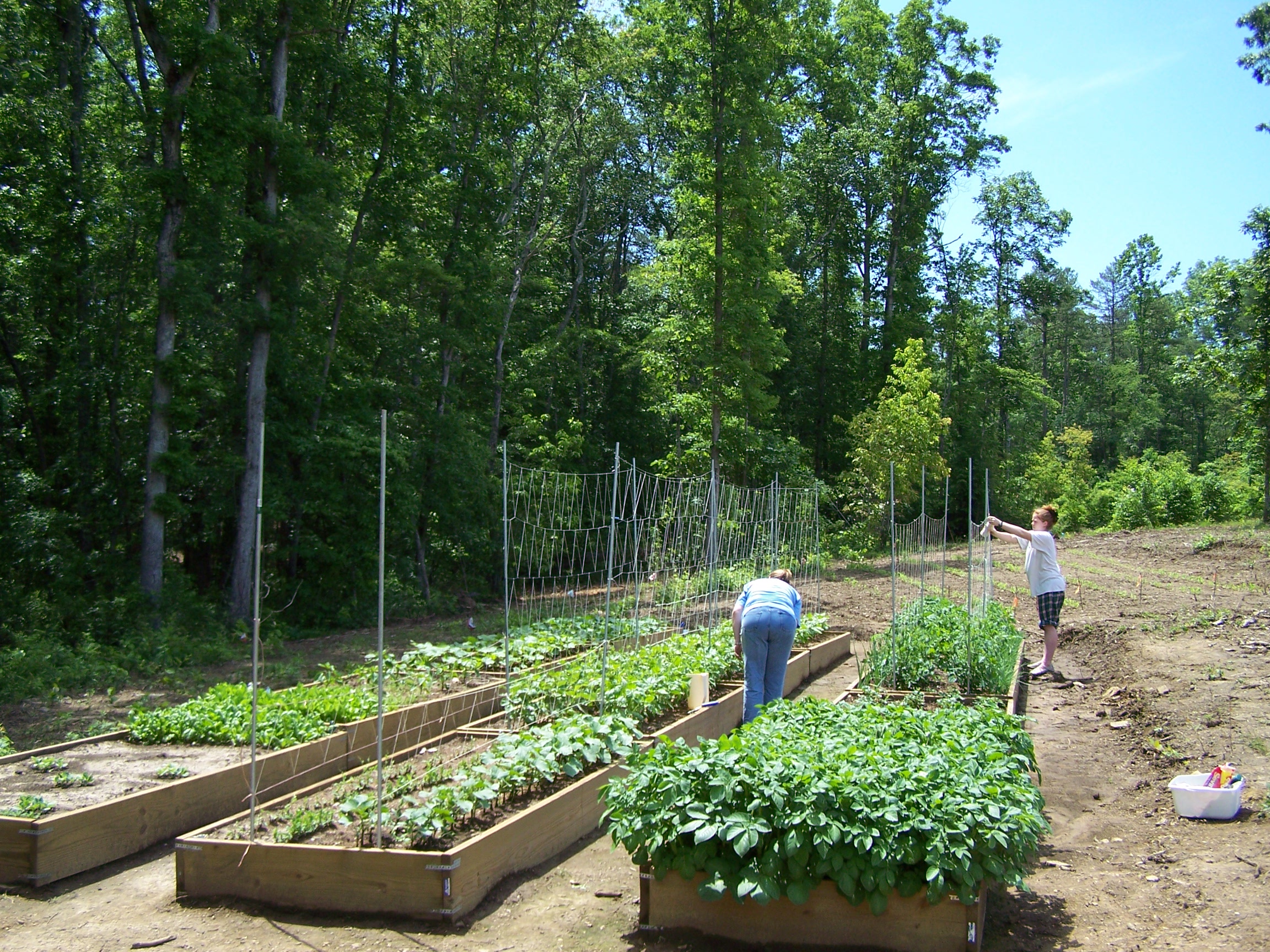
            Most people would guess that the deep change in me came mostly because of my time in another country. Perhaps, but I don’t think so. I can trace the transformation in my thoughts and dreams to one summer spent in our family garden. OnRaised Bed Gardene week, really. I had just come back from a fun but stressful month at Tennessee Governor’s School for the Humanities. I was feeling hurt and frustrated by school friends and looking for a place of cleansing and healing isolation. I began to work with my mom every day in our family garden. It took me only a few days to recognize the peace and significance that I felt in the mornings I spent working there. The way I talked began to change. I started to dream out loud of a small house where I could live simply with my family and a large garden. I gave thanks openly for the simple things, and I expressed frustration that I couldn’t express adequately to my friends just how I had changed and how much this new connection meant to me. I often lamented to others and in my journal, “How do I explain the feeling of waking up, putting on shorts and a t-shirt, walking out to the garden, picking green beans that I grew myself, snapping them, throwing them in a pot with a little sugar and salt and pepper, eating them, and not needing anything else in the world?
            A trip to my old neighborhood in Atlanta reconfirmed that I had changed deeply and dramatically. The suburban life that once seemed to me the only way to live now repulsed me. I felt like I was drowning in a huge sea of pavement. Traffic seemed unreasonable – where was everyone going? Parking lots made me squirm. Strip malls appalled me – why in the world should a town need an entire store devoted solely to makeup? I regularly ranted to my mom about the stupidity of such a lifestyle. She reminded me that this was the way the majority of Americans live, that most didn’t know any different, and that not too long ago I was one of them. As I walk through my garden, through the trees between the garden and my house, and through any open space, I often reflect on that trip and on Gerard Bentryn’s statement, “If you cannot see where your food comes from, you are doomed to live in ugliness.” As I do, I am overcome with gratitude to God for guiding me and my family to this place and giving me the opportunity to learn to see.

Preparedness Fair at the Village on Sewanee Creek

It’s official.  Our first annual preparedness fair will be held at the Village on Sewanee Creek Commons, villager homes and gardens and our nature preserve on July 23-24, 2010.  Call in advance to reserve a campsite or exhibitor space.

See the attached printable

flyer for details.  Preparedness Fair Flyer

See you here!

Personal Freedom, Creativity and Work

“Everything that is really great and INSPIRING is CREATED by the INDIVIDUAL who can LABOR in FREEDOM.”

 Albert Einstein

In this quote, Einstein pulls together several of my most cherished themes (emphasis is mine). I feel most inspired when I can create something with my own mind and hands. It may not be ground breaking to someone else. But to me, it is beautiful. It makes my life happy. I feel inspired.

Yesterday was one such example. I worked all day beside my neighbor, Joe. We put up the frame for a dock on my brother’s pond. That simple installation was part of several other solutions.  We now have an inexpensive valve system for a 4″ pipe that won’t freeze and break in the winter, a place to fish from in the summer and overflow control for the dam. I can look forward to extending that big pipe from the bottom of the dam to a micro-hydro generator. I think we finished it in time to let the pond re-fill before summer sets in and to stock it with lots of catfish.  All together, it’s a very simple, yet elegant solution that took time and several iterations to figure out and implement, culminating in a sense of satisfaction.

We also restarted the wood furnace and routed hot water through an old car radiator with a fan behind it to heat a greenhouse cold frame tunnel within the bigger greenhouse. I was surprised by the amount of heat it puts out and how efficient the solution is. I went to bed last night feeling good. What a blessing it is to be able to work and create on my own land with my own hands. One of the reasons it is important for Villagers to own their land is that essential element of personal accountability. Without that, it becomes too easy in an intentional community to expect others to carry the load. One must give in order to receive. As the scripture says, “Thou shalt not be idle; for he that is idle shall not eat the bread … of the laborer.”   Upon achieving a measure of self-sufficiency based on one’s own labors, it becomes even more fulfilling to help others. 

Finally, Einstein speaks of freedom.  How wonderful to be able to make my own choices and either enjoy or suffer the consequences of my own thoughts and actions.  Out in the country, I feel so much more free than in a suburb where everyone is looking over my shoulder, judging every action or inaction, and the epitome of creative labor is how well and often my lawn is mowed.

Prepper’s Top Ten Necessities for Life in Troubled Times

  1. Relationships: Positive, mutually supportive with capable, skilled people
  2. Spiritual & Mental Health: The foundation for all positive action.
  3. Physical Health: Sustainable, natural health care to supplement a healthy lifestyle.
  4. Water: Reliable, secure source of pure water
  5. Food: Natural food from a source you trust and control (yourself)
  6. Shelter: An energy efficient dwelling
  7. Energy: Redundant, reliable, private sources of storable energy.
  8. Reserve: Store and rotate a backup supply of everything you use (water, food, medicine, tools, fuel, clothing & other consumables)
  9. Trade: Prepare to trade for everything else (Cash, Non-Depreciating Assets, Barter-Valuable Supplies, Practical, marketable Skills)
  10. Knowledge & Skills: True self-sufficiency comes from experience – knowing how to do it yourself.

Take a good look at this list.  If this were a report card, what would your grade be on each of these important subjects? For the past 50 years, the developed world has lived in a pampered, complex, yet socially dysfunctional style that values:

  • Entertainment & Entitlement over productive Work
  • Self-Indulgence over Selfless Service
  • Pleasure over Moral Integrity
  • Intellectual Prowess over Practical Skills
  • Dependence on complex systems over Independent Self-Sufficiency
  • Conspicuous Consumption over Provident Preparation.

Is it any surprise that most people lack the skills, preparation, and resources to confidently face a troubled future? Is it any wonder that people feel helpless and out of control? Is there any way you can become confidently competent and provisioned for these ten essential items all by yourself? It’s a daunting task.  But, with help, you CAN do it.

That’s why relationships are at the top of the list. That’s why we are building a community of self-sufficient people at the beautiful Village on Sewanee Creek. If your values are the inverse of the above list, If you want to become more confident, more self-sufficient, and more at peace with your neighbors and in harmony with nature, If you desire close, trusting relationships in a like-minded community, but aren’t ready for a religious or hippie commune, give us a call.

We have fun learning from each other

At the Village, we encourage intelligent, open interaction about things that matter in life.  We encourage a diversity of opinions, seasoned with a good measure of humility as we seek to learn from one another.  We have a private website called “friends of Sewanee Creek”  where Villagers, prospective villagers and other like-minded people exchange information on many topics and build relationships.  Here is a sampling of a recent exchange.
======================================================================================================================
Study Links GM Corn to Organ Damage
Not to jump on the food scare band wagon, but I coincidentally just ran across this article. It says studies are now linking Monsanto genetically modified corn to organ damage in rats (liver, kidney, heart, adrenal, spleen and blood cells).
Naturally, Monsanto claims the studies are bogus. Given the pervasive use of GM seeds in the US, I suspect it will be a long time before conclusive evidence comes to light or anything major is done about it. I’m thinking how long did it take for tobacco usage to be effectively challenged?
Read the article in Food Safety News at http://www.foodsafetynews.com/2010/01/study-links-gm-corn-to-organ-damage/?CFID=1479691&CFTOKEN=49241182

Digging a little deeper on this site I also found an article reporting that Monsanto has withdrawn its application for approval of GM corn in Europe. http://www.foodsafetynews.com/2009/11/gm-corn-pulled-due-to-food-safety-concerns/

Right now I’m feeling good that we drink 100% chemical free water from the sky and have a freezer full of home grown GMO free corn.


Added By:   Grant Miller On Mon, 01/25/2010 04:49:23 am

Villager 1 – 01/25/2010 08:22:54 am
While I wouldn’t doubt that GM foods have their own problems, I also believe that humanity in general has chosen to go down food paths that are not appropriate to our body chemistry for millenia now.
In fact, all grains (corn, wheat, etc.) cause mild to severe inflammation in the bodies of ALL people. In other words, our bodies are not intended to consume grains in large quantities, let alone as dietary staples. In fact, there is a growing consensus that a grain based diet is the leading culprit behind heart disease and several common cancers.
This problem is magnified by various myths propagated within our culture. The idea that all fats are bad. The idea that body fat is caused by consuming animal fats. The idea that a vegetarian diet (which almost always includes grains) is healthier than a more primitive meat and *true* vegetable diet.
At the end of the day, once a society has sacrificed its allegiances to the alter of convenience and cheapness, its food supply is going to go to hell. GM foods are just one step along the path of a food supply that’s divorced from a natural and optimized state.

Grant Miller – 01/26/2010 11:03:22 am
Politics and Religion are the taboo subjects we are warned never to discuss openly. Ahhh, but then there’s food. Nothing strikes closer to the stomach or the taste buds.  So, I thought I would have a little fun with this one. Here’s my best shot for now.
I think it would be fun to hear your ideas about food in the form of a fun limerick.

“We are what we eat” they all say
and make such political hay.
We debate about diet
till we wish they’d be quiet
and leave us quite out of the fray

Some choose to only have meat
While others claim life’s staff is wheat.
Empty carbs make me draggy
my spare tire gets saggy
but then, without bread where will I put my butter?!!!

Now meat, when taken to excess
puts my bowels in utter distress
A constipated grouch,
I lie on the couch
But good meat is simply the best!

No dairy? that’s out of my loop
Ice Cream’s my favorite food group
But milk makes me swollen
down deep in my colon
with gas, but I’ll have one more scoop!

Then come the social elite
when choosing a diet to eat,
say, “let them eat cake”
Oh!, goodness sake
Few things are as good as a sweet.

Others say fruits, nuts and sprouts
will make you most healthy, no doubt
But, Some get quite edgy
while touting their veggies
and leaving the meats fully out

And when it comes down to fat,
I’ll testify, “that’s where it’s at.”
For if you want flavors
that everyone savors
Nothing even comes close to that.

But, as for me and my house,
we mostly just try not to grouse
at the food placed before us
cause Dad always warned us
to clean up our plates or get out.

So, after it’s all said and done
There are few foods I’m likely to shun.
Without rhyme or reason
In any old season,
Moderation is rule number one.

Except for Ice Cream, Butter, fat of all kinds, fresh home baked bread, fresh strawberries or raspberries or peaches right out of the garden, a thick, juicy grilled steak, mashed potatoes and gravy, buttered yams with brown sugar and pecans, corn pudding, fresh steamed, buttered broccoli or pretty much anything that makes my mouth feel exquisitely happy and reveals no immediately discernable cataclysmic side effects.       smile

Villager #2 – 01/26/2010 09:14:04 pm
..Love your poem, Grant. Right on!!

Friend #1 – 01/26/2010 10:13:03 pm
I am no expert, but I think we need to remember that almost all the food we eat today has been “genetically modified” in some way. Even non-hybrid seeds are the result of centuries of genetically crossing to emphasize desirable characteristics. One can argue that this is different than the modern GM process; but how much really?
And whether corn, wheat, rice, oats, rye, etc is best eaten fermented, I think there is much biased research out there to stake too much in it. You can find a study that supports just about any point of view.
Inuits can survive on mostly meat, fat, and fish. But, they have many many generations of adaptation. Not sure we could do the same. Does that really mean that grains are bad for us? Like so many foods today, perhaps grains are misunderstood. Perhaps it’s not the grain, but the refining that gives it less-desirable qualities. Breaking a grain apart, throwing away the germ, bran, or other components, destroys the complex interactive ‘wholeness.’
I’ve done research on raw milk. Milk has a bad reputation–many people are stricken with significant stomach ailments after consuming milk products. Raw milk is illegal to sell in most states. In some of those states, a person can arrange with a dairy farm to become a part owner of a cow (cow shares) and consume raw milk from ‘their’ cow. So what is wrong with raw milk? The US Government says it killed people and made many sick at the turn of the 20th Century. Further study, many years later, suggest that most if not all of these incidents were due to improperly stored raw milk. However, the ban on raw milk stands. So what is the big deal? Studies (yep, those darned studies) suggest that lactose intolerance and it’s accompaning stomach ailments in many people, comes from the pasteurization of milk; it kills the good bacteria that aid digestion;It breaks apart the whole, and destroys the interactive complexities. As with meat, if milk is not properly handled, it will make you sick, but most food is that way!
So perhaps the same type of issue exists with grains; breaking them down and refining them takes away the good compounds. Food is wonderfully complex. It’s probably why we can’t duplicate the health benefits of an apple, orange, or broccoli. There exist many supplements on the market, claiming to give the benefits, but they all seem to fall short; they can’t duplicate the complexity of the raw or whole food they derive from.

Grant Miller – 01/27/2010 06:47:15 am
I like your take on this, Clayton. One thing I know for sure is that I don’t know much. In my short life I couldn’t possibly count the number of fad diets, supposedly well-founded on studies, that were quickly superceded by an opposing view. That’s not to say that we should throw all the babies out with the bathwater. Rather, take a long-term, skeptical view. Live carefully, eating moderately, the foods you perceive to be natural, as the gifts from God that they are, and enjoying food to its fullest.
As we explore and test what works well for each of us, share it. I love xxxx‘s conviction about a diet that obviously works well for him and I am grateful to learn this perspective. I’m not quite ready to go there for my own reasons, some of which may be peculiar to my own body or belief systems. Yet, I am enriched to learn more of another perspective and encouraged to trust that more meat could be a healthy way to re-balance what I consume now. Thank you, xxxx, for having the courage to share your beliefs and experience with conviction, yet with the humility that accepts other’s experience and beliefs.

=============================================================================================

If you like this kind of sharing with like-minded people, you can request an invitation to the Friends of Sewanee Creek at info@sewaneecreek.com.  Please note the reasons for your interest.

How One Top Executive Left the Rat Race for a Self-Sufficient Community in the Mountains

How One Top Executive..

How One Top Executive Left the Rat Race for a Self-Sufficient Community in the Mountains

Posted using ShareThis

Child’s Play – Sand Box or Sand Mountain?

In our quest to build community at the Village, we don’t think just about the physical facilities that are needed, but how they must come into being.  Often the best way to assure that common structures don’t become neglected mausoleums (like so many planned gated community clubhouses) is to involve the community in their conception and construction.

Today, I’ve been thinking about building facilities that bring people together, including a playground for kids, a man-cave common shop for building projects and tinkering and a place for female activities like scrap booking or quilting.  But we must start from the point of creating activities rather than creating buildings.

A couple of weeks ago we enjoyed a day of play with two families who visited with their nine young children.  As the adults were preparing hobo dinners in the fire pit, we noticed that the kids had gathered at a large mound of dirt near the stage.  They were busily digging caves, leveling pads for imaginary structures, playing king of the hill and any number of other great, creative games.

So, this morning we were noodling about building a kid’s playground.  We were reaching into our childhood memories for hints of what will make it the coolest, most fun, most awesome place for kids to hang out and play. I remarked that the first thing we need is a good sand box for the creativity it brings out.  Then it struck me.  The traditional sand box simply won’t do.  It’s too two-dimensional.  We need a sand mountain. And what better way to build it than to involve Village parents and their kids in its conception, placement, and construction?

We have all the materials we need right here at the Village.  I’m thinking rather than use pressure treated lumber for the box, why not use some of the huge logs that have already been cut?  Discarded tires make great barriers or climbing structures too.  Build three sides tall and fill it with sand.  When the sand goes flat from a lot of play, I can bring my tractor in to re-pile it into a mountain.  Maybe put a climbing wall on the back side of the logs.

But then, what do I know?  My most important work is to get the Villagers involved in a way cooler solution.  Who knows?  It might be so cool that the adults will rediscover how much fun it is to play in the sand and we will have to expand it.

Anyone up for a sand sculpture contest?

Thoreau’s 4 Steps to Great Accomplishment

“To accomplish great things, we must not only act, but also dream; not only plan, but also believe”
– – – Henry David Thoreau

Thoreau’s wisdom begs four great questions:
Do I have a dream?
Do I have a plan?
Am I acting on the plan?
Do I believe I can get there?

To the first three, I can shout an unequivocal, “YES”!
I have a big, vivid, dream.
I have worked out detailed plans that are continuously revised against life’s realities.
And I have worked to realize the dream.
These are the easy and obvious steps, commonly practiced by much of humanity.

The greatest obstacle to grand dreams is in the daily grind of caring for faith despite the setbacks, the delays, the distractions, the unbelievers, the trivializers and the scoffers.
Faith is a delicate flower that must be nurtured and protected against all enemies.

I am thankful for friends and family who lend me their hope and encouragement, especially my neighbor, Joe Nunley.
Without friends, my faith and my dreams may have suffered a premature death.

Becoming a Self-Reliant Asset to your Community

Today, build something useful & beautiful that will outlast you.
Make a habit of building and sharing every day.
You will be a self-reliant asset to your community.

And….. you will love yourself more!

Self-Reliant Living: Alternative Energy

We keep pushing the envelope, learning how to live independently.  I love the sense of freedom and peace of mind that gives me.  Water and food were our first focus.  That foundation is feeling pretty solid now.

Our next focus has been energy.  We have been seriously researching lots of alternatives for reliable, low cost electricity generation.  Most people think of solar PV, wind and, to a lesser extent, micro-hydro for green power. But there are problems with each.

Solar Photo Voltaics are expensive.  The costs are beginning to come down, but aren’t there yet.  Probably won’t be for some time.  I want to power my house without bankrupting the occupants.  And I don’t want to have to sacrifice so much on consumption that I give up all the conveniences.  Then there are the cloudy days, requiring big battery backup.  PV cost per KWh is just way too high.

Wind is nice.  Lots of new innovations, especially with vertical axis turbines.  They are primarily designed to make wind power acceptable in an urban environment by putting the turbine close to the ground.  But that’s where there isn’t much wind.  Oh, well.  We’re rural, so that’s no advantage.  Wind’s disadvantage for me?  You need really strong, consistent wind to produce a lot of electricity – like on the plains of Nebraska.  We are on a plateau at 2,000 feet with nice breezes, but not gale force winds.  We could still do it, but would need multiple windmills to make enough electricity for our needs.  Again, the costs become too high relative to the output.  Plus, you only get electricity when the wind blows.

Then there’s hydro power.  It’s the lowest cost per KWh alternative, but you need either a big river or a perennial creek with lots of head (drop in elevation). We have the latter, but flow varies a lot depending on recent rainfall.  Summer flow isn’t enough.

It all comes down to cost and continuous reliability.

We discovered a little-known, low-cost, low-tech and proven alternative.  It’s called wood gasification.  Surprisingly, over a million cars in Europe were powered with wood during World War II when gas was short.  Unlike the other green power sources, we have an abundance of fast growing, renewable, free wood here.  So, we are installing a system that converts wood into a gas that can run an internal combustion engine with plenty of horse power to drive a generator.  We can run it any time, in any season, independent of the weather.  And, best news of all, the cost is competitive with the big utilities on a cost per KWh basis.

The founder of the company that has brought this technology into the 21st century will be here a week from next Saturday installing our new system.    Give me a call if you would like to see it or any of our other self-sufficiency systems in action.

Learning from Chickens

A chicken may just be one of the dumbest animals on the planet. Yet, today I found that there is much to learn from them.

I spent a good part of my Sunday afternoon relaxing in a lounge chair just observing our new chicken yard. Here’s some background to my story.

About 6 weeks ago, we took delivery of 30 Guinea Hen Chicks. We nurtured them in a cardboard box on our back porch till they outgrew it. A couple weeks ago Joe and I built a chicken coop. As soon as it was ready we moved the Guineas to the new coop while we finished off the fence around the chicken yard.

Guineas are originally from Africa. They are self-sufficient, extremely hardy, voraciously eat bugs (particularly ticks) and are great watch “dogs”. Pretty good neighbors by all my criteria.

Joe has been raising some laying hens and a rooster that he offered to give us. A couple days after completing the fenced yard, we moved the chickens in after dark while they slept. That was Friday night. We put them on their roosts so that when they awoke the next morning they would find themselves in their new home. Joe even brought a box for a nest and a golf ball as a placebo egg. The ball is a cue to where they are supposed to lay. Sure enough, the next day we had 4 beautiful eggs next to the golf ball. That was Saturday and we had a repeat performance today. Nothing like truly fresh eggs.

The first day the chickens and guineas mostly ignored each other. Their second night together I found them snuggled up tightly on the roost. One chicken even had a guinea under her wing.

Today, I noticed that they had become much more segregated. One of the red hens has taken to intimidation, chasing the guineas all over the yard and out of the chicken house. But when it gets dark, they all end up in the house on the roost again, although this evening, at a greater distance. They seem to have noticed a difference. The guineas are about half the size of the chickens, but growing rapidly. When mature, they should be roughly the same size. It will be interesting to see who intimidates whom when size is no longer a differentiator, the chickens are outnumbered about six to one and the guineas have a tactical flight advantage.

The behavior I found most interesting today was guinean. Guinea hens are extremely social animals, running in a tightly packed flock. In this case, I thought they were acting quite human. I had laid out some straw in one corner of the yard. There was plenty there for all the guineas, but it was mostly ignored. One guinea chick randomly took an interest, plucked a single piece of straw from the pile and sprinted for the opposite end of the yard, shaking the straw violently in its beak. Suddenly, that piece of straw became highly desirable to the whole flock, improved as it was in form and function by the shaking. As many chicks as could get near the first guinea began trying to take it away, while continuing to ignore the straw pile. There ensued a mighty chase until the first guinea finally dropped the straw. On the ground, it immediately lost its appeal and the flock’s attention returned to scratching randomly in the dirt.

How similar are people who must have the latest chic’ (pun intended) gadget just because someone else has it. How they scurry frantically about until it it is either acquired or becomes unfashionably passe’. How quickly the cycle spends itself and we rush off in hot pursuit of some new object in a different direction!

Aah, the vanity, avarice and covetousness of men, guineas and chickens. Also, like the red hen, how quickly we seek to intimidate or exercise authority over others just because we can.

Observing chickens may be at the peril of your pride in the human species. You might conclude that we aren’t much smarter than they. On the other hand, maybe we could all learn from watching chickens and stop running around like,  uhhhh……
a chicken with its head cut off?

Community -The Value of People

I get calls all the time from people saying they are looking for a community of “like-minded people”.  It seems that has become a cliche’.  Like most buzz words, it’s worth digging a little deeper to find out what it means to the person using it.   A wise man said, “the map is not the territory”.

The Village is all about making a place to live where people share similar, bedrock values especially caring about and being able to depend on their neighbors.  That takes a lot of work.  It means I have to explore their map of reality below the surface cliche’s.  Fortunately, by the time most people call me they are pre-screened.  They have found us by searching on some important key words.  They know they want a self-sufficient lifestyle and they want community.  They aren’t very interested in a superficial country club lifestyle where everybody wants to flaunt their wealth.  Most of the time, they are busy professionals, intelligent, successful folks with solid values who want to simplify.  They have usually read my blog, so the field has already been narrowed to a select few with a pretty good fit – compatible values.  But even then, I’m not shy about telling people who wouldn’t fit that they might be happier with a different kind of community.  Why?  Because I live here and I’m building the kind of place where I want to live for the rest of my life.  Great relationships with people are more important than money.  People are more important than things.

In hard times especially, people need to draw together.  Trusting relationships are everything.  This message seems to be resonating with people more and more as the economy looks ever more shaky and the government looks ever more out of control.  At a time when most luxury resort type communities haven’t sold anything for a year and are going bust, we are growing rapidly.

If you call or visit, there is no high pressure sales pitch.  Even before we show you around, we like to sit and chat for a while – explore your “map”, your values, your goals and aspirations.  Before you fall in love with the land we want to know that you will love the kind of people who are here.

We offer a private website where villagers, prospective villagers, contractors, and even neighbors from outside our “non-exclusive” development can get to know one another and share their views, ask each other candid questions and make sure this is where they want to be.  I have even offered to set up conference calls between prospective and current villagers to explore the fit.  It’s a slow process and it risks killing sales, but I think it’s worth it.  After all, making a move like this is a big change for most people.  There’s more to a happy life than a nice secluded house nestled in nature’s beauty.  You’re not buying dirt and trees, you’re hoping to buy a happy life.  We do everything we can to assure that will happen for our Villagers … and for ourselves.

3rd Annual Independence Day Celebration @ the Village

An independent, self-sufficient lifestyle is one element that defines the Village.  So, Independence Day is OUR day, our 3rd annual.

We will start celebrating on Friday the 3rd with a double feature on the big screen under the stars in our amphitheater.  Call for an invitation to join us.  You might even consider bringing a tent or RV to camp out near by.

The 4th will start out with an early flag ceremony.  Bring a flag to plant in a field of flags.  Celebrate the freedom and independence promised by our constitution.  At the amphitheater stage, we plan to have bluegrass and country music with some free form jamming.  I’ll bring my sax.  You’re welcome to join in.  You can hike and explore our 500 acre nature preserve.  In the evening, villagers will share a potluck dinner and fireworks.

If you would like to join us, please RSVP us at (931) 442-1444.

Tiny Homes – Big Life

Some time ago a Realtor suggested to me that the formula for calculating the cost of building a home should be a large multiple of the cost of the lot.  At the time it struck me as a bit odd.  The more I have considered it, the more out of step that thinking seems.  It reminded me of advice I received as a young man.   I was contemplating marriage and buying an engagement ring.  The jeweler informed me that I should budget a certain percent of my annual salary for that ring.  There was no consideration for any of my personal values, economic circumstances, nor of my future bride, only custom and fashion.  A thinking person holds neither fashion nor custom in very high regard.  It seemed that someone concocted these  formulas more for the benefit of the salesman than for the happiness and well-being of the buyer.

For a person who values nature, if there is to be such a formula, shouldn’t the numerator and denominator be flipped?  Shouldn’t the land value be a multiple of the house?  Which is the more durable, the more valuable over time?  What does REAL in Real Estate refer to?  Great architects will invariably assert that good architecture is molded to the character of the land, not the other way round.  The most famous example of the principle is “Falling Water” designed by our most lauded architect, Frank Lloyd Wright.  But I hold that the true spirit of the principle was best illustrated by my favorite philosopher, Henry David Thoreau.  He found his greatest joy living in about a 150 square foot house of his own construction beside a lovely pond in the woods.

Today, it has become quite fashionable to downsize to small, even tiny houses.  How good it would be if behavior were driven by wisdom not fashion, but what a happy coincidence we find ourselves in!  The unforeseen benefits of a small home are substantial.  When the land one lives on is of greater value than the house, the true proportional value emerges between things made by man and those made by God.

This conflict of interest has reached absurd proportions as American suburbs filled with McMansions that people can neither afford nor use.  Huge spaces that only require the owner to fill them with furniture that they can also not afford.  Possessions own us.  Thankfully, current economic hardships have brought a degree of common sense back to at least some.

In the Village, it’s really ok to own a small house rather than be owned by a huge, wasteful one.  There is no minimum house size here. We are blessed with a mild climate and stunningly beautiful land filled with plants and animals in their natural state.  A small home invites one to be outside and enjoy all that nature has to offer.  The Village lifestyle is the antidote for the cocooning generation, holed up with TV’s, video games in cavernous mansions, full of things and yet empty of life.

How full one’s life becomes when the great out-of-doors becomes the boundaries of our habitation, not the walls of our house.

For some ideas on living small, check this out:   http://www.tinyhousedesign.com/

Spring Green and Peace is in the Air

It’s that beautiful time of year when the new green is fresh and delicate.  Recent rains have filled the creeks to overflowing and the waterfalls roar.  At our elevation, the dogwoods, wild azaleas, wildflowers and mountain laurel are about a month behind Atlanta – now in full bloom.

Spring brings out the best in us.  While the dark clouds of the economy and world events are still with us, people are breaking free of fear and indecision.  In the past couple of weeks we have sold seven lots and our new Villagers are a cut above.  Intelligent, hard working, concerned about having and being good neighbors, there is a sense of excitement, energy and cooperation awakening in the Village community underlying a sense of well-being and deep calm.

New owners are voluntarily working together to share information, green construction ideas and purchasing power as they build their homes.  It’s a good place to be.  This year promises to be the best ever.