Official Year of Hysteria Begins Today

Well, I guess today is the official beginning of the year of hype and hysteria.  One year from today, the Mayans reportedly predicted that the world will end.  This History Channel doccrockumentary chronicles many of the reasons we should live in fear.  To be honest, there are a lot more scenarios one could get catatonic about.  Bad as these predictions are, they only scratch the surface.  Not enough time in less than an hour.  I found it laughable that the hosts of this program, after building to a crescendo of terror, concluded that on December 21, 2012, one would “go armed to Mom’s house” to make sure she’s OK.  Another said he was thinking of stocking up on a few weeks of food.  What’s THAT all about?
If the YouTube version goes away you can watch the entire show here.

What do I think?  Hooey!  The words “confluence of catastrophes” keep coming up in this piece.  Yep, there are a lot of things happening.  Who hasn’t noticed?  But the greatest confluence here is between people making money out of fear, selling advertising.  “Your Mercedes won’t help you”.  But apparently, if you have an advanced Lincoln, things will be, oh so nice “with innovative technology built in that’s able to aid and assist you”.

I’ll double down on my bet that the world will NOT end on December 21, 2012.  I won’t be doing anything special on that day.  That date will come and go like Y2K, with a whimper.  It’s absolutely the safest bet anyone could make.  If I’m right I can brag about being right.  If I’m wrong nobody will know, cause we’re all dead.  🙂

Meanwhile, the world IS gradually, but at an exponentially increasing rate, descending into poverty and chaos.  Technically, what I’m about to write isn’t prophecy, since it’s already happened and is continuing.  It’s been going on for some time now.  There will be many more natural disasters that will happen around the world.  More governments will be overthrown. Civil liberties will be lost.  Corruption will grow even faster, at all levels unabated.  People will watch on their TV’s and i Pads.  Terrified for 15 minutes, then go to bed, waking up the next morning in the same state of denial and indifference.  People kind of like to be scared.  That’s why roller coasters and horror movies sell.  But these things don’t require any forethought, work or sacrifice of the present luxuries, indulgently viewed as necessities.  People don’t like that.  So, they won’t DO anything about it other than periodically whip up their fears for a perverse thrill.

I can testify from personal experience.  For years, at least 99% of the people who inquire about joining our self-sufficient lifestyle in the Village on Sewanee Creek, after confiding that they are deeply concerned for the future, are still thinking about it, but not doing.  Back in 2006 when times were good, I suggested that it was time to prepare.  Then the sub-prime mortgage crisis began gradually in 2007.  People wanted to wait till better times came and they could get more out of their houses.  Then the 2008 meltdown hit.  People said they desperately wanted to be here, but were upside down on their mortgages.  I suggested times probably weren’t going to get better.  They didn’t.  Today is no different.  People have little money compared to a few years ago.  But they still live in big heavily mortgaged houses, drive expensive (a bit older) cars, wear stylish clothes, eat expensive prepackaged food, pay exorbitant amounts for insurance and health care and incessantly wring their hands.  They still have many assets that could be traded for a simpler, more secure future, but they won’t make any decisive changes.  Frozen in the headlights.  No, that light at the end of the tunnel is not natural.

The great depression was a bad thing.  I believe we are in a depression now that is just as bad measured strictly by economics, but papered over by mountains of debt and extended unemployment payments.  When those cease, people will feel the pain much worse than the great one.  Will there be sudden jolts and disasters?  Of course there will.  But what we have been seeing is not a one-day event.  It’s already happened and will continue to stew the masses like the clichéd frog in the pot.  It’s a really BIG pot.

While the central premise of this documentary, the Mayan prophecy, is mostly hype, they did manage to get a lot of things right, the things we already knew.  If you haven’t already started preparing in earnest, drastically cutting back on the frills and aggressively providing for future necessities, my bet is you won’t.  You will be among those looking for a gun, pillaging your neighbors when TSHTF.  Good luck with that.

What do I expect to be doing on December 21, 2012?
I won’t be surprised if my financial resources are almost completely depleted (or close to worthless, ravaged by inflation).  It’s likely I will have discontinued all my insurance because it’s accounting for fully one-third of my expenses now and probably isn’t sustainable.  So, I’ll be very careful to take care of my health, eating well, exercising and learning more about foraging in the woods for natural remedies.  Not such a big deal.  That’s the way people lived throughout all history up until just a hundred years or so ago.  I’ll still be driving my old cars, some of which lack computerized chips and would survive an EMP or solar flare.  But the price of gas will be pretty high, so I’ll probably be sticking close to home most of the time.  It’s nice that I like where I live.  It’s peaceful and naturally beautiful.  I’ll be wearing my old clothes.  I’ll be living in the grace of God, day-to-day raising our food.  By then, my work building a self-sufficient community (marketing, blogging and sales) will be over, so I won’t depend as much on my wife to do the farming.  I’ll be helping a lot more with the daily chores, feeding the chickens, chopping wood, tending the garden, making compost, taking care of the orchard.  My entire focus will be on daily living.  Do I fear the hoards of starving, thirsty people from the big cities?  I guess there is some risk of that and it’s an unpleasant thought.  But if there is anywhere that can be more easily defended than where I am  and with the people who have joined us, I don’t know where it is.  Will I be well armed?  Is the Pope Catholic?  There is some comfort in knowing that there is little here for anyone to come after.  When you raise what you eat and live simply there isn’t much to plunder.  It’s now late in December and we are still eating fresh tomatoes, potatoes, sweet potatoes, squash, peanuts and other produce from the greenhouse.  A new crop of winter greens (Kale, Spinach, broccoli, beets, carrots, etc.) is just coming on.  Kill the farmer and you kill the goose that lays tiny golden eggs.  That reason for a sense of security goes double for living on the edge of Grundy County, TN where people have lived close to the bone for generations.  Survivors all.

After the hysteria, there’s a hymn that I love.  It speaks to the human condition whether in poverty or wealth, sickness or health, joy or anguish.  It is an anthem of eternal hope.  After viewing something like this History Channel documentary, it helps to sing:

Come, come, ye saints, no toil nor labor fear;
But with joy wend your way.
Though hard to you this journey may appear,
Grace shall be as your day.

‘Tis better far for us to strive
Our useless cares from us to drive;
Do this and joy, your hearts will swell –
All is well!  All is Well!

Why should we mourn or think our lot is hard?
‘Tis not so;  all is right;
Why should we think to earn a great reward
If we now shun the fight?

Gird up your loins;
fresh courage take.
Our God will never us forsake.
And soon we’ll have this tale to tell –
All is well!  All is well!

We’ll find a place which God for us prepared,
far away in the West.
Where none shall come to hurt or make afraid;
There the Saints will be blessed

We’ll make the air with music ring
Shout praises to our God and King.
Above the rest, these words we’ll tell –
All is well!  All is well!

And should we die before our journey’s through,
Happy day!  All is Well!
We then are free from toil and sorrow too;
With the just we shall dwell!

But if our lives are spared again
To see the Saints their rest obtain,
Oh, how we’ll make this chorus swell –
All is well!  All is well!

Our Intentional Community Works Together

I’ve been exchanging emails with some nice folks who went to Italy to set up a ministry, ended up staying for an extended period, but are soon ready to return to America.  Laurel asks some great questions.  As I summarized what’s happening in the Village, I felt pleased with our progress and decided to share it.  The names were changed for their privacy.
__________________________________________________________________________________________________________________________________________________

Hi Laurel,
I’ll do my best to answer your questions within the text of your letter below.

From: Tom & Laurel Fitzgerald
Sent: Sunday, December 04, 2011 3:07 PM
Subject: Greetings from Italy

Hello,

We are seriously considering purchasing two lots at the Village. I believe my mother would be happier on her own lot.

I’ve spent many hours looking over modular home floor plans and trying to familiarize myself with the whole building process. We’ve never had a home built before – let alone considered trying it from overseas.  I am the kind of person to research and understand before moving forward – but then I am ready to move quickly as I’ve already spent all that time organizing all the steps and making the decisions ahead of time.

I’ve given some thought to your question about job/income.  Because we couldn’t think of actually living there earlier than 24 or even 30 months from now, it is a difficult question to answer.  However, Tom has agreed that a really neat goal would be to create a job/income via a joint-venture with others at the Village who want to create a business.  How or what this would look like, we are uncertain.

There are others here who are interested in working together to create income.  That could take any of a number of different forms including a partnership/joint venture with joint ownership or separate, yet synergistic businesses, leveraging different skills.  I have found from experience that with the best intent and integrity, partnerships are almost always problematic and tend to create friction.  So, personally, I prefer the latter option.  Some ideas and opportunities might include:

  • The Ensigns (lot 2) are deeply into the “maker movement”.  Fred plans to start an alternative energy company that builds hybrid solar systems (passive heat and PV).  He is an amazingly innovative guy with a tremendous work ethic.  He will do well no matter what he attempts.
  • George Jones recently purchased a very expensive training program that he has generously offered to share with anyone in the Village.  It teaches one how to set up an online retail/wholesale business starting simply with eBay, then graduating to building a website and social media, etc.  He is a bio-chemist and also plans to build a still for ethanol fuel production.
  • Ted Thomas (lot 12) is retired, but he has a PhD in plant genetics and really knows his stuff.  Some time ago he developed a strain of grass used on golf courses that has some wonderful characteristics.  He has indicated an interest in growing turf on plastic sheets for commercial applications.
  • Michael Stevens (lot 11) has had his own business from before he moved here developing websites that attract a lot of visitors and paid advertising.  He continues to do well with that business.  His wife, Sherry, recently got a position teaching at nearby University of the South and loves it.
  • The Fords plan to be here in the spring.  They are accomplished musicians and currently operate a recording studio that they plan to re-open after they move here.  Being close to Nashville will be good for them.  You can listen to their music on  their website.  Proximity of the Ford’s new home to the amphitheater will also be excellent. They are excited about spearheading the community performing theater effort with Village children and whoever else wants to join in.  I’m also excited about finally putting together a Village band so I can enjoy jamming together on my sax.
  • I continue to put time into developing the Village, but in this economy, real estate isn’t profitable.  So, I’m developing other sources of income too.  Recently, my wife and I discovered a health supplement that has made a big difference in our health.  We were so impressed that we have decided to take it on as distributors.  I’m also looking at a couple of other opportunities.  My escrow/title agent tells me there is still opportunity at the low end to buy and flip houses.  The key to success is buying them right and she has an inside track that she is willing to share.  Also, I have a small invention I’m working on that I will test market soon.
  • The cost developing the Sewanee Creek logo, website, blog and brand can be put to better use as the community develops.  Our combined output from gardens or other cottage industry projects can be marketed under the Sewanee Creek brand.  My wife is an expert quilter.  She has put her skill to good use recently making handbags.  She markets them at local markets and on her Facebook page.  I have experience in brand development from a career in chain retailing.  Michael’s website building expertise and George’s training program could be valuable there as well.
  • One of the most critical pieces of any business is human capital.  We have managed to attract some of the best.  There are more that I haven’t mentioned who own property here, but haven’t relocated yet.  I think we are already well positioned to thrive, not only as a self-sufficient community, but one that continues to attract talent and business innovation.

I’ve seriously been looking into the bed n’ breakfast idea and have already decided to go the short-term rental route which requires paying tourist taxes and registering a LLC. I believe we could generate a lot of interest in the location by Europeans, even if it is not a typical tourist stop in the US.

Marketing is always a big challenge, so your connections in Europe would be a BIG plus.

My one concern is that with all of my searching to read the covenants, I could only find a file speaking of it being updated with a Word file attached, but it didn’t show up on my browser. Would you be willing to send a copy of that to us? It would be very helpful during this stage in which we are exploring, dreaming, and researching.

I’m sending a copy of the covenants that were registered with the county several years ago.  You need to know, however, that I intend to make some revisions to them, in the direction of fewer restrictions.  I used a neighboring development’s covenants as a model early on because I was an inexperienced developer.  As I learned and fine-tuned the philosophy of the Village, I decided to opt in favor of greater personal freedom for private property.  That’s why I removed copies of the existing covenants from my website.  The only rules for house construction that will remain are the requirements for a large covered porch and restriction against permanent trailers.  I think porches are important to encourage interaction between families.  We don’t want the village to be a low-end trailer park littered with junk.  As written, the covenants on tree-cutting require my approval to cut trees over a certain size.  Those covenants will disappear for land outside the natural preserve.  I have lived in suburban developments before where the covenants were onerous and ridiculous, especially for a rural environment like ours where we want to encourage mini-farms with animals and technological innovation.  The intent of the changes will be to avoid excess regulation.

I’ve also been kicking around that idea Becky has about starting a retreat. That could be a very interesting idea and if she is looking for collaborators, combined efforts might prove more profitable. Tom and I have experience in organizing church retreats and mission team retreats. We’ve also worked at a Christian retreat center and between us have experience in the areas of housekeeping, laundering, food prep/service and preparing an inventory database for the maintenance crew. If this is something she is interested in dialoguing about, I would welcome that.

We would be all over that idea, except that the nest egg we started this project with has hatched and flown off. 🙂  Not enough left to build a nice retreat with right now.  Working together to service such a retreat would be fabulous, spread some of the work and a lot of fun, I think.  We look forward to a better day when we have some extra cash to invest with no more debt.

Completely changing the subject, we used electric golf carts at that retreat center for dropping off dirty laundry, delivering clean laundry to the various linen rooms, moving cleaning supplies between buildings, moving food from the storage shed to the dining room, for answer maintenance calls and bring supplies, and for carting flowers from the greenhouse to the various flower beds.

I like that!  We have a bling golf cart that could be used for that if we build the retreat.

And speaking of flower beds, I’m interested in understanding how the community garden works? Can anyone participate? Does one sign up? Is there a rotation? How does it all work, exactly? Does the community garden include a small orchard? What about the greenhouse? Is that your personal endeavor, or is that a community project?

Right now, the community garden is wide open.  Those who live here now have all opted to spend their time and energies building their own gardens.  As each lot has plenty of room, it’s just more convenient to tend a garden closer to the house.  The primary purpose of the community garden has always been more for socialization and learning than for production.  We have solved for socialization and learning by rotating every week between families on our private plots.  Each week, usually Thursday, we all get together to work on a project designated for and by the Village owner on that weeks rotation.  Last Friday was our turn.  We had four (4’X10′) cold frames made of PVC and 5-year greenhouse plastic sheeting. They weren’t being used and had been left outside the big greenhouse and damaged in the wind.  We repaired them and since Becky and I aren’t using them this year, lent two to George and two to Michael.  I think Michael is actually going to use them as shelter for his pigmy goats.  We put the two for George on the raised bed garden that we all built a few weeks ago on his property.  Hopefully by next week, the seedlings that we planted a few weeks ago in our greenhouse will be mature enough to transplant to George’s cold frames.  As for the greenhouse, it is our personal property, but it is larger than we can use in winter (2,000 square feet) and we are happy to share it with Villagers in exchange for help in it.  It’s working out great.  While the men worked on the cold frames on Friday, the women worked cleaning out the remnants of our tomato, pepper and peanut crops.  So, even sharing it with others we still have a lot of empty beds that need planting right now.  Everyone is really enjoying working together and sharing.
Back to the community garden.  I built some raised beds in the Commons early on with improved top soil from the local worm farm.  George has planted and tended some herbs there, but other than that, it hasn’t been used much.  The Lewis family, who are building their house now and aren’t here yet have volunteered to take it over and raise a crop this spring.  It will be good to see it being put to good use, as George will no longer need it.  As demand increases in the future, there is plenty of room to add more raised beds in the community garden.  But it’s interesting how things have evolved with people helping each other on their private land.  I think that’s even better than the common area garden.

I hope this answers your questions.  Don’t hesitate to call or write again if you have more.

Happy day of rest,
Laurel

Best place to survive East of the Mississippi

My wife and I have always thought that our location is optimal for living through difficult times.

Our intuitive sense was recently validated by the foremost expert in the field.   His name is Joel Skousen and you can read all about him, his analysis of world conditions and his consulting business on his website.

The third edition of his book, “Strategic Relocation” was released for sale this year.  It includes:
* 200 new pages with detailed analysis of every state and province in the US and Canada
* All new color maps for regions, provinces, and US States, showing threats, private and public land use, population densities, roads and terrain
This book can be purchased here.

A few months ago, I received an email from Joel.   He said,

“You’ll be pleased to know that the Cumberland Plateau received the highest rating for any area in the East in the new 3rd Edition of Strategic Relocation.”

In a follow-up conversation with Joel, I validated that his rationale matched mine.  If you would like to know what and why, you can buy his book or you can drop me an email, call (931) 442-1444 or send me a message from my website.

Preppers might also be interested in one of my older posts on the ten best places to survive in America.

On a side note, Mr. Skousen recently pointed out that Atlanta has the largest disparity of wealth of any large city in North America.  Thankfully, we are several hours drive from Atlanta, but that’s also fortunate for Atlanta residents looking for a safe haven within a reasonable driving distance.

It’s not what you make. It’s what you keep that counts.

Sustainability

It’s the buzzword of the decade.  Wrapped up in that word are other buzzwords like “green” andeco-friendly.  But these words represent passing fads.  The bedrock reality underlying sustainability is a much more prosaic, boring, yet little understood word, “Economics”.   It’s a terrifying word.  It suggests complex supply / demand curves and the inscrutable workings of inscrutable institutions like the Federal Reserve, the IMF and the World Bank.  People are increasingly frustrated and angry with the “banksters”, politicians and other manipulators of “the economy”.

Take a deep breath.  It’s actually quite simple at our level.  Make more than you spendThat’s it.  Take charge of your life.  Live frugally.  Be industrious.  Build and create.

That’s not to say that one need not be aware of the many external factors that weigh in on the spending side of the equation.  America’s favorite holiday, Thanksgiving, is next week. 

The Washington Post informs us Thanksgiving Dinner this year will cost 13% more than last year.  Yup, inflation is accelerating.  It’s about to get a lot worse.  Thankfully, I’ll be keeping more of what most people will be spending on a Thanksgiving feast this year.  We raise our own vegetables and poultry!

We’ll be enjoying some non-traditional, but delicious green tomato pie, remnants of our summer garden after a hard freeze last week.  Interesting how that word “Sustainability” is increasingly associated with another buzzword, self-sufficiency.  Keeping more of your output is inseparably connected with controlling both your income and outgo.  And that’s what self-sufficiency is all about – personal independence and control.

The good life is about more than financial economics.  Peace of mind is an even bigger part.  That’s why self-sufficiency, the sense that I’m in control of my destiny is so closely connected with sustainability and economics, which are all about achieving an abundant life.  Abundance can be in things, but has a lot more to do with state of mind.  It’s hard to have one without the other.

It’s not easy to be self-sufficient and independent.  It takes forethought, planning, intelligence and work, all values that were common to the early American ethic that seem to have become lost in the generations of excess.  Thankfully, those values are coming back into fashion.

One of the obvious elements to consider in the outgo part of the equation is the general cost of living.  We selected rural Tennessee as the place to buy land and put down our homestead.  Tennessee offers the lowest overall cost of living in the U.S.  For thinking people who want an abundant life, keeping more for themselves of what they produce, it’s an obvious choice.

For thinking people, there are many ways to cut costs beyond the current coupon fad.  Coupons only tie people to existing products and systems that reduce your control of your life.   Coupons might be put to better use as band-aids with a little stick-em.   That’s all they are anyway; short-term relief for a chronic disease.  Band-aids can be useful, but not for long.  In the Village on Sewanee Creek, an intelligent Intentional Community, people work together.  Cooperative effort on gardens, homes and other projects increases productivity and reduces costs.  We try to standardize on equipment and vehicles.  That way, it’s easier to repair things (increased productivity) and maintain extra parts (reduced, shared costs on a few critical items).   This kind of coöperation takes extra thought, extra preparation, extra commitment.  That’s why most people don’t do it.  That’s why most people don’t keep a lot of what they make.

At the end of the day, economics is pretty simple at our level.  Keep more than you spend.  Spend only on things of lasting value.  Work with your neighbors.  It’s all natural law.  We call it … “in harmony with people and nature”.  It’s our motto and it’s working to create a more sustainable, abundant life for people in the Village.

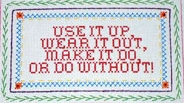
Use it up, Wear it Out, Make it do or Do Without

Tennessee Intentional Community

This was my mother’s mantra when I was little.  Having survived the great depression in her childhood, she was a raving evangelist of frugality.  That didn’t mean I was deprived in any way.  My Halloween costumes, made from pieces of this and that, were always extravagant pieces of art.  I was always the best dressed kid in my school, consistently walking away with the best costume award.

Speaking of school, when I decided to run for school president in the 6th grade, I easily trounced my opponents due entirely to my father’s artistic creativity.  He built an amazing, rotating sign from old wood scraps, a rotisserie motor, photos we developed in his basement dark room and his hand drawn Peanuts cartoons.  How could I lose with an endorsement from Charlie Brown?  Back in the day, that sign was so far ahead of its time, it became a sensation.

Some years lager, my wedding reception had a Hawaiian theme because my bride and I had lived in Hawaii as college students.  True to form, both my parents dialed up the heat.  My Dad created a replica of the church where we were married standing about eight feet tall.  The room was decorated with life-sized coconut trees and an outrigger canoe, all made from scavenged stuff, but looking like they came out of a Madison Avenue design studio.  The brides maids and grooms men wore authentic Hawaiian formal wear, made by my mother.  Hawaiian friends provided the entertainment.  They were willing to do the gig for free because they felt they owed my parents so much.

I guess that’s why this YouTube Video caught my attention.  Whether or not you buy into man-made global warming and the need to reduce our carbon footprint, it’s just way cooler to get the creative juices going and make great stuff out of almost nothing.  In our intentional community at the Village, we look for opportunities to be creative, together when possible, and as frugal as we can be.  It’s what I would call an abundant lifestyle.

Anyway, I hope this video inspires you to do more.  With some creativity, even a depression can be fun. 

Moral Chemistry

The Parable of the Good Samaritan. Other relig...

Good Samaritan

If there is one principle that the greatest sages, prophets, philosophers and religions throughout the ages agree on, it is the golden rule.

“Do unto others as you would have them do unto you.”  It is the foundation of moral behavior.

Cultures that foster the golden rule have a higher degree of trust, resulting in greater coöperation, productivity and wealth.

The Village on Sewanee Creek has three foundational principles:

  1. The Golden Rule
  2. Self-Sufficiency
  3. Personal Liberty and Accountability

Focus on these three principles creates an environment where harmony, trust and productivity can flourish.  But people are imperfect regardless of good intentions.  So the message of this TED talk is encouraging.  Above good intentions, there are physical explanations for different people’s ability to empathize and practice the golden rule.

Turns out that bio-chemistry plays a major role and there are things we can do to improve our own natural tendencies to live moral, harmonious lives.  I particularly like the concluding prescription.  Hope you enjoy this talk as much as I did. 

Demographics Drive Change

Whether it’s population or economic growth, exponential growth inevitably ends with bust and collapse.
Here is a video that explains the impact of exponential growth. 
World news is fixated on the UN’s pronouncement that we are passing the 7 billion population mark.
Ironically, there are many countries where population collapse is the issue as chronicled in this op-ed from AlJazeera, “BABY BUST SPELLS TROUBLE FOR RICH NATIONS”
Japan is the poster child, but Russia, Europe and even the US are on the list of countries now or soon unable to support aging populations. For those interested in seeing what the future looks like for countries with aging populations, check out this blog on the rusting of Japan.   Written from the perspective of an affluent expat financial analyst who is fluent in the Japanese language and culture, I find it fascinating in an eerie-dreary sort of way.
While energy resource depletion (aka Peak Oil) is one of the fundamental tectonic plates shifting beneath our feet, population demographics is another one.
Demographics defined my thirty year career. Perhaps nothing is as sensitive to or exposes demographics so clearly as how people eat. I was at the forefront of exporting American food service and retail chains to emerging nations around the world. I successfully developed well-known brands like IHOP, Papa John’s, Pizza Inn, 7-Eleven, Dunkin’ Donuts, Baskin-Robbins and Blockbuster Videoin over fifty countries.

7-Eleven's could be found EVERYWHERE in Thaila...

Baskin-Robbins Korea 1 of thousands

In the 70’s, it was Japan. There was a massive demographic shift as young mothers entered the workforce (similar to what had occurred in the prior 15 years in the USA. Japan was becoming more affluent. Young families with growing incomes and less time wanted convenient food options. Japan was mimicking America’s infatuation with chain restaurants. Japan’s growth curve was steep and so was the decline.
None of the brands I represented had the marketing or financial clout of McDonald’s, so I had to be sensitive to targeting only countries that had youthful, aspiring populations, mostly in developing countries where success was assured. For me, that almost always meant youth in Asia. Our greatest successes were in places like Japan (in the early days), Korea, Thailand, the Philippines, Saudi Arabia, Kuwait and other middle Eastern countries and more recently Eastern Europe, China and India.  Developing Latin American Countries

I opened this shop in Pakistan

were OK for inexpensive products like Dunkin’ Donuts).  Western Europe was always a tough nut to crack. My career taught me to be intuitively sensitive to population and economic demographics. Lesson number one.

Lesson number two was equally grounded in fundamental tectonic fact as expressed in the phrases “watch where the feet point” and “follow the money”. In the politically charged, sometimes back-stabbing corporate world of a senior executive, it was often difficult to know what alliances would form to support or betray you. Even hero de jour, Steve Jobs, was thrown out of the company he founded.  Those things shift quickly in the winds of expediency and personal interests. But if you have your ear to the ground you can always sense the grinding at the tectonic level. That is where the truth is.

As world resources become increasingly strained and rich nations slide into poverty, I see a growing call coming for population control measures that will target the less productive members of society, the old and infirm. It will be justified as “scientific” and natural survival of the fittest. Alex Jones and commentators like him attribute that to the “New World Order” elites, rising fascism, communism and the “banksters”. The mass media counters by marginalizing that rhetoric as nut-case “conspiracy theory” or “fear mongering”. It is hard to forecast who will be the leaders, the movers and shakers in a radically changing world. But it is clear that the world is about to shake because at the tectonic level (demographics and resources) there are unmistakable clues to the inevitable. Leaders like Hitler are impotent by themselves. Their power derives from their ability to tap into the tectonic forces of the masses. Demographic tectonics tells me there will be a mass of people clamoring for solutions. History tells me that someone like Hitler will offer solutions. The solution to over-population and under supply of resources is inevitably eugenics.

Under the din of claims, counter-claims and fault-finding, the tectonic plates of the masses continue to shift. Regardless of where one hangs the blame, earthquakes, like nature in general, move without regard to our feeble attempts to explain them.   It seems an ironic twist of language that my early career was defined by the potential of youth in Asia, while in later life I am thinking more about the potential for euthanasia. My early analysis of the demographic potential of “youth-in-Asia” led me to respond correctly and productively to the needs of the masses by developing thousands of restaurants and retail outlets in emerging nations. Later analysis of demographic potential for euthanasia leads me to the conclusion that in a eugenic world where only the fit and productive survive, we had better get on with the job of being not only fit, but productive and self-sufficient.

My baby boomer generation has mortgaged future generations with debt that cannot be repaid.  Those generations will default on that debt just as surely as sub-prime mortgagees did.

Best Preparedness Manual

A very wise man said, “perfect love casts out fear”  1 John 4:18

Another wise man said, “if you are prepared, you shall not fear”.

In a world rife with fear of many things, these two dictums are prescriptions for peace and harmony. Our motto is, “In harmony with people and nature” .   We seek to follow both of these prescriptions for peace.

I have frequently blogged about the need for communities to be bound together by a commitment to living the Golden Rule, the most basic manifestation of love towards fellow-man.  Communities where that is the dominant principle will do well during periods of social and economic chaos.

Top Ten rules for Self-Governance,   Neighborhood rules for a Sustainable lifestyleAustere but Without Fear, Antidote for an Economy of Fear, Top 9 Antidotes for Hard Times

But, there is another popular dictum that says, All you need is love” . . .  NOT!
Yes, it’s important to surround yourself with loving people, but regardless of how heartfelt the singing, kumbaya does not feed, clothe or shelter.  That’s where other forms of preparedness come in.   To cover ALL you need, combine personal preparedness, know-how and self-reliance in a like-minded community with a commitment to support, share and care.   Another name for that is the Village on Sewanee Creek.

My blog also has a lot of information on preparedness like  Top ten Self-Sufficiency and Survival Skills, and we periodically sponsor preparedness fairs and workshop  events open to the public,

Just as Holy Scripture is the manual for a life committed to love of fellow-man, there is a manual recognized by many as the final, comprehensive word on prepared, provident living.  It’s called the LDS Preparedness Manual and you can download it FREE here.

Follow this manual and you’re halfway there.

Build a great house for under $10,000

I was needing to build a guest house. Inexpensive, but strong, well insulated, attractive and off-grid ready.  There is a series of YouTube videos featuring Bob Vila building houses with Steel Shipping Containers, sometimes called CONEX boxes.  When finished, they make attractive houses, indistinguishable from others in the tract.  But the cost per square foot is about on par with standard construction at $150 to $200 per square foot.  Other than the appeal to save-the-earth recyclers, I have a hard time seeing the point.  There has to be a better way.

Done, for less than one tenth the cost.

A little over a  year ago, I bought two CONEX boxes to build a guest house.  They cost $2k each, delivered in rural Tennessee from Atlanta.
I put them on six steel reinforced concrete piers next to the main house.   I purchased good quality used double pane windows and doors from a local salvage place for about three bars of a song.  It was handy to already have plenty of dry storage with the containers already in place.  The old saying “time is money” turns out applies not only to the cost of labor and capital, but to one’s ability to buy materials at a discount.  A dry, secure place to store materials while you take the time necessary to buy frugally and build is an important feature of CONEX boxes that saves lots of money.  Over months, that dry storage was put to good use to accumulate inexpensive surplus or used components like sinks, toilets, cabinets, counters, carpet, tile and a wood burning stove from CraigsList, eBay and other local salvage sources.

Immediately on delivery, the boxes are dry and secure.  But they aren’t insulated and that’s a big deal on a house.  Without it, these steel boxes become ice boxes in winter and ovens in summer.  We are fortunate to live in an area where Tyson has forced the closure of all the older chicken houses.  That’s good in several ways.  First, the toxic stench is gone.  Second, the neighboring chicken farmers are no longer subject to Tyson’s vassal labor conditions.  Third, the chicken houses are slowly being disassembled and sold for scrap metal and the 1 to 2 inch thick foam insulation panels are often discarded.  I acquired two kinds of insulation for less than a song (about the chorus of Yankee Doodle Dixie), almost nothing.  The spun glass type went over the container tops and under the low-pitch steel roof.   Because each container is built to handle the weight of ten or fifteen more containers stacked on it, each loaded with tons of cargo in hurricane force winds on a tossing ocean, there’s no worry about having a higher pitched roof to carry a snow load, especially in mild southern winters.

With a plasma cutter, a friend cut holes in the sides of the CONEX for doors and windows and a gaping hole between them to open up a large space for a living area.   It was a fairly simple task to frame the holes with standard 2X4’s and install doors and windows.  Using standard framing and drywall, it was easy to add interior walls for a storage room, bathroom, bedroom, kitchen, living/dining area and laundry room.  Needing more space in the main house, the laundry was immediately moved into the end of one of the CONEX boxes, installing plumbing and electrical in the process.  A huge chest freezer was added.   In short order, parts of the new house were functional even before it was insulated. The thick marine plywood floors could be easily drilled for plumbing.  Used cabinets and the electrical panel (also bought used) were easily mounted to the steel walls in the new laundry room and hooked up by a licensed electrician.

Then I installed more vertical studs on the exterior walls, screwing them flat, directly to the steel walls from the inside.  The two-inch depth of the studs is perfect to frame the 2 inch thick insulation panels.  Next, I ripped some treated deck boards and screwed them horizontally into the vertically oriented studs. I nestled another 1 inch layer of insulation panels between the deck boards and on top of the 2 inch ones.  That makes three inches of solid foam insulation on the walls, almost what you would have in a commercial walk-in freezer.   With the insulation in place the difference was immediately gratifying.  The space, while not yet aesthetically pleasing, was comfortable and livable.  People interested in sustainable housing often speak of the relative advantages of insulation vs. thermal mass.  With the container house, you get both!  By putting the insulation on the outside, tons of steel are on the interior where the mass absorbs, retains and radiates heat or cold from AC, wood burning stove or other heating system.  This thermal mass helps keep interior temperatures relatively even.  Meanwhile, the insulation on the exterior keeps the extreme temperatures outside.  Another benefit of putting the insulation on the outside is that it doesn’t eat up precious interior space.  Finally, top off the insulation with exterior siding, and Wa-La, it’s beginning to look pretty nice.  Eventually, as time permits, I am thinking of cladding the exterior with cord-wood harvested from the property to give it a rustic feel.

A trip to Dalton, Georgia, just across the Tennessee border was well worth it.  Dalton is the carpet and flooring capital of America.  I found a great deal on commercial quality carpet squares that stay in place without glue or tacking.  You can easily replace just the soiled or worn ones.  Granite tiles go under the wood stove and vinyl for the kitchen and bath.  I love the look of the corrugated steel walls.  Granted, they aren’t the smooth drywall look most people are accustomed to, but something a little different is nice.  So, keep the variation in the walls.  Simply paint them with some lively colors and accent the larger reinforcing members and doors with a contrasting color.  It wouldn’t be hard to overlay the steel walls with drywall or paneling, but if you enjoy a different look and like saving the time and money, paint works just fine.  I especially like the back-splash wall behind the kitchen sink.  Blending several vibrant colors, you can create a rainbow effect that gives life to the kitchen.  The deep corrugation in the steel is perfect for up or down lights that wash the wall and intensify the colors.  “Inexpensive”, “innovative” and “attractive”.

CONEX guest house kitchen

As you work with these big steel boxes, there are endless outlets for creative innovation to be discovered.  Once set on the level, you have already conquered the carpenter’s primary challenge – plumb, level and square.  After that, it’s just a matter of hanging stuff on them.  Rather than try to make the finished product look and act just like the surrounding cracker-box tract houses, it’s fun to  tease out the unique benefits of building with them.  From thermal mass/insulation qualities to the unique undulating aesthetics of corrugated walls, to very serious economic benefits, there is  a lot to be learned and achieved with steel shipping container construction.

This project is only the beginning.  The goal is to make this little house sustainable and off-grid with the same kinds of economic savings.   Use Solar PV (photo-voltaic), but spend $10k or less to do it.  Use hydro-electric from the 50′ waterfall nearby and wind.  Integrate and balance these complementary renewable power sources for both the house and transportation.  Use the battery pack on a golf cart to flexibly store and supply energy to the house, the cart and portable applications like running an electric chain saw or MIG welder somewhere out on the 750 acres that make up the Village.  Folks in the Village on Sewanee Creek are looking for the freedom that intelligent, frugal, debt-free design can afford.  We’re experimenting with these and other abundant lifestyle solutions.  Thankfully, we share and help one another in our common goals, so I don’t have to do it all myself.

If this appeals to you, contact me for more info or a tour here

More shots of the completed guest house are in my talk on sustainability at the University of the South

10/16/17 read about, see new photos of this updated house, now available to experience for yourself at Stay in our Amazing CONEX Tiny Home


Moving toward something good

1967 U.S. postage stamp honoring Henry David T...

Image via Wikipedia

I recently had an inspiring conversation with someone who has had a long-standing interest in the Village. We talked about how fragile our world is on almost every front, from climate changes to economic melt-downs to rioting in the cities like London and Birmingham, to corruption in politics and big business. You all know the list.

Then the conversation turned to preparation. Why do we want a self-sufficient lifestyle? We both agreed that it is totally impossible to prepare for every doomsday scenario. We do our best to be pragmatic about our preparations. We keep our eyes wide open. We try not to be in denial, but also not in hiding. In the end, none of us know what challenges may come our way or when.  Meanwhile, we don’t want to over-react.
Fear can ruin your life.  It’s important that we continuously move towards something good, not just away from the things we fear may be bad.

I often think of the life Henry David Thoreau, the great poet and philosopher, described in his landmark book, Walden Pond. He moved there, not to flee anything, but to move toward a more simple, peaceful, self-assured life. He wanted the freedom that comes from stripping away the bonds that come with having too many possessions. They tend to own you, rather than the other way around. He wanted the peace that comes from knowing that your life is not dependent on the whims of someone else, a job or the economy, or … whatever. And he proved it possible IF you strip away the unnecessary.

Life without many of the things we had come to think of as necessities is actually pretty good. I no longer carry a cell phone. After realizing that we hadn’t turned on the TV for a couple of months, but were paying about $80 per month in satellite fees, we cut it off and haven’t missed it much for a couple of years. Life is slower now even though the seasons and years seem to be rushing by at an increasing pace. When I was a young executive on the fast track my greatest fear was being unemployed. Now I can’t imagine going back.

Reflecting on all the people who have visited us over the years, most of them at some time said how much they aspired to this simpler, freer lifestyle. Yet such a small percentage act on those desires. I think it’s all about how we deal with fear and desire. I think most people who look into the self-sufficient lifestyle are initially motivated by fear.  Unfortunately for them, it’s the same fear that keeps them from making a major change in their lives because everyone fears the unknown and big changes.

Hopefully, the people who do make the change are the ones who have made the mental commitment to move toward things they desire in life and let the things they are moving away from gently recede into the background.

Aftermath of 9/11 – Hope, Peace, Power

Victor Guzman survived 9/11 from the 85th floor of the World Trade Center  Watch this video to see how he lived to tell how 9/11 changed his life in a positive way.
In a strange way, his story is my story.

I was on the opposite coast that dreadful morning, but the impact was no less devastating.  I had celebrated my 50th birthday 12 days earlier by being downsized from the best, most lucrative position of my career as International Division President of Allied Domecq (Baskin-Robbins and Dunkin’ Donuts).  I almost never watch TV, but for some reason that morning I flipped on the news a few seconds before the image of the first plane hitting the first tower seared itself into my consciousness.  I believe the impulse to turn on the TV at that moment was not an accident.  I called my family together and remember telling them that I didn’t know what it meant, but it was hugely significant and the world would never be the same from that moment forward.

Newly emancipated from my career at its peak, I was still full of confidence.  I decided to take advantage of that moment of freedom and reward my dear wife, who had faithfully followed me across the world as we climbed the ladder.  We abruptly sold our California house, moved to Atlanta and built our 5,000 square foot dream house where we could be near her family.

What followed was four years of unemployment.  It was a period when, like Mr. Guzman in this video, I had the time to be intensely involved with my family.  We enjoyed precious moments working, playing and studying the scriptures together.  It was also a time of grief and depression.  My oldest son, stricken with the disease of schizophrenia took his life.  The first five years following 9/11 was punctuated by some consulting work and one year as International Division Managing Director (President equivalent) at Papa John’s International.  In that year, my performance exceeded all the targets I was given, but within one year to the day, I was fired by a boss who had never intended to fill that position and knew it would be vacant again one year from filling it.  I had sold our Atlanta home and relocated to a place we didn’t want to be.  Success meeting my objectives at Papa John’s had refreshed my confidence, but this time I was done with living inside the matrix, the corporate life.

It had been just over five years since 9/11 and my departure from Allied Domecq.  The second 5-year phase of post 9/11 life began.  Always supportive, Becky followed me as I threw what was left of our life savings and all of my energy into building a community where we could live free and independent, surrounded by honest, supportive, creative and hard-working people of like mind, good people who care about their fellow-man as Christ taught.  This second 5-year segment has not been easy, nor financially profitable. Today, I have more questions than I have answered.  But, of the things that are important, I am blessed.  My children are now all independent – two in college, two married with children.  I had time to be with them in their formative years, building and enjoying them. I live in a place of immense natural beauty.  My personal land and home are debt free.  I have time to think and have spent a much of my time meditating, reading and writing.  My wife has thrown herself into raising a garden that feeds us.  We have a secure, private supply of clean, pure, life-giving water.  Our efforts have yielded a core group of trusted, beloved friends.

So, you can see, 9/11 has a great deal of significance to me.  You could say it was the beginning of a ten-year journey through tumult, failure, sadness, depression, blessings, hope, peace and empowerment.  The journey has just begun.

In this moment of reflection, I am impressed to tell you that
the outcome of the next years will depend on whether we sink into confused despair or realize that we are individually and collectively powerful.  With God’s guidance, we can create a world of hope, peace and power.

Top Ten Rules for Self-Governance in a Self-Sufficient Community

On SewaneeCreek.com, my blog and preamble to the Village Covenants I have stated that the only rule of great import in the Village should be the “golden rule”. I also recognize that this rule may be the most difficult of all commandments to live in its fullness.

Some time ago, I recorded in my journal that for the past several mornings, our family spent our morning hour considering Christ’s monumental Sermon on the Mount. I marveled how he wove together sometimes seemingly contradictory concepts, presented back-to-back, not only achieving complete harmony between them, but a richness, depth and texture only seen or felt when the tapestry is viewed as a whole, stretched out on the wall and illuminated. One such observation was his comments on being non-judgemental, immediately followed by a caution not to cast our sacred pearls before swine. At face value, the determination of who qualifies as “swine” requires judgment. But stepping back from the tapestry, I was stunned to behold the picture of a supremely wise, quiet and untrammelled person who sees no need to judge others for their shortcomings because he is so focused on overcoming his own. With such a focus, he is so much at peace that he also feels no compulsion to share (or foist) his wisdom upon others who may not understand or appreciate the subtleties of truths he holds dear, having learned them by the hard knocks of personal struggle and knowing that without similar struggle, understanding does not follow. He walks his path at peace with himself, caring about others and prepared to love and uplift them without judging and without compulsion.

With this beautiful tapestry in full view, my heart-felt at peace. I wanted only to understand and emulate the words of the master.

Recently in reading Mahatma Gandhi’s autobiography, I observed this same great spirit of peaceful wisdom. Gandhi commented that Christ was his greatest example and that Christ’s Sermon on the Mount is the best example of how we should live. Yet, he commented, the people who least understand or practice Christ’s teachings are Christians. Whether that is true or not, I do not know. But I do know that mature wisdom dictates that we follow the principles laid out in this supernal sermon and lay aside our petty tendencies to judge, to exercise compulsion or to arrogantly consider ourselves above any other of God’s creations, our brothers and sisters.

Although I hold myself as a flawed, yet sincere disciple of Christ, I have discovered nuggets of great truth among all peoples and all spiritual traditions of the world. I hope that, just as the great Gandhi, a Hindu, was able to recognize the wisdom of Christ’s teachings, we can open ourselves to truth wherever it is found, meditate upon it, personally adopt and emulate it and become people of deep and abiding wisdom, faith, hope, and love for one another.

Can that happen in a world so full of strife? Are the principles taught in Christ’s Sermon on the Mount really practical to live? Though many would dismiss it as impossible in our modern, complex and competitive world, I submit that it is no more difficult, no less possible than it was in Christ’s time. And if we are to find peace in this life, the ONLY way.

The Spirit of Self-Sufficiency

There seems to be a general consensus among people that times are hard and will likely get harder.  People are fearful and dissatisfied.  Some who are awake to the fragile nature of our world are frantically provisioning for all sorts of real and imagined calamities.  While it’s good to prepare, our best preparations are not in things.  They are in us.

This is illustrated in a book I finished just last evening.  Unbroken is the true story of Louie Zamperini–a juvenile delinquent-turned-Olympic runner-turned-Army hero.  It tells of his horrendous suffering as a castaway on the Pacific and in Japanese POW camps, of deprivation, hatred, redemption and his resilient, unbroken spirit.  I awoke peacefully this morning thinking of a journal entry I made several years ago.  I had completely forgotten and was surprised to find a second notation about a dream I had where I too was an Olympic runner.  Funny how much the subconscious mind remembers and connects when all is lost to the conscious mind.  Here are some excerpts from my journal.

____________________________________________________________________________________________________

3/24/2009 – Journal Entry

I have a new favorite scripture.

Philippians 4: 11-13
Not that I speak in respect of want: for I have learned, in whatsoever state I am, therewith to be content.
I know both how to be abased, and I know how to abound: every where and in all things I am instructed both to be full and to be hungry, both to abound and to suffer need.
I can do all things through Christ which strengtheneth me.

As our family read this passage, I was inspired by Paul’s strength and courage in a Roman prison – for 5 years.
We had a wonderful discussion about what it was that made Paul so strong in the face of deprivation of everything that normal people hold dear – especially his freedom. It strikes me that the last verse holds a key.
Paul asserts with infinite confidence that he can do all things. What caught my attention was the why and how of that strength. I noticed that in the King James Version it does not say, “I can do all things through Christ who strengthens me.” Instead, it says which strengthens me.  The antecedent that which refers to is doing through Christ.  By doing His will, acting on His eternally wise counsel, we are strengthened. Paul emphasizes an important part of that counsel when he says he has learned to be content in whatever state he finds himself.  In modern terms, “happiness is not in having what you want, it’s in wanting what you have”.

I am filled with His Spirit, His strength and His peace most, not when I am on my knees begging for it, but rather when I am doing my best to do and be as He counsels…. then I am strong, capable and confident that I can do, be and withstand all things. In those moments, a deep sense of peace distills upon me and I am happy regardless of what is going on around me.

________________________________________________________________________________________________________

Some one hundred years ago it was determined that the average American had about 70 wants, things he desired to have. A similar survey was taken of his grandson and he had nearly 500 wants on his list and today, I’m sure that number is even higher. Why? Because people are not content in what they have!
(Joe Guglielmo)

_________________________________________________________________________________________________________

10/9/2009 – Journal Entry

In the past few months I haven’t thought much about this scripture.
Last night I had a strange, vivid, unusually coherent and powerful dream that seemed to last most of the night. I dreamed I was in the Olympics as a sprinter and surprisingly (as I dislike running and have no talent for it) won a medal. After the race, there was a great deal of pomp and confusion.  We were dressed in regal clothes with lots of patriotic emblems and medals representing our athletic accomplishments.  We were taken to special stores where we could buy more commemorative stuff and shuttled about for photo op’s and interviews. At one point the whole group was asked to think hard and come up with 100 short quips about goal setting that could inspire others.
In my dream, I came up with only one statement. It was “I can do all things through Christ which strengtheneth me”.

_________________________________________________________________________________________________________________________

Paul was right.  Self-Sufficiency is not about physical preparation as much as it is about spiritual and mental preparation.  We must learn to be at peace, strong, contented in whatever state we find ourselves.   A wise man once said, “If ye are prepared, ye shall not fear”.  Prepare your state of mind by wanting less.

MuslimTerrorists taking over the world

I get a lot of forwarded chain emails.  I don’t forward anything, but I note trends.  Over the past few years, a disturbing trend has emerged of hysterical people worried about the takeover of America by Muslims and Sharia law.  There are lots of photos and videos of European cities like Paris and London over-run by praying Muslims with the implication that the US is soon to follow.  There are demographic charts extrapolating the birth rate of Muslims taking over the world by sheer numbers.  Then there are the court cases in the US with Muslims asserting egregious claims to their civil rights while trampling on the rights of law-abiding American Christians.  Of course, this is all juxtaposed against reminders of 9/11 and what they did to us.  Just for fun, we have Homeland Security and the TSA to freshen up our psychological wounds and remind us of the freedoms we have already given up in order to protect ourselves against these Arab demons.  Isn’t it outrageous?  Their terrorist women want to travel in total anonymity while real Americans are subjected to the delightful alternative of sexual groping or a nude x-ray strip search!

Terror is such a wonderful tool for moving the masses.  It’s especially nice when terror can be blamed on a minority group that is little understood, of foreign origin and has very different beliefs and social norms.  Aren’t Jews Arabs great?

Don’t get me wrong.  I’m not shilling for the Arabs.  I have spent a great deal of time working in the Middle East.  I have read the Koran.  I have observed the hypocrisy first hand even as I recognize that they haven’t cornered the market for it.  I’m not a fan of Islam.  I just don’t think Muslims are any greater threat to us than the Jews were to third Reich Germans.

Years ago I was strolling the grounds of the Eiffel Tower in Paris with a friend I had just met there.  Both of us were Americans on business in the city of lights.  It was a quiet, lazy Saturday morning and we had taken a little time to be tourists.  As we strolled, enjoying some easy banter, he was accosted by a team of artful gypsy’s.  One attacked him by rustling a newspaper in his face, obscuring his vision and overwhelming his senses, while the other lifted his wallet and passport.  Boy, were they good!  I was grateful that they had singled him out instead of me.  He spent many more days in Paris sorting out the mess and restoring his passport.

It’s time to check your back pocket to see if your wallet is still there.  If it is, relax a bit and get on with real life and providing for yourself and family.

But, beware of gypsy’s with newspapers or chain emails.

Nashville Meetup – Intro to Preparedness Colonies

For those in the Nashville area, this Saturday, July 16, 2011, I will host, along with my esteemed colleagues, a 2-hour discussion on preparedness colonies.  We will discuss pros and cons of different types of colonies, how to find, connect, evaluate, join or build one.  What makes a colony succeed or fail?  What do you need to be an effective member of a colony?

You can find out more, sign up and RSVP for this workshop at
http://www.meetup.com/PROVIDENTLIVING/events/22957301/

Why We Tip

Some time ago, Fred posted a somewhat inscrutable comment that said something like the things we are embarrassed about can be the glue of like-mindedness.  Fred’s comments are usually thought-provoking and I have thought about it frequently since then.  Apologies in advance if I misinterpret embarrassment as guilt, but it’s a good segue, so I’m going for it.

I received a link to this NPR piece on Why We Tip from an old food-service website subscription.  It piqued my interest.  Its conclusion is that most people tip out of generalized guilt.

Despite that I spent my entire career in food service, with the accompanying social tipping pressures, I am an inconsistent tipper at best.  I have been told that I’m just plain cheap.  I choose to call it frugal, but that’s not the real reason or the point.

I believe deeply in the effectiveness and goodness of clear rewards and consequences for behavior.  If there is anything in my life that was successful and I am proud of, it is my children.  My approach to fathering was to let natural consequences be the primary teacher.  I chose to be a poor buffer and a good mirror.  It worked fabulously.  My kids were and are wonderful, exceeding me and my expectations in every way.

Apply that philosophy to tipping.  It is nothing less than a metaphor for life.  Early in my food service career, I was taught and completely bought into the story that tipping began in medieval rough-and-tumble road houses as an incentive for good service.  Simple and straight forward.  Get the food to me from the cook before it gets cold or spoils.  I will pay you for your extra trouble.

When I get poor, inattentive, surly service I often respond with either no tip or a penny to send a clear message.  I feel no guilt because I have done the right thing.  My intentional action has the potential to result in a positive change that could make the world a little nicer place, at least  for the next patron…. Or not…  At that point it’s out of my hands and rests firmly with the server who will either change the behavior for better tips or become more surly and angry at me.  Their move, but at least I have provoked a conscious choice.

On the other hand, when I get really good service, I take genuine pleasure in rewarding the server with a generous tip.  I often go out of my way to clarify the message by commenting to them and/or the on-duty manager what a pleasure it was for our paths to have crossed.  I don’t need one of those impersonal, anonymous comment cards.

I was once told that what we are building here at the Village is an “intentional community”.  It occurs to me that I have been trying to live all my life out of intention.  That is, I think, the opposite of living out of unthinking, guilt-based, or unexplored and poorly understood traditions.

To be clear, I am no saint and no stranger to feelings of guilt.  But as I look back on my life, I find that the things I did that worked and I am proud of, almost always came from a positive, intentional motive.  Actions starting from guilt often lead nowhere but to more guilt with unintended results.  As a motive for quitting a bad or ineffective behavior, I like natural consequences a lot better than nagging, amorphous, brooding guilt.

I am consciously working to build a culture at the Village  on Sewanee Creek  that is intentional and therefore positive.  A place of continuous learning, endless creativity, openness to exploring and recognizing the beauties of this world in their stark, truthful and sometimes harsh natural reality.  Nature is a great teacher.  I guess a certain amount of guilt is sometimes useful, but I hope that the glue of our like-mindedness will be made mostly of intention.

Surround yourself with Extraordinary People

What do you want to surround yourself with?
I wanted to write something for you about this, so I Googled “surround yourself with” and here is the advice that came up on the first page.

I agree.  I NEED to surround myself with the best, the extraordinary, so that I can become my best.  That’s easier said than done.  It takes work to attract and keep the best in your life, especially if you are looking for people who are better than you are.  I have spent the last five years of my life with that single-minded goal, to attract extraordinary people to the Village.  Our list of permanent residents is still small, but it includes people of extraordinary talents, skills, accomplishments, experiences and character traits.   To name a few, these highly accomplished people, all with post-graduate degrees in their field and stellar life accomplishments, include among their skills:  published philosopher and writer, chemist, plant geneticist, musician, Sr. business executive, successful entrepreneur, web developer, teacher, world travelers, electronics/communications expert, linguists, etc.  If you include those who have purchased land but have not yet built and moved in, the list becomes too long.  Overlaid on these skills are values of hard work, positive thinking, humility, mental toughness, creativity, generosity, mutual caring, independence, self-sufficiency and a strong desire to be part of a cohesive, sharing community.

Have you noticed that on my website, the request for information page includes a text box that asks an unusual question?  “Tell us a little about why you are interested in living in the Village on Sewanee Creek and what you would bring to the community as a neighbor.”  Do you know of ANY other developments where land is offered for sale, but applicants are asked to justify their contribution in terms other than dollars?

I don’t refer to myself as a “developer”.   My primary focus is building this community, so my business card says simply “founder”.  Unlike developers whose work focuses exclusively on subdividing, meeting government codes and selling, I actually live here and have different, vested, personal interests.  So I spend the bulk of my time blogging to attract extraordinary people, then interviewing and observing to understand whether they would be happy and contribute here.  When a person buys land in the Village, only a little of the value they are getting is in dirt, trees, creeks and a nice view.  They are buying years of my single-minded labor to assemble a community, a circle of extraordinary people.  For some, it is hard to recognize tangible dollar value in that.  Those who think the above quotes are only nice platitudes won’t join us in the Village.   They are unlikely to commit to the lifestyle we aspire to or even discover my website with its carefully crafted key search words.  And that is good.  We aren’t looking for average people who have money but don’t get it.

For those who strive to surround themselves with greatness, with people who will lift you higher, people who are like-minded, passionate, intelligent, creative and so on, to these the beautiful land is a nice incidental.

That Village residents understand and value this was recently demonstrated to me by one of them.  We were on an outing together to Nashville to see my favorite play, Les Miserable.  As we drove together I took the opportunity to discuss some community business.  I mentioned that property values in the Village have stayed significantly higher than any nearby as indicated by recent sales.  I sought their views on changes to the covenants because I want to make them as minimally restrictive as I can while maintaining the beauty, tranquility and productivity of the Village.  A Villager with two young children dismissed higher property values.  “Resale value is irrelevant to me”, he said.  “I plan to live here the rest of my life.”  Then he added, “I just want to be sure you will continue to be selective with the quality of my new neighbors.”  BTW, this young, extraordinary man is our post-graduate philosopher/writer/entrepreneur and I would say he gets it.

Putting Independence back in the 4th of July

Getting ready for our traditional July 4th celebration at the Village on Sewanee Creek.
It’s the most important holiday in America because it commemorates our freedom, how we got it, lost it, and our responsibility to restore it.
Want to put Christ back into Christmas?   Without freedom, there is no religion, nothing of value.
How about putting freedom and independence back into Independence Day?

Join us at the Village for a traditional 4th.   Potluck BBQ, movies, family skits, education and lots of fun.

May the Fourth be with you!

How to Take Control of your Wealth

I have long been puzzled by the appeal to return to a gold standard.  Yes, I know that gold has been the traditional repository of value throughout the centuries.  But what makes gold intrinsically valuable? Is it its lovely yellow hue? Its soft, malleability?  The fact that it doesn’t rust?  Or is it that, along with these nice features, there is simply a limited supply that inhibits inflation?  A currency that is backed by it should therefore not be inflatable.  That too is true, but this all seems too simplistic.

The wealth of the world is continuously increasing in line with its population, increases in productivity, scientific knowledge and technology.  So why should a fixed amount of currency representing a rapidly changing store of value be a good thing?  Wouldn’t that result in massive deflation as world economies expand? This begs the question, what is wealth?  Is it money?  Obviously not. If we were to assume that gold is money, would it BE wealth? No, it is only a medium of exchange that symbolically represents wealth. Money is simply used to grease the wheels of commerce. It is an intermediary tool used to move in and out of different forms of real, tangible wealth.

Wealth is actually food, water, shelter, clothing, cars, trucks, trains, planes, fuel, electricity, farms, manufacturing and production capacity, washing machines, blenders, microwave ovens and even electronic gadgets that people value for making our lives more pleasant.

It’s a very long time since I studied macro economics in graduate school, so I’ll admit to being a little rusty. But I was fortunate to have an excellent professor who had held a fairly senior position at the Fed, but had rejected it in favor of a libertarian philosophy.  He was an avid follower of economics Nobel Prize winner, Milton Friedman. I learned that control (expansion and contraction) of the money supply is the primary means of manipulating economic power and that power is currently under the exclusive control of a highly centralized and private banking system. As an inexperienced, young student, I lacked the practical perspective to understand the implications of what I was learning. Some 35 years later, I’m beginning to get it.  Ok, so I’m a slow learner.

To the extent that a person is reliant on a money supply that can be manipulated at the whim of another private entity, whether that is in the form of gold, paper currency, electronic blips on a computer, tulips or puka shells, we have lost the ability and freedom to manage our own lives. We are unwitting serfs in a modern feudal system shell game. We are sheep in a farm being repeatedly sheered through intentionally created boom/bust cycles of inflation/deflation and a villainous system of usury.

Is there a means of escape? Yes, but it is an inconvenient one.  People the world over are so conditioned to value convenience and comfort above all else that few would be willing to take the prescription. I know a little about the value we place on convenience. I personally created the business plan and negotiated the deal for 7-Eleven Thailand with the CP Group when I worked for the Southland Corporation. 7-Eleven is the world’s largest operator of convenience stores. Thailand, with about 6,000, now has the 3rd largest number of 7-Eleven stores behind the US and Japan.

Can you guess the ultimate convenience I am suggesting we need to ween ourselves from in order to gain back our freedom and stop the theft of personal wealth?

Contact me to explore the answer.

Visit the Village on Sewanee Creek Website

Related articles:

Principles for a Strong, Free Community

Cover of "The 5000 Year Leap (Original Au...

Cover via Amazon

I’m reading, thanks to some friends of Sewanee Creek, an insightful book that chronicles the creation of the United States. It is called The 5000 Year Leap. by Cleon Skousen.

There have been many aha moments, but I just read the opening lines to the 7th principle of freedom: the proper role of Government. It resonated so strongly with me that I felt compelled to jump on the computer and share it.

Under the bold header, “What Powers Can Be Assigned to Government” it reads,The founders recognized that the people cannot delegate to their government the power to do anything except that which they have the lawful right to do themselves.”

My experience in business management taught me that this is a true principle. In many ways I have always been a bit of a contrarian, preferring to march to the beat of my own drum and driven by strongly held, biblical principles of right and wrong. Often, in the course of my employment, I found that my principles were at odds with those in higher authority. On a couple of occasions I tried to institute change from a grass roots level. That approach invariably landed me in hot water and confirmed to me that this is a true principle. In a corporation, those who have position power will have their way, that is as long as they are clever enough to exercise and maintain power, as they usually are upon reaching a high or ownership position.

That understanding emanates from business experience, which can/should be very different from government of a democratic republic.  But the underlying principle is eternal and immutable. You can not delegate power that you do not have.  In the domain of government, where in America our underlying assumption is of a government for and by the people, the application can become circular and confusing until one inserts the concept of God-given, unalienable rights. These rights and the power that proceeds from them are few and broad, but must be tightly defined.

To return to my business analogy, as a mid-level manager, I had neither the right nor the power to institute change within an organization that I did not own or been delegated rights and powers, regardless of my sense of right and wrong. As stated elsewhere in this great book, rights stem from ownership. Where I disagreed with my superiors my options were, (a) execute exactly as I was directed, (b) convince those in authority of a better way or (c) resign and find a place to work more closely aligned with my values.

Only when rights of ownership and true authority are respected can an organization of any sort reach the potential to achieve the purpose for which it was created. If it is true that the rights of government of the USA are vested only in the people, it is clear that there has been a boardroom coupe.  America is ruled by unelected bureaucrats who report indirectly to hands-off elected officials who have made themselves unaccountable to those who should be vested with power, the people.  But the people have become deservedly dis-empowered because of their witless incompetence in the exercise of their power. Anyone who has participated in boardroom politics will recognize that only those who exercise their power with wisdom and clever insight will retain power. Even owner/founders are routinely deposed by hired managers. The American people have lost power because they have failed to exercise their true, God-given power.  God giveth and the government taketh away.  America is no longer a Republic.  It is a corporation, ruled by hired managers.

I want to relate this back to something more local, as that is all I feel empowered to speak of with any confidence any more. The Village values individual freedom and rights. Rights stem from ownership. Ownership should be the result of honest thought, labor and investment. This is why individual (not communal) property ownership is a keystone to successful community whether at the Village or Nation/State level. That is why the Village on Sewanee Creek is different from most “intentional communities” that typically end up in flames because they are often built on a utopian socialist, common-ownership model.

It is a little understood fact that the constitution of the United States was not ratified or even drafted till years after the successful conclusion of the revolution. Similarly, I have felt it inappropriate to impose homeowner association bylaws for the Village which should be the product of land owners within the village. George Washington declined the offer to become a king. He was a public servant in the best sense. I desire to do the same. My wife and I own most of the Village property now. But when it is sold, I am a Villager, created equal and with equal rights to other Villagers.

For those who might be interested in a model for government of the Village (not to mention the Republic of the USA) read The 5000 Year Leap.