Celebrating Tax Day with Atlas Shrugged

April 15 marks the release of Ayn Rand‘s landmark, Atlas Shrugged, in movie theaters.  Its release on tax day, is a symbol of freedom-loving patriot’s revolt against a government run amuck with socialism.  Rand’s protagonist is John Galt.  He throws off the chains of socialist leaches and creates his own community of creative, productive, freedom-lovers.  Galt’s gulch becomes the center of a movement that sucks the producers out of the system, depriving the less productive members of society from their source of support.

I have been accused of being a John Galt.  See my blog where I admitted that “in some respects, I’m galty as accused“. My Galtiness is in my philosophy of rights to property, personal accountability for productive work to produce one’s own life requirements and the pursuit of freedom from over-regulation that fosters such productive attitudes and results.

But I make a distinction.  I am only partly Galty.  I have great respect for many of Rand’s ideas, but I find some of them destructive, even heretical.

Listen carefully to Ayn Rand’s speech via the persona of John Galt and you will also hear an unyielding rant against “mysticism” which, in her view is any form of religious faith.  Her god is rational thought and the quest for wealth is unbridled materialism that is the product of one’s genius and labors.  There is no room for art, for love, or value of anything but wealth and its perks.  Hence, there is no room for charity.  It is ALL about the returns I deserve.  There is no room for gratitude to a supreme being or a debt of sacrifice for the well-being of anyone but myself.  It is all about looking out for #1.  Those who are not born gifted to be bright or creative, those who are disabled and are therefore less productive do not deserve to eat at the table of the deserving wealthy.  From Rand’s perspective, wealth is the proof of deserving productivity.  Taken to its ultimate extreme, Galtism becomes fascism.  Where fascism becomes tyranny, it is no different from the ultimate form of socialism, that is communism.  Both fascism and Communism are, in the end, just political labels for the same thing, tyranny and both are forms of slavery.

Anyone who has observed Wall Street’s theft of America‘s wealth, the corruption of Monsanto that strips the farmer of his ability to save seeds, or America’s subsidization of big business while ignoring the under-capitalized and politically out-gunned small business entrepreneur knows that wealth is not necessarily the ultimate sign of morality.

I accept Rand’s challenge, “I am, therefore I think”.  And I think she has it amazingly right SOME of the time, but equally and disastrously wrong at other times.

In my view and as Rand asserts, to be happy we all must be creative and work hard.  But we must also make a personal choice, un-compelled by government,  to love, sacrifice and be generous to our neighbors.  Rand decries the cowardice, the lack of principle and morality of the middle road.  Yet error of thought often lies in definitions.  The middle road can also be defined as balance.  In that sense, I seek a middle road and find joy there.

If you haven’t read Atlas Shrugged or seen the movie yet, you owe it to yourself to stretch your mind with Ayn Rand’s deep and inspiring thinking.   You can listen to John Galt’s most famous speech here:

John Galt Speech FULL part 1 of 3
http://www.youtube.com/watch?v=IfIOHRm-YxY

John Galt Speech FULL part 2 of 3
http://www.youtube.com/watch?v=istRE8I0LvE&feature=related

John Galt Speech FULL part 3 of 3
http://www.youtube.com/watch?v=zz-xxXwJjuI&feature=related

Atlas Shrugged – the documentary
http://www.youtube.com/watch?v=Tv29SXnd2dk&playnext=1&list=PL439AA5582583CB4A

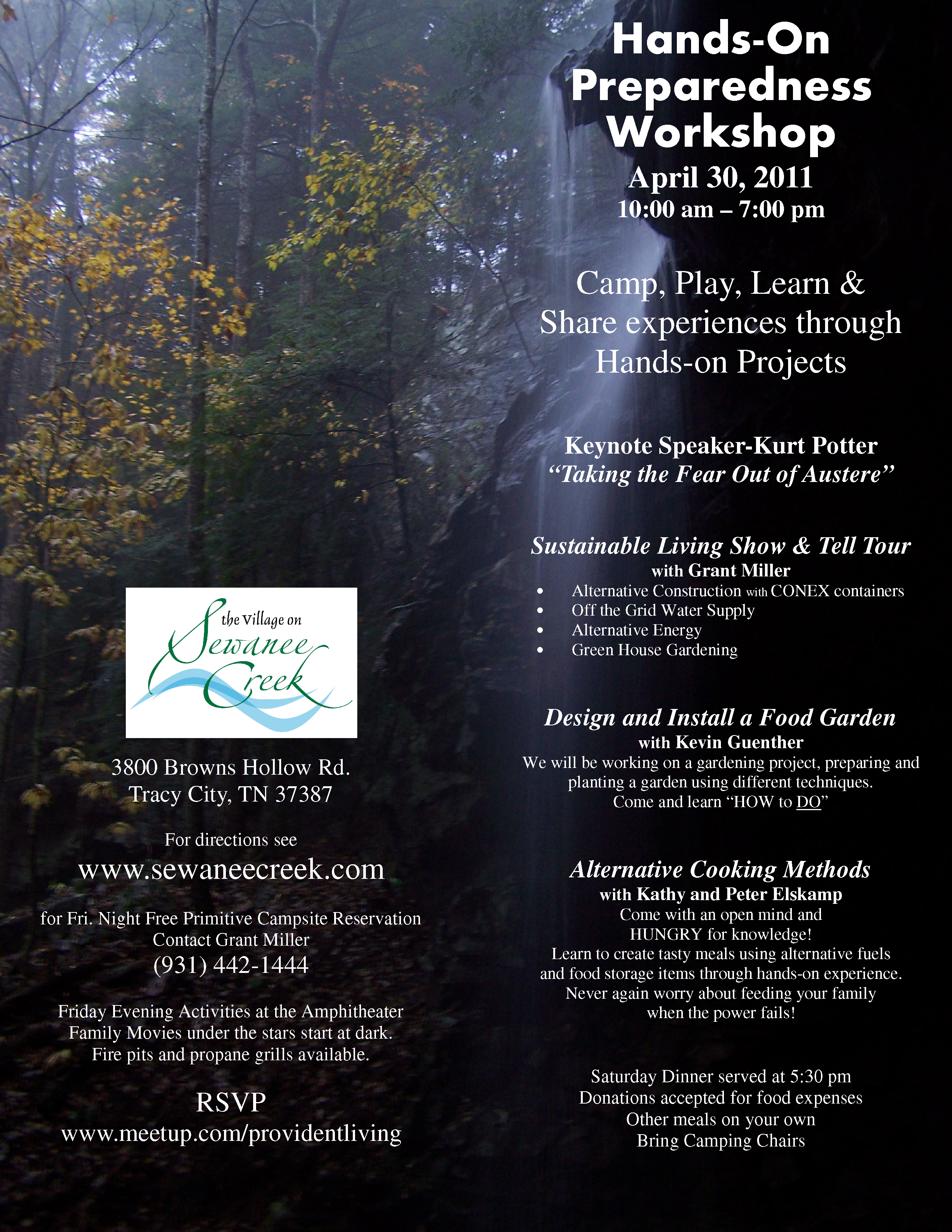
2011 Preparedness Workshop becomes Semi-Annual at the Village on Sewanee Creek

Feedback from our Preparedness fair last July was excellent but with plenty of room for improvement.

On breadth of content, we received high marks.  But because there was so much going on, a lot of folks struggled to get involved in all the activities they wanted to, even with repetition over two days.  Things were tightly scheduled, so people were rushed getting from one venue to the next.  This resulted in the most consistent piece of feedback, the desire to have more focus and depth at the expense of variety of topics.  Incidentally, the fair happened to fall on the hottest day of 2010.

In response to experience and feedback, this year we will have two one-day events, one in the Spring and one in the fall to correspond with planting and harvest seasons.   That should assure comfortable temperatures and it leaves room on the calendar for the Village’s traditional Independence Day celebration.  The name is being changed from Fair to Workshop to reflect the increased focus on fewer activities, but by having two events this year we can compensate for fewer varieties at each workshop.

I am especially thankful that this year, the burden of coordinating, setting up and preparing for the Fair won’t fall on me.  Last year, I spent three full months getting ready.  This year, coordination and most of the planning is being handled by our newest Villager with the help of the Provident Living meetup group out of Nashville.  If you plan to come, please register with the Provident Living meetup group at http://www.meetup.com/providentliving/ Make sure you RSVP and add a comment if you plan to camp on Friday night.

That should be enough background on the main changes.  So, here’s what to expect for our Spring Preparedness Workshop.

To see info about last year’s July Preparedness Fair, click

https://1stvillager.wordpress.com/2010/07/17/hands-on-preparedness-fair-workshops/

or

https://1stvillager.wordpress.com/2010/07/01/preparedness-fair-the-village-permaculture/

or

https://1stvillager.wordpress.com/2010/05/21/preparedness-fair-at-the-village-on-sewanee-creek/

Bashing the Obama/Bush-Military-Industrial-Congressional Complex

Recently there was an Obama bashing post on “Friends of Sewanee Creek” our private website.  It was one of those chain emails that get mindlessly forwarded by people with a particular point of view.  Upon checking Snopes, it was found to be at least a partial fabrication.  No surprise.  One of the site members, a conservative, remarked that he was tired of the Obama bashing.

I responded:

I agree that the energy being expended toward “Obama or ANY bashing” is mis-directed. This is not to say that Obama deserves our admiration or support.  Only that the focus on Obama is a carefully manipulated distraction from the real issues.  Obama is a puppet.  So is congress. Both are dangerous to our liberty and to the peace of the world.

____________________________________________________

The US government and virtually all governments are thoroughly
corrupt from the top down
.

The global military-industrial-congressional complex are collectively the problem because
THEY ARE DRIVEN BY GREED AND POWER.

The global military-industrial-congressional complex are firmly in power because
THE PEOPLE ARE DRIVEN BY GREED AND POWER,
corrupt from the bottom up.

____________________________________________________

Please re-read the statement between the bars and think about it.
It’s simple cause and effect.
No solutions will be evident without a clear understanding of the problem.

Whether overtly religious or not, few people practice Christ’s teachings of charity, love and service either on a personal level or national policy level . Hence, Republicans who are supposedly the party of the religious right continue to support aggressive war and imperialism under the false flag of democratizing the world. But if you listen carefully to their rhetoric you will find the real motives are based on self-preservation of our standard of living over the rest of the world – grass roots greed and power.

No single individual is to blame for the world’s problems. It is all of us together. Therefore, No form of bashing will accomplish anything but distraction from the real problem that lies in each individual heart.

I am convinced that we are now beyond the point of no return where political activism using the levers of democracy can be effective.  Hence, while I pay attention to the theater of politics for cues, I believe that our only salvation is in the moral character of individuals.

Never has the saying, “All politics is local” been more true. We must begin with personal morality and by that I do not mean sexual morality, although it is certainly included.  For an example of effective political action that can turn the tide, I look to Mahatma Gandhi, Martin Luther King, the writings of Henry David Thoreau and especially the example of Jesus Christ.  The most effective non-violent movements start by restoring moral judgment to a large, critical mass of the population.

Short of achieving such a mass conversion, the only solution is to work with converted, small, local communities.  If you can’t control the world, control yourself, then your personal environment. Perhaps if I prove to myself that I can discipline myself, then influence a small community, I can gradually regain the hope that leads to faith that leads to power, to change the world on a larger scale. That’s what Gandhi did. Until then, I have no right or reason to hope for anything better.

Ex-Pharma Rep comes clean, exposes industry corruption

This lady makes good sense.

Sometimes it’s overwhelming to think of all the information on the web that points to evil, controlling, manipulative behavior that loosely falls under the category of “conspiracy theory”.

The thing that deludes people into thinking all this is just paranoia is the myth that all evil is somehow coordinated by a small group of evil doers at the top of a great pyramid of evil.  Then again, maybe organic pyramid structures are a naturally occurring phenomena.

Watch Saturday morning cartoons.  Isn’t it amazing that almost all of them nowadays are based on the simplistic story of a super hero pitted against an arch evil nemesis who is single-handedly out to control or destroy the world?  When we grow up, cartoons are relegated to the world of childhood fantasy along with anything that smacks of cartoonishness.  Out goes the baby with the bathwater.  Ergo, arch-villains don’t exist or are at least an aberration from the norm.  Humanity is basically good, so to think that the mass of people would cooperate in a massive evil scheme is… unthinkable.

I view this a little differently.  It has been my life experience that most people really care about one thing – getting ahead.  That boils down to two words, money and power with their derivatives (fame, beauty, sex, comfort, pleasure, etc.)  I have made it a habit of evaluating motives by looking at where the feet are pointing – actions, not words.

Adam Smith, the father of modern economics posited that there is an invisible hand that moves all mankind in a free market to make efficient choices in their own enlightened self-interest that furthers the good of all through general economic growth.  Having observed the nature of man in general, I suggest that Smith was absolutely correct, except that there are cumulative evil side effects of the invisible hand.  Selfish interests do not produce benign results in the long run.  The uncontrolled quest for wealth and power will ALWAYS lead to corruption.  Stated more succinctly, “Power corrupts.  Absolute power corrupts absolutely”.

While almost everyone knows and acknowledges that couplet as fundamental truth, why is it then, that most people remain so optimistically blind to the fact that big, powerful institutions, with incredible consistency, have only one objective in mind, self-enrichment and empowerment at ANY cost?  The higher one rises within the pyramid, the more single-minded one is required to be in pursuit of the one and only god of money and power.  Those lower in the pyramid not having absolute power are corrupted, but not yet absolutely.

Once you recognize that as a fundamental fact in our fallen world, conspiracy is not a theory, it is the most routinely observable human behavior of all.  Conspiracy is a fact of life for everyone.  Everyone is scheming to get ahead.  Conspiracy is nothing more than the survival instinct on steroids.  Conspiracy is just normal individual human behavior with at least one accomplice.  To posit that conspiracy is only a theory or a symptom of paranoid crackpots is to deny that there is greed or evil in the world.

Since we are on the topic of pharmaceuticals relative to the most common of all human diseases, it seems appropriate to ask, “Is there an antidote?”

The answer is YES, but like many antidotes, it’s tough medicine.  Attempting to kick habits that are not only natural to the human condition, but encouraged by drug pushers masquerading as executives, politicians and officers is infinitely more difficult than kicking heroine cold turkey.  If you decide to make the attempt, you will need a good physician and a support group of loyal friends.

I have a recommendation:  There is a good doctor named Jesus Christ who wrote the book and operates a worldwide chain of clinics.  There are many alternative cures of varying efficacy  developed by prophets, philosophers, gurus and shamans around the world.  Some of them are also good.  At the core, the good ones all practice the same golden rules.  But, for my money, Dr. Christ, GD is the best.

There are also many local support groups.  I’m partial to a network forming at the Village on Sewanee Creek of reforming addicts.  As with all addicts, it’s a constant struggle to stay on the wagon, hence the need for a support group.  As a former senior executive, I can testify from personal experience.

AUSTERE but WITHOUT FEAR – A Message from Sendai, Japan

I lived in Japan for two years (1971-1972) and returned there many many times over the years on business. The Japanese people are amazing.  Since the morning I learned of the quakes and tsunami, I have been in touch with close Japanese friends via FaceBook and Twitter – glimpses of quiet, stoic courage.

A friend forwarded this letter to me this morning from a lady who lives there, but is apparently not Japanese by birth.  Her reflections on life in the aftermath describe what is happening there more fully, simply beautiful. Despite deprivations, this letter recounts people living even more richly than before – on a different level.  It’s amazing to think how different life experiences have prepared me to be where I am today.  To see what life can be, and hopefully will be like in the Village minus the calamities, read on.

_________________________________________________________________________________

Hello My Lovely Family and Friends,

First I want to thank you so very much for your concern for me. I am very touched. I also wish to apologize for a generic message to you all. But it seems the best way at the moment to get my message to you.

Things here in Sendai have been rather surreal. But I am very blessed to have wonderful friends who are helping me a lot. Since my shack is even more worthy of that name, I am now staying at a friend’s home. We share supplies like water, food and a kerosene heater. We sleep lined up in one room, eat by candlelight, share stories. It is warm, friendly, and beautiful.

During the day we help each other clean up the mess in our homes. People sit in their cars, looking at news on their navigation screens, or line up to get drinking water when a source is open. If someone has water running in their home, they put out sign so people can come to fill up their jugs and buckets.

Utterly amazingly where I am there has been no looting, no pushing in lines. People leave their front door open, as it is safer when an earthquake strikes. People keep saying, “Oh, this is how it used to be in the old days when everyone helped one another.”

Quakes keep coming. Last night they struck about every 15 minutes. Sirens are constant and helicopters pass overhead often.

We got water for a few hours in our homes last night, and now it is for half a day. Electricity came on this afternoon. Gas has not yet come on. But all of this is by area. Some people have these things, others do not.

No one has washed for several days. We feel grubby, but there are so much more important concerns than that for us now. I love this peeling away of non-essentials. Living fully on the level of instinct, of intuition, of caring, of what is needed for survival, not just of me, but of the entire group.

There are strange parallel universes happening. Houses a mess in some places, yet then a house with futons or laundry out drying in the sun.

People lining up for water and food, and yet a few people out walking their dogs. All happening at the same time.

Other unexpected touches of beauty are first, the silence at night. No cars. No one out on the streets. And the heavens at night are scattered with stars. I usually can see about two, but now the whole sky is filled.

The mountains around Sendai are solid and with the crisp air we can see them silhouetted against the sky magnificently. And the Japanese themselves are so wonderful. I come back to my shack to check on it each day, now to send this e-mail since the electricity is on, and I find food and water left in my entranceway. I have no idea from whom, but it is there. Old men in green hats go from door to door checking to see if everyone is OK. People talk to complete strangers asking if they need help. I see no signs of fear. Resignation, yes, but fear or panic, no.

They tell us we can expect aftershocks, and even other major quakes, for another month or more. And we are getting constant tremors, rolls, shaking, rumbling. I am blessed in that I live in a part of Sendai that is a bit elevated, a bit more solid than other parts. So, so far this area is better off than others. Last night my friend’s husband came in from the country, bringing food and water. Blessed again.

Somehow at this time I realize from direct experience that there is indeed an enormous Cosmic evolutionary step that is occurring all over the world right at this moment. And somehow as I experience the events happening now in Japan, I can feel my heart opening very wide. My brother asked me if I felt so small because of all that is happening. I don’t. Rather, I feel as part of something happening that much larger than myself. This wave of birthing (worldwide) is hard, and yet magnificent.

Thank you again for your care and Love of me,

With Love in return, to you all,
Anne

More background on Anne:  http://scribbler.ca/?p=192

We have extra land. Anybody want to farm it?

Food security is the ultimate liberty.  If you can do it in  urban NYC, you can do it anywhere.  For some more inspiration, watch this YouTube video.   http://www.youtube.com/watch?v=vDxBEUOImjI

The Village on Sewanee Creek is about 750 rural acres on Tennessee’s lush Cumberland Plateau.  Of that, about 80 acres is cleared land that could be farmed.  Some of it is.  (The balance is either in deep woods or in a deep rugged canyon nature preserve) We have already built a community raised bed garden.  But there’s more.  Either on lots currently owned by Villagers, but as yet unfarmed or on unsold lots.

Want to farm but need land?  We have it and we can help you learn to farm.  Call us at (931) 442-1444.

I like liberals

despite the fact that I am not one.  

I know I’m venturing into dangerous territory, the no-mans-land between opposing trenches.

I am conservative, and cautious, sometimes fearful, repressed, yet sometimes driven.  People like me keep the world from spinning out of control or at least we like to think we do.  We live within our means.  We save for the future.  We plan for the worst.  We are captivated by a steep moral code that puts boundaries around our lives.  Boundaries make us and others around us feel safer.  We’re fairly predictable.  Politically, we demand fiscal sanity; recognition of what is real.  We analyze the data, find trends and, unless we anticipate something huge happening to reverse the momentum, we generally expect trends to continue.

But there’s another side, buried deep inside of me, that cries out to be creative.  It is an irrepressible force that bursts out of its cave from time to time with a defiant roar.  That creative urge demands that I sheer off the constraints, think unthinkable thoughts, and believe the unbelievable, that insoluble problems can be solved simply, damn the data.  A liberal thought might be something like there is plenty of money to go around to feed the hungry, clothe and house the poor from government coffers that can somehow be magically filled simply by printing more money or redistributing it from the rich.  It is an urge that tells me mankind is basically good, that despite the endless trail of failed utopian societies that depended on people to be unselfish, love others more than themselves and share without restraint, utopia is possible and deserves to be attempted yet again.

Fortunately, my primary self reasserts and I usually come to my senses.  I realize that communes where all property is held in common never survive long, not in a pure form.  Almost nobody loves others better than or even equal to themselves even if there have been one or even a few exceptions.  And though I try to be otherwise, that includes me almost all the time.  That’s why I recognize that personal ownership of property is essential.  Without personal ownership, we typically slide into sloth and “poor greed”.  That is, the back side of the greed coin most people attribute only to the wealthy, which is “driven greed”.  In the end, greed is a problem everywhere.  It is not limited by class.

Consider two unlikely questions together.  “Why do I like liberals?” and “How often do arch-conservatives excoriate liberals as the cause of moral corruption and America’s destruction?”  “Rome is falling because of the damned liberals.”  If you hang around Republicans the refrain is familiar.  These two questions together remind me of another odd couplet.  “Why do I love my wife?”  And “How many jokes are there about men who can’t ask for directions, won’t put the toilet seat down and women who refuse to think logically.”  Why do I love my wife even if she drives me nuts?  Maybe it’s because I need her so desperately.  In the balance between the yin and the yang of our profound but natural differences, something magical happens.  Two halves make a whole.  Take away either half and you have . . . a hole.

If we were a culture made up only of conservative accountants, who would plant the beans to be harvested, much less counted?  (That is NOT to say that only liberals are productive, LOL.)  Or, more accurately, who would dream the big dreams, take the leaps of faith, think outside the steep walls, invest their life savings on an impulse that has less than a 1% chance of success, yet ends up surprising everyone with cold fusion?  Those are liberal, throw caution to the wind, faith-driven impulses.  When I was young, my avowed liberal private sax teacher often said I must play with abandon to be any good as a jazz musician.  There is something liberating in being liberal that allows people to abandon reason, take illogical leaps of faith, and come up with something totally unexpected, fresh, new and good.  It is the ultimate expression of faith.

Isn’t it a bit ironic then, that faith in God, is generally thought of as more natural to the politically conservative side of the aisle while atheism is associated with the educated liberal elite?

Of course, the argument favoring the flip side of the yin/yang equation is equally important and, if you are basically conservative, I don’t need to elaborate.  If you’re not, well, you just don’t get it, do you?

That conservative/liberal dichotomy helps explain to me why the art community seems to be disproportionately full of liberals.  I love art.  There is nothing that validates me more than when I feel creative.  I love creativity, whether I observe it in the scientific laboratory, in the tinkerer’s back yard, the artist’s easel or an inspired jazz improvisational performance. 

If I love creativity, how can I help but love and need creative people?  Many if not most happen to have a wide liberal streak running through them.  There’s an old cliché that I think applies equally in love, politics and life.  “Can’t live with ‘em and can’t live without ‘em. 

And so it is; I like liberals.

Top 10 Self-Sufficiency and Survival Skills

These days a lot of folks are thinking about how to survive tough times ahead.  It’s tempting to end your short list after a stash of food, and an assault rifle with plenty of ammo.  Good luck!  In a pinch, it’s not the things you have as much as the skills you have that will be your most valuable assets.  By the way, since it takes years to acquire all the necessary skills for provident, abundant living, I recommend adding COMMUNITY as a pre-requisite to an attempt to become truly self-sufficient.  You will find that the task is much less daunting and the journey more enjoyable if you work with other like-minded people to divide, conquer and share the spoils of your efforts.

Whether you want to move into rural America or stay put in the suburbs, here are some skills you will need whether or not TSHTF.

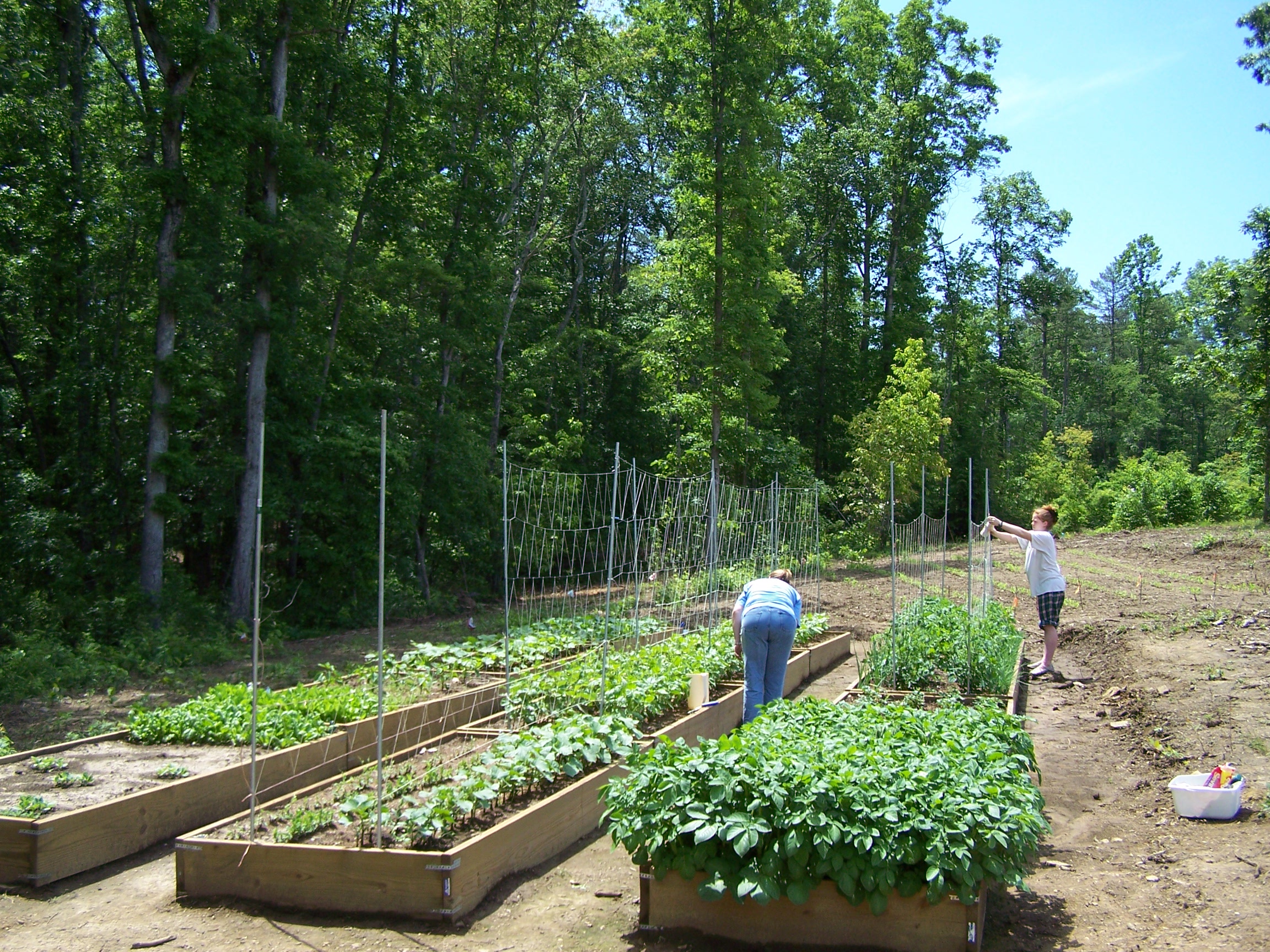
# 1 Grow Fresh, Wholesome Food

Most people have some experience gardening even if it was just watching a bean grow in a Styrofoam cup way back in kindergarten.  But could you live off of what you grow?  It’s definitely possible.  Our first summer garden in the Village provided us with roughly 80% of everything we ate, but we learned in subsequent seasons that doing it consistently can be challenging.   We added a 2,000 square foot green house, intending to grow food year round and found that it was a whole different animal… uh vegetable.  It takes time to build up soil quality, learn what grows best in your area, how to control insects, crop rotation and a myriad of other complex and inter-related issues. 

Fortunately, gardening is the single most popular hobby in the USA, so you know that it’s rewarding and you can swap knowledge with lots of people.  Agricultural colleges operate an Extension Service in most counties where you can get tons of useful, local information and soil analysis.  Local farmer’s coops are a great source for tools, fertilizer and seeds.  But your best source of information will be your neighbors who have successfully grown food for years.  They know local soils and weather patterns and where to buy or trade non-GMO heritage seeds.

Extend your garden with permaculture methods by planting a fruit and nut orchard that will yield abundant crops year after year without tilling and planting.  But start soon.  Developing a productive small-scale farm takes time.

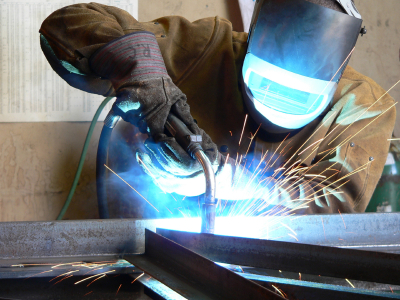
#2.  Learn to Weld

Learning to weld is easy, especially if you use a MIG wire-fed welder. Just adjust the wire feed speed and voltage to match the thickness of steel you are welding.  You can get the hang of it with just a little practice and a few tips from a friend who knows how.  Community colleges often offer inexpensive classes on Welding. One near us is also certifying welders for work at nuclear plants in Alabama and NE Tennessee. 
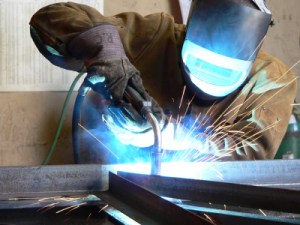
I bought a little 120V MIG welder at Harbor Freight for about $100.  It’s a good idea to stock up on a bunch of flux wire.  Not a bad investment as inflation kicks in, especially on commodity intensive stuff like steel.  I use my little welder a lot and liked it so much that I bought a second one that runs off of 220V current and can do deeper welds.  It was about $180. 

If you haven’t welded before you will be amazed at how often you will use it, whether in a survival situation or just doing some DIY repairs around the house or shop.  Then again, you can barter or start your own small welding business for some extra cash.

For real self-reliance you might want a portable generator/welder combo. You can find these for sale all the time on www.governmentliquidation.com or, just use one of the generators you already have.  When we built the amphitheater stage, we added a 40’ container with massive doors that open to a big movie screen and lock closed to house the barbecue and A/V equipment.  It’s in a scenic, remote location at the Village. My 7KW Honda generator and MIG welder worked great.  I’m now putting the finishing touches on a guest house built from two shipping containers.  If you plan to do any welding on this scale, I also recommend getting a plasma cutter, also available inexpensively from Harbor Freight.

#3 Learn Basic Carpentry and Home Repair Skills
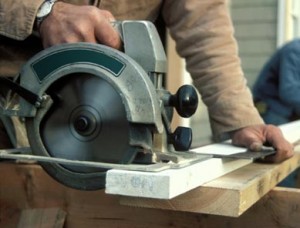
Start with some DIY projects around the house.  Build a deck, a shed or a playhouse.  Building it plumb, square and level are the basics and are easily learned. Ask a friend who has some carpentry skills to help out.  The Amish don’t have a patent on community barn raising.  It’s a great way to learn, build something great in a short time and bond with resourceful friends. 

Any long-term crisis requires these skills.  Even in good times there are plenty of opportunities for the service-minded person to enjoy helping a widow or single parent in need.  I have found there is nothing more satisfying than building or fixing something well.  Carpentry, Electrical and Plumbing skills will all be in demand.  Having learned some of these skills from a friend, if you are the one on the block who knows how to fix stuff it’s your turn to make a lot of friends quickly.

 #4 Learn To Trap and Hunt
Hunting is one of those basic survival skills that have also found their way into mainstream recreation. There are plenty of hunters around.  You need to make sure you are one of them so some of the local game finds its way onto your table and not someone else’s.  This is a skill that takes time to master.  It’s not just about marksmanship.  It requires one to understand the movement patterns of animals in the wild – the where and when of their eating, drinking, sleeping, communication and mating patterns. 

Since we have an abundance of hunting land right here in the Village, it has been easy to barter for hunting lessons with good hunters for the right to hunt here.  I think that’s a far superior learning method to book or video learning because it’s local.  But traditional learning methods have their place too.

Trapping gives you a more reliable, efficient way to get fresh meat.  Traps and snares work while you work at something else or sleep. Traps can cover a wide area. A hunter can sit in a tree stand all day and not see a thing.  If you are more interested in dinner than sport as I am, trapping is for you.

There are a lot of different types of Snares, Live/Box traps, leg hold traps and body gripper traps. Each has a different purpose and different methods that need to be learned for trapping anything from small game like rabbits or squirrels, to large game like deer or feral hogs to nuisance animals like coyotes, beaver or raccoons.

Look for a local Trappers Association and join up for their mailing list, workshops or just some fun outings.

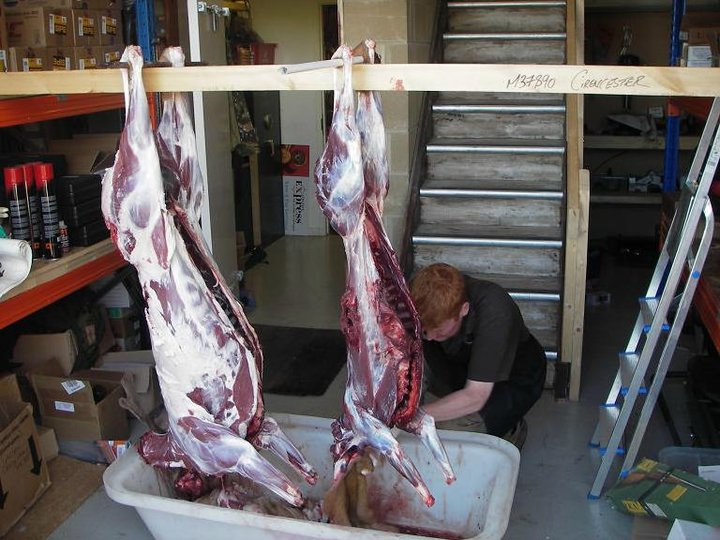
 #5 Learn how to Butcher Animals

This skill is a natural, not only for hunters and trappers.  Near the Village there are several small farms that raise grass fed or free range livestock (beef, goats, chickens, turkeys, etc.) One of our Villagers is an avid carnivore.  He’s in the process of buying more land from me, planning to raise his own beef.  I lowered the price a bit with an option to keep a cow of mine in his pasture land.  Butchering skills come in handy for significantly reducing the cost of bringing your beef (or chickens or wild game) from the field to your dinner table.

The first time I butchered a deer, I was pretty clueless.  It was a partial road kill, with a broken back it limped onto my property and I needed to learn quickly.  That deer made it into my freezer and we enjoyed the venison, but it wasn’t pretty.  Later a hunting friend showed me how.  Learning how to properly butcher and store animals for meat is a skill that everyone wanting to be self-sufficient should have.

 #6 Fish for Food
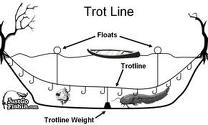
This isn’t about trophy or pleasure fishing where a secondary objective is to have a nice nap in the sun. You need to be able to bring in a quantity of fish reliably and fast.  First, buy and learn how to use trotlines, fish traps and nets.  Then learn how to make your o  wn.

Like trapping, a good trotline can be left to do your fishing while you build a barn or chop firewood.  And when you return, you’re likely to find several fresh fish on the same line just waiting to be fried up or smoked.

In spawning season, many fish will school up and move together.  My wife and I have enjoyed a salmon run on Alaska’s Kenai Peninsula.  Many other freshwater lake and river fish like Walleye, Bass, Stripers and Crappie have similar spawning behaviors you can take advantage of.

Google trawl and gill nets for supplies you need.

Warning!  These techniques may be illegal where you are. Be familiar with local regulations.  But then, if it comes to a choice of a potential fine versus hungry kids, well… you decide.

#7 Gunsmithing – Learn To Repair Guns

For the aspiring Survivalist or Self Reliant person, having a variety of guns for various purposes is a no-brainer, whether for hunting or defense.  Knowing how to clean, repair, site and adjust guns is probably just as important as knowing how to use them.  Any  guy who has been through basic military training remembers that one of the first things you learn is how to disassemble, clean and reassemble your weapon efficiently so it will work properly? No shortcuts when your life depends on it.  Keep basic spare parts for your guns and learn how to fix each one if it breaks.

Many Video’s and Books on Gunsmithing can be found on Amazon or Brownell’s. Pick ones that cover your gun types.

#8 Operate a HAM Radio

We decided early on that having someone in the Village with communications skills and equipment is important.  With the many skills I need to master, we decided another Villager would take this on.  He happens to be my brother who is just finishing his house.  Since he already had his license, this decision was easy.  For now, he has a good portable HAM, but he’s planning to install a fixed unit with tall antenna.  I plan to get my license when I can get to it.  In a disaster, a HAM radio is your communications lifeline to the outside World.  To appreciate its importance, there was a great TV survival mini-series a few years ago called Jericho.  You can find it on Hulu.com.

Last year, the requirements for a HAM radio operator’s license became a lot easier.  No Morse code is required.  A few hours study and pass an online test and you’re on your way.  Then, join a local club for practice and to build a resilient network.

  #9 Advanced First Aid

“Knowing advanced life saving first aid skills should be the goal of every person who is prepping for life.   And I’m talking about skills that go above and beyond those taught in basic first aid classes.

Learn how to treat major wounds, such as a sucking chest wound, until help can arrive. Could you set a broken bone? How about removing a bullet? It’s not as simple as some macho guy on TV makes it look. You’ll have to assume at one point during a crisis, you’re first aid skills will be needed. If not by you, then possibly by a family member or friend. You may be their only hope for surviving.”
The Survival, Emergency Preparedness and Self Reliance Blog

  #10 Small Engine Repair
Small engines provide most of the power that makes self-sufficient living enjoyable and even doable for folks of our time.  As I look around our homestead, I’m surprised to count the number of small engines I use.  (Chain Saws, 4-Wheeler ATV, Generators, Pumps, Air Compressors, Saw Mill, Rototillers, and the list goes on)

Knowing how to repair any of these small engines is a huge plus because it seems they’re always breaking down.  Because we’re in the country there are a number of small engine repairmen I can and do depend on, many more per capita than you would find in a big city.  Most people around here use small engines a lot.  But in a crisis situation, good repairmen may be overwhelmed.  Your local community college may offer classes on basic and advanced small engine repair. Once you’ve learned the basics, the rest is a piece of cake.

Auto repair has elements of Small Engine repair skills, and I’m tempted to include it here, but in a real crisis I’m thinking of getting back to alternative modes of transportation.  Automatic transmissions or sophisticated electronics built into most newer model cars are way beyond the reach of today’s shade tree mechanics.  If I can fix the small engine on my 4-wheeler that will get me by for transportation within a ten to fifteen mile radius, that will do, especially if I have more than one vehicle.  I do have an older model 4-wheel drive stick shift, carbureted vehicle.  It’s great for off-road use or on icy roads.  And, for those wanting to be prepared in case of an EMP attack, it has no sensitive electronics that could be fried by a massive pulse.  For this older vehicle, small engine repair skills will get me a long way.  Then, of course I could go back to horse and buggy days as some around here do.  I know where to buy a saddle horse for almost nothing.  Come to think of it, where the cost of gas is headed, that might not be a bad idea.

At a minimum, you should be able to change a tire, and change out parts that frequently break like starters, alternators, water and fuel pumps. If you can’t do these simple chores, you’d better have money or another vehicle to rely upon should one go down.

This is my top 10 list.  It is only the start if you want to be truly self-sufficient.  To give credit where credit is due, I got inspiration for this article from a like-minded blogger on The Survival, Emergency Preparedness and Self Reliance Blog.  My list is a bit different from his, so you might want to visit there for more ideas and a different slant.


#11 Food Preservation

Yes, there are many other important skills I couldn’t squeeze into the top 10.  I’ll sneak in one more.  Food Preservation is really important because in most climates your winter garden won’t satisfy all your needs for fresh food.  Food preservation includes Canning, Smoking, Dehydrating, Salting, Pickling, Root Cellars, Refrigeration/Freezing and much more.  Maybe I’ll do a list of the next 10 another time and lead off with this one.

The Religion of Science

Is Science the new opiate of the “educated’ masses?

In our time, Science has generally replaced religion as the accepted means of understanding truth.  Religion has been discredited in our secular world, not only as a means of finding truth.  It is regularly vilified as a dogma that produces conflict, war, and the plundering of the planet.  Religion is redefined as dogma that stagnates thought and impedes the advancement of mankind.  In many “progressive” circles it is held as the source of all things evil.  Science is the new religion of our time and applied technology (light bulbs, micro-wave ovens, i-phones, computers) its proof, our Bible.

It has been twenty years since the announcement of “cold fusion” at the University of Utah. MIT scientists and government researchers exaggerated its death and prematurely buried it.   Now still unexplainable yet real experimentation results are exhuming this science from the grave.  Immutable truth has a habit of haunting those who discount it for fun and profit.

Look beneath the surface.  The serious inquirer discovers that imbedded within this drama are all the important questions about man’s search for truth, good versus evil, the corrupting politics of power and greed, human nature, faith and God.  These two YouTube videos, Cold Fusion Suppressed Technology (http://www.youtube.com/watch?v=htgV7fNO-2k&feature=related ) and Cold Fusion – More Than Junk Science (60 Minutes, CBS News ( http://www.youtube.com/watch?v=JyNn_Z6wCIk ) do address the scientific methodology as a proof of viability, but the important message is that beneath the methods, the sine qua non of any search for truth are motives, morals, integrity and values.  Absent this, we see the same dogma stagnation, manipulation of the masses for profit and power and rape of natural resources that have been seen as the province of “organized religion”.  Perhaps the new high priesthood of science based in government granted University research should be relabeled “organized science”.

But I digress.  Is morality not the realm of spirituality and religion?  I’m not speaking of the corrupted form of religion, manipulated by despots throughout time, but the religion of humble seekers of eternal truth.  The questions for our age are,

  1. Absent moral purity, can science be trusted any more than religion?   
  2. How can you tell if there Is underlying integrity?

And the answer just might be the modern maxim, “follow the money”.  The increasingly cynical masses have come to trust the wisdom that money leads to power.  Power corrupts and absolute power corrupts absolutely.  An unfortunate conclusion is that everything is corrupt, including religion, government, corporations, wall street, labor unions and the last bastion of credibility, the new religion, science.  The masses have thrown the baby (religion) out with the bath water.  With the current levels of cynicism it is conceivable that the same could happen for all other institutions including science where no one trusts anything.  Faith is dead.  This would truly be the cataclysmic end of the civilization foretold by prophets of doom.

The quest for knowledge of truth is personal and lonely.

The question I often ask myself and others is, “How do you know that?”  The answer is usually discomforting.  We must all rely on someone else’s first hand observations and analysis for things that we don’t personally and regularly touch and feel.  (Leave aside, for the moment, whether we should trust our own observations and feelings.)  That reliance is called faith whether exercised in the spiritual or scientific realm.  Because we individually lack the training and knowledge to assess the truth of almost everything, we construct means of creating credibility analogs. 

When a technology reaches the state of mass production where virtually everyone experiences its effects, then everyone universally accepts the scientific explanations that underpin it.  Yet few and sometimes no one really understands the basic physics of those explanations.  What’s more, even the science that purports to explain the phenomena often shifts under our feet as it discovers new “knowledge” that modifies the old.  This begs the question, “what do you know”? . . . . Really.

Conclusion:
So, how do we avoid a second coming of Noah’s deluge in the form of babies in bathwater?  In the end, science and religion are in many respects different sides of the same coin.  Each seeks to unwrap the mysteries of truth, each through a different process and each focusing on different areas of truth. 

The holy grail of science is the process that can be peer reviewed and most importantly, replicated under controlled circumstances, usually by a few qualified, knowledgeable scientists.  The masses then read the results in their text books and believe them to be true.  Their method of validating truth is two-fold. 
First:  Primary, personal experience with observable phenomena.  Flip a switch and the light comes on. Tune the radio and hear the music. (Yet understanding of the physics of electricity or radio waves is typically shallow to non-existent).
Second:  Vicarious faith in the prophets of science, and their disciples.  This faith is based on second-hand evidence, analogs for trust:  Nobel prizes awarded, credentials at prestigious research Universities, acknowledgement from peer reviews, and for the masses, talking heads in popular TV, newspapers and books.  For the average person this faith is in nothing more than a popularly accepted dogma.  It is no different than the religious faith exercised by the masses of the Middle Ages.

The scientific method of religion for the individual is similarly two-tiered.
First, primary, personal experience with the results of experimentation:  Pray for an answer to an intractable problem and receive an understanding that is enlightening or comforting, outside our normal thought process and unexplainable other than through the whisperings of the spirit.  Exercise faith and witness a healing of the body, or often more importantly, the soul.  Give generously of your means and love and reap the benefits.
Second, the testimonies of trusted people that we know personally, or the stories written long ago in scripture.

In either case, the personal inputs upon which people base belief are the same.  In both cases, adherents will swear to a knowledge of the truth of their conclusions. 

Today’s popular wisdom chants Karl Marx’, “religion is the opiate of the masses”, a means to wealth and power.  It’s an outdated slogan since that baby is out the window a long time ago in most 1st world nations.  A time will come, perhaps soon, when people begin to understand that science has its own false prophets.  These evil people have mastered the confidence game for power and profit but care little for the improvement of people they are meant to serve.  They care even less about truth other than that which results in personal gain.  Just as religion has been subverted, so can science.  Science is the new opiate of the “educated” masses who are educated with scientific dogma but lack wisdom. 

Perhaps, when people understand the vulnerabilities of science they will begin to recognize that science and religion are indeed, two sides of a multi-dimensional coin.  It is a coin that can be used for good or evil and a coin that, to have value, must seamlessly incorporate the strengths of each and root out the corrupting virus that is man’s quest for money and power over truth.

It seems to me a great irony that during the dark ages, utter contempt for religious beliefs was primarily the province of tyrants.  They were the ones who manipulated religion to justify and instigate unspeakable horrors in the name of God while the masses were unwitting but sincere followers of the tyrannical “keepers of the faith”.  Today, it seems a majority have embraced contempt for religion, resulting in a scramble to adopt tyrannical values.  Hence, we can trust no one.  Would that everyone embraced godly values that would form the basis for trust and discovery of truth through science, religion, meditation, philosophy, historical perspective or any method that gets us closer to the truth.

Yesterday was a great day!

Our kids are home at the Village. 

Over the past few weeks we took an epic car trip from Tennessee to San Diego and back, stopping to see our older kids in Wichita and Mesa, Arizona along the way.  We met our son, Jonathan, who was finishing his truly epic 4,000 mile charity bicycle ride from Virginia Beach down the East Coast to Florida and across the USA to San Diego.  http://nuttyputtycyclers.com/updates

While in San Diego, we enjoyed seeing old friends and family and meeting new ones.  I downed the biggest burger of my life at Hodads in Ocean Beach and relived memories of my youth surfing.

On the return, we routed through Provo, Utah where we picked up our daughter from BYU and drove straight through, no stops, rotating drivers.

Whew!!!  We’re home.  We miraculously missed the Eastern severe cold and snow that happened while we were enjoying 85 degree weather in San Diego.  And, we dodged another bullet, returning home as Southern California is being drenched in record breaking rain.

Yesterday brought us all back down to earth as we were priviledged to help pass out huge boxes of food to the needy at the Grundy County Food Bank.  I had the best job, walking customers to their cars, pulling large carts bearing food and re-packing it into their cars.  It gave me the chance to listen to their stories.  One very elderly lady made my day when she told me how grateful she was to all the volunteers who made life possible for her.  Another younger woman with three kids had recently found housing.  She is a registered nurse who had been rendered homeless after a car accident that left her incapacitated, unable to work. 

As I worked, the thought occurred to me how wonderful is this country we live in!  Even where there is great poverty, I witnessed plenty, where great quantities of food were contributed from abundance by local merchants (including Walmart and many smaller contributors) and many local citizens turned out to assist in its distribution.  Each of some 300 families left with enough food for close to a month.  How wonderful!

There is still so much good in people and in the world.  My heart sang and my spirits were lifted.  Merry Christmas to all! 

Thanks to my dear wife, for getting us involved with the Food Bank.  She is the heart and soul of Christmas, not to mention my life.

Am I John Galt?

An article about the Village appeared on Huffington Post about a year ago.   Yesterday, I happened to revisit it and found a number of appended comments.  Most were surprisingly angry and critical.  I was at once both amused and troubled.  On this site, having formerly been an executive is apparently an unredeemable sin.  I was also accused of having spread the disease of American fast food.  Of both charges, I plead guilty.  I trust in Christ for a redemption of my sins whether in or outside of that role, but I hardly believe the role itself to be damning.   On the other hand, I was mildly amused at the self-righteous, hypocritical tone of those who castigate the food industry.  I say, “who among you”, especially in the liberal New England home of Dunkin’ Donuts, “has never partaken of the forbidden fruit?   Let him cast the first stone.”  Not to mention pancakes, ice cream or pizza, for which I also stand double guilty as accused and to which I will probably remain addicted until my dieing day. 

One comment suggested I was a Galt.   “Who is John Galt?” is the iconic line from Ayn Rand’s Atlas Shrugged.   And so I echo the words of the apostles at the last supper, “Is it I, Lord?” 

I think not.  But then again, there are elements. . .  

Galt calls for a strike against socialist collectivisim. He makes a stand for creative, productive people vs. the “entitled”, indolent masses.  I call for cooperation and (quasi-socialist, that’s voluntary) sharing within a community of independent, self-sufficient, yet selfless, caring people. 
Galt calls for enlightened selfishness with perhaps a subtext of entitlement to luxury and materialism.  I call for people to live a simpler life, voluntarily sharing their wealth with others, including the wealth of nature and the wealth of their knowledge and intellect while enjoying the fruits of both mental and physical labor.   Our town is not gated, however, as we seek to include the local folks within our circle of self-sufficient friends and benefit from their local know-how.  Nor is it an exclusive enclave for the wealthy.

On the other hand, Galt does call for people of extraordinary talent, education, creativity and resourcefulness to band together to enhance their lives and so do I.

And Galt sets up a community for like-minded, creative people known as “Galt’s Gulch,” a town secluded in a Colorado mountain valley.  Hmmm, the Village is built on the Cumberland Plateau, locally called “the Mountain” and Sewanee Creek runs through the Valley we own.  Perhaps, in some respects, I’m galty as accused, and for these “sins” I hope to become a little more galty by association.

My son is a wise goose!

This morning I giggled with joy to read my son’s BLOG and find that he has learned to be as wise as a flying goose.  He is making a cross-country charity bicycle ride for young widowed mothers and fathers with children.  You can read his BLOG at http://nuttyputtycyclers.com/general/oct-9-2010-flat-tires-tan-lines-and-shark-teeth-2

But first, let me explain why flying geese are so wise:

The Wisdom of Flying Geese

In the Spring, when you see geese heading North for the Summer or South in the Fall, flying along in “V” formation, it’s interesting to know what scientists have discovered about why they fly that way. It has been learned that as each bird flaps its wings, it creates an uplift for the bird immediately following.

By flying in “V ” formation, the whole flock adds at least 71% greater flying range than if each bird flew on its own.

 Basic Truth #1– People who share a common direction and sense of community can get where they are going quicker and easier because they are traveling on the thrust of one another.

Whenever a goose falls out of formation, it suddenly feels the drag and resistance of trying to go it alone and quickly gets back into formation to take advantage of the lifting power of the bird immediately in front.

Basic Truth #2– If we have as much sense as a goose, we will stay in formation with those who are heading in the same direction as we are.

When the lead goose gets tired, he rotates back in the wing and another goose flies point.

Basic Truth #3– It pays to take turns doing hard jobs, with people or with flying geese.

These geese honk from behind to encourage those up front to keep up their speed.

Basic Truth #4– We need to be careful what we say when we honk from behind.

Finally, when a goose gets sick, or is wounded by gunshot, and falls out, two geese fall out of formation and follow him down to help and protect him. They stay with him until he is either able to fly or until he is dead, and then they launch out on their own or with another formation until they catch up with their group.

Final Truth- If we have the sense of a goose, we will stand by each other, protect one another and sometimes make new friends who seem to be going in our direction.”   http://www.noogenesis.com/pineapple/geese.html

We want to build a community of wise geese, here at the Village on Sewanee Creek.   Are you a wise goose?  If you think so, we’re recruiting!

Wisdom

Solomon of old asked God for one thing, Wisdom.  Having been granted his prayer, he is acknowledged as one of the wisest men of all time.

I believe that wisdom is NOT the ability to think wise thoughts.  Wisdom is actuating knowledge of truth.  Wisdom is in the living, not in the thinking.

Until one lives truth, true thoughts are little more than electro-chemical impulses of the brain.  Noble thoughts though they may be, failure to live by them will condemn rather than redeem us. 

James 1:5
If any of you lack wisdom, let him ask of God, that giveth to all men liberally, and upbraideth not; and it shall be given him.

Conclusion:  I must pray much harder for the wisdom to ACT in truth, for I know that my behavior falls far short of my best thoughts.

Hands-On Preparedness Fair – Workshops

Our call for highly qualified workshop leaders has been answered in spades.   The quality and diversity of topics to be covered at the Fair on July 23-24 is outstanding.  See some of my older posts for a flyer and overview.  Here is a sampling  Preparedness Fair Schedule 7-24-2010

A sequence of three presentations, starts with
Permaculture Design and philosophy, (Saturday @ 10 am)

Permaculture is a design science that takes a whole-ecosystem approach to sustainable development. The term, Permaculture, means permanent agriculture and permanent culture. Permaculture developed in Australia in the late 1970s, by Ecologist David Holmgren and Natural History Professor Bill Mollison, and has since spread throughout the world. Leaders of the sustainability movement are applying Permaculture principles and design methodologies to everything from gardens, home sites, village designs, businesses, and entire regional economies.

Participants will be introduced to a unique tool that incorporates natural design systems into problem solving on multiple levels. Design Resource will offer future classes with in depth studies on topics like energy, food, healing aspects of the landscape, community networking and financial permaculture                                              

 BACKGROUND:   Kevin Guenther is a registered landscape architect, Leed AP professional and certified permaculture designer who has focused his consulting business (Design Resource) on sustainable design

Followed by:
Foraging and Gathering Food and Meds  (Saturday @ 11 am)

Hike through our 500 acre natural preserve in Sewanee Creek Gulf:  Foraging for food and Medicine is the 2nd hour of the permaculture presentation                                                                                                   

Workshop leader, John Rose says, “I work very much hands on, and each location I visit is different. There are a few guidelines common to the practice of safely interacting with anything in nature, whether it is wild plants, wild animals, weather, the elements in general, and ones approach to them.  Includes a general document that will help clarify these things.  I will also include a list of items that are useful learning tools such as a good small notebook with pen, or pencil for drawing and describing plants in their element.  This same notebook can be used as a nature journal for keeping track of such things as time of year, environmental conditions, weather, terrain, and many other aspects, all important to correctly identifying a plant at any given time of year, and under varying conditions.  I will look at not only edible and medicinal plants, but also poisonous plants, and plants that have other utilitarian uses for such things as fire starting, cordage, shelter, and other things.”

And third in the sequence:
Preparing Foraged Foods and Meds  (Saturday @ 2 pm)

Dr. Christina Berry adds that simply identifying edible plants and meds won’t get you far if you don’t know what to do with them.   This workshop will teach about preparing foods and meds from the foraged vegetation found on your foraging journey. Preparations of tinctures, teas, salves and syrups will be made and explained. Discussions of the use of different herbs for different treatments will also be discussed. Resources will be provided for further research.

And there will be much more.  Other workshops include:

TVA’s energy expert, Les Hartman and Village founder Grant Miller present
Alternative Electricity Generation Options.  (Saturday @ 9 am)

Understand available options, pros & cons of each, cost/KWH range, personal work cost, etc.    Understand options for grid tie vs. local battery storage.  See various electricity production options including water, PV, a Lister Diesel Generator and Wood Gasification.

Delve deeper into PhotoVoltaic Solar electricity with George Horrocks, chief design engineer with Tennessee’s largest PV installer.
Power from the Sun  (Saturday @ 10 am)

 Learn the Basics of Producing Electricity from the Sun and Why There has Never Been a Better Time to Go Solar. Whether you want to lock in your energy costs for life, clean and green the world, have backup security when the grid goes down, or see solar as a revenue generator for your family or business, with the price reductions of nearly 50% for solar in the last two years, coupled with incentives in the form of grants, tax credits, and TVA’s Generation Partners payments, now is the “perfect storm” of opportunity to install a solar array.

First on the priority list for preparedness is water.
Rain Water Collection Systems Tour and Demonstration  (Friday @ 3 pm & Saturday @ 1 pm)

Join Paul Owen of Nature’s Tap for a tour of the Miller Home off-grid system.  Understand the benefits and costs of setting up a Rain Water Collection System that can reliably supply all of your water needs.

Then explore options for Water Purification with George Miller,  water quality lab manager for the Palm Springs/Coachella Valley Water District via internet link from California. (Saturday @ 1:30 pm)

Discuss water purification options including filtration, chemical, UV, distillation, etc.    Learn the best use of water from various sources, its treatment primarily for drinking, and its storage.

What about food?
Tour the garden, greenhouse and orchard with permaculturists and gardeners.  (Friday @ 5pm & Saturday @ 1pm) Explore your questions about self-sufficient gardening.  Then learn how to prepare food, observing dutch and solar oven prep’s.  (Saturday 11 am through lunch).  Enjoy tasty BBQ catered from local restaurant, Holy Smokes and learn how to preserve meat and fish by smoking, drying and making jerky.
Sample some local favorites while observing the process of milling wheat for bread, home-made yogurt from milk and tasty jam from local berries.

And you can Can.  Learn how with Carolyn Park and Becky Miller
“Food Preservation Made Simple, Quick and Easy, By Dry-Pack Canning Method”  (Saturday @ 11 am)

CLASS OBJECTIVE:
Have a hands-on experience while learning a proven food storage method.
PARTICIPANTS WILL…
-Learn how to properly can foods such as whole grains, legumes, sugar, and other dry foods.
-Participate in a step-by-step process for canning and sealing dry food in #10 cans and mason jars without the use of electricity.
-See how proper food storage can extend food shelf life for up to 30 years.
-Obtain handouts to help you gain the knowledge to build your own food bank and become food secure.
DISPLAYING:
-Other Food Preservation Methods
-Equipment
BACKGROUND:
Carolyn and Becky have had life long experience in gardening and food preservation. Experience was drawn from three generations of family farming and homemaking.  Recently they have focused on long-term food storage to promote family sustainability and wellness.

“But wait, there’s more”   🙂

  • For hunters or wannabe hunters, expert hunter Bob Blackburn will host a round table discussion on hunting in the Tennessee Woods.   (Friday @ 7:30 pm)
  • For self-defense, expert Brad Bleasdale will present a two-hour course entitled “Choosing and using a Pistol for Defense”   (Saturday @ 10 am)

This Class will cover gun safety, types of handguns, how to eliminate “caliber confusion”, holsters, lights, and lasers, and a host of other topics.
Designed for people considering a pistol, or as a refresher for those who already carry.  Perfect for women, youth, or novice shooters.
Class will include hands-on instruction, and range time with a certified shooting instructor.  Gun and ammo will be available for those without.
Children are welcome but must be accompanied by an adult.

Bio:  Brad Bleasdale is a lifetime shooter and shooting instructor.  Blessed with the heart of a teacher, Brad teaches novice and intermediate shooters the basics of firearms safety and competence.  Brad has instructed hundreds of people in the safe and effective use of firearms, with specialized classes for women, youth, and church groups.
$10/person or $25 / Family.  MUST HAVE:  Eye Protection (sunglasses are fine), ear protection, folding chair, notebook, water.   Bring your own Handgun and Ammo

Alternative HealthCare for mind and body.

  • Start with a 2-hour Native American flute lesson that will soothe and heal the soul, by renowned musician Tony Gerber.  This hands on instruction includes a Native American Flute, all for just $60. (Friday @ 4 pm)
  • Take care of the physical you with a discussion of holistic healthcare methods that have worked for you.  Remedies for every day live.  This round-table will be presented by Dr. Cliffton Brady.  (Saturday @ 1 pm)

Entertainment and Fun

  • Enjoy a movie under the stars at the 26′ wide Village Amphitheater.  Bring your own steak or hot dogs to grill for an outdoor feast.
  • Groove to the jam session sounds of “Space Craft”  (Friday Supper, Saturday Lunch)
  • For the young in body and spirit, learn to rappell off the cliffs near Miller’s Falls with certified instructor, Jesse Gainer or play Village Games with Haley Blackburn.

And that’s just a sampling.  So much to learn and do.  So little time.  Come, join us for the first annual Preparedness fair at the Village on Sewanee Creek.

10 Best Places to Survive in America

One of our villagers just sent me a link to this blog
http://survivalpreparednessblog.com/10-best-places-to-survive-in-america/comment-page-1#comment-104

Unconventional among “10 best places to live lists”, it focuses on places to survive that are rural and the #1 criteria is CHEAP land.

While the Village doesn’t qualify as having the cheapest land in America, I happen to think that the higher cost at Sewanee Creek is offset by quality of life in a planned retreat where you surround yourself with instant community with like-minded people who are committed to helping each other learn to be self-sufficient. 

There’s an old saying about being penny wise and pound foolish and getting what you pay for.  Cheap land may not be the defining factor if you have spent your life behind a desk and lack the necessary skills to go it on your own.  Even for folks that are die-hard outdoorsmen, going off-grid alone is a tough way to live.

Otherwise, I like their logic.  Mountainous, remote, moderate weather, good local and natural resources.  His #10 pick is just a few miles away from us and he cites the natural beauty of the area. 

Overall, I like this BLOG.  What do you think?

Preparedness Fair @ the Village – Permaculture

Permaculture Design Class 2010I’m excited to announce one of the presenters at this year’s preparedness fair at the Village on Sewanee Creek.  Kevin Guenther is a renowned sustainable landscape architect from Nashville.  He will be presenting on the Permaculture ethic, how it is both a community building mind-set “PERMAnent CULTURE” and a method of low impact, productive agriculture, “PERMAnent agriCULTURE”.    I’m attaching a flyer for one of Kevin’s paid courses on the same topic.  Permaculture Design Class 2010

Segueing from Kevin’s presentation, we plan to do a walkabout tour of some of the 500 acres in our Nature preserve to discover naturally occuring “permanent” food and med’s. 

Finally, what to do with those natural treasures?  We will prepare some of these into edible dishes, topical ointments, or other medical remedies.  Practical, hands-on information you can take home and use.

For more information about this year’s Preparedness fair go to https://1stvillager.wordpress.com/2010/05/21/preparedness-fair-at-the-village-on-sewanee-creek/.

A time for Conservation

As we helplessly watch the destruction of the Gulf of Mexico and surrounding shoreline communities I am reminded of how important it is for each of us to be good stewards of the earth God gave us.

In the ecology of the earth, there is a delicate balance between species, filling each niche precisely. But change is constant and natural. Not to worry. Thankfully, as changes in climate or habitat occur, and any given niche is vacated, it is usually rapidly filled by other plants and animals, maintaining a delicate balance. But when massive destruction of habitat occurs we are the losers. The beauty of our earth can become a wasteland.

In times like this it is easy and tempting to point fingers at BP and government or business in general, blaming all our ills on others. But there is plenty of blame to go around. These are times when we should ask, “what am I doing to be a good steward of this earth?   Am I blameless? ”

One of the ways you can support the conservation of the earth is by keeping large tracts of land and eco-systems in their natural state. That’s not economically possible for most folks, but in the Village on Sewanee Creek, we are offering a way to economically contribute, own and enjoy. By setting aside 500 acres of rugged country as a nature preserve, we not only conserve the earth, we are saving a place for the enjoyment of ourselves and our children.

I often wonder if people truly appreciate the value of this space we are preserving.  The Cumberland Plateau is some of the most bio-diverse land in North America.  Of course, everyone wants things at the lowest possible price. So, when I get comments that Village land is too expensive, I wonder if they are connecting the dots. I wonder if they understand that by purchasing a piece of ground here, whether it’s an acre or ten acres or more, they are sharing in the benefit of 500 acres of pristine woods, waterfalls and creeks. They are acquiring and protecting these things not only for themselves but for the health of this earth. When one considers value in this context, land in the Village is a tremendous bargain.

Like-minded vs. group-think

Working towards creating what some would call an intentional community, I am often told by interested folks that they want to live with “like-minded” people.  Since I learned early in life that words often don’t mean the same thing to different people, I have been interested to know what “like-minded” means.

Does it mean?:

  • We agree on everything?
  • Faced with similar situations we always come up with the same solution?
  • We have all the same beliefs on politics, religion and other controversial topics?
  • Our world view is identical as to the cause, effect and solutions for evil or social injustice?
  • We are focused on achieving all the same objectives?
  • Our methods for dealing with problems are the same?

If any of the above represents a proper definition of “like-minded”, I fear that finding any two like-minded people in this world may be a daunting task.  Even within a group of devout believers of a narrow religious sect, reaching complete unity of thought is extremely difficult as illustrated by the failure rate of intentional communities when group or leader-imposed unity of thought and action is the single-minded goal.

So, while living with like-minded people sounds like a nice place to be, in practice it is difficult to define, let alone live. 

Take “like-minded” in another direction and I also wondered if it might mean “group-think” in a negative sense.  Is it healthy for everyone to think the same?  Think lemmings.  Think Jonestown, drinking the cool aid and mass suicide.  In these cases, wouldn’t independent, rational thinking have been a better solution?

Does that mean we should abandon the notion “like-minded” altogether?

 I think not.

What brings “like-minded” back down to earth from the ethereal heights of utopian ideal is its interpretation in terms of broad principles instead of detailed tactics.  When people deeply share and are committed to good principles and values like honesty, sharing, love, service to others or unselfishness, their daily actions reflect their core thoughts and beliefs.  They may define themselves politically as conservative or liberal, Republican, Democrat, Libertarian or hold even more extreme or unpopular views.  But if they choose to treat each other with deep respect, love, concern and they choose to serve one another with all their hearts, why should it matter that we hold different views on issues outside our immediate relationships?  These differences are the things that bring spice to a conversation, enlightenment to a thinker, breadth and depth of thought.  The unchallenged mind is a lazy mind.  Let us, therefore, welcome diversity of thought, but strive for unity in purpose, values and principles that uplift and build us as individuals and as a community.

This kind of “like-minded” is something to like.

A Life Transformed – Part 2

Part II: Dreams

            My summer in the garden changed my vision for my future almost entirely. Things about which I had rarely thought suddenly became central to my idea of happiness. Food was one of those. Being blessed with the opportunity to eat so much whole, real, home-grown food has deeply convinced me of its importance. In just the past few years since we moved here, my family has developed a simple, but unique food culture that gives me a physical, tangible connection to this place as I move on to college and other chapters of my life. I’ve even told my parents that for my graduation present the only thing I want is a supply of our home-canned vegetable soup mix, salsa, Mom’s apple sauce, and, of course, green beans. My everyday breakfast of homemade yogurt and the delicious mainstay of homemade bread with homemade strawberry jam are traditions I plan to carry on. I’ve learned here how powerful food, especially whole, healthy, real food, can be to bring families and communities together.

            Now, when I look at my family’s garden, I see a great deal more than plants that give me nourishment. I see a visual representation of my connection to my family and to this place and of my own personal growth. I see a teacher that has many more lessons for me, lessons about simplicity, gratitude, humility, discipline, perseverance, respect, inner peace, the importance of connections, gentleness, caring, observation, hard work, independence, and love. I truly believe that, as Masanobu Fukuoka teaches, “The ultimate goal of farming is not the growing of crops, but the cultivation of human beings.” Growing food is about growing yourself.

            But most exciting, when I look at my garden I see my dreams for the future connections I hope to share between myself, the land, and my own family. When I look at the corn field I can hear the taps of my toddlers’ feet and the excited squeals of their game of “peek-a-boo” between the stalks. I can imagine their dad calling them over to help him stuff one of his old shirts for a scarecrow and a precocious 3-year-old telling them they’re doing it wrong. I can see myself buried in a mass of green bean vines until I feel a tap on my shoulder; my little son’s face is glowing with pride at the huge carrot he has just picked. I look now at the tiny fruit trees we planted a year ago and imagine them tall and strong enough to hold little climbers eager for the first ripe apple of the season.

My glimpses have spilled over from the garden spot to encompass all of our land. I envision a driveway lined completely with blueberries and raspberries, flowerbeds filled with sweet potatoes in front of the porch. The house itself is very small, but always warm and filled with light and laughter and people rushing in and out. I can feel the rush of summer air as someone opens the back door to bring in another basket of green beans to snap. “Grandma” is taking a batch of her famous whole wheat bread out of the oven (the smell is to die for) and “Grandpa” is sitting in an armchair serenading us with his saxophone. Someone hops on the piano bench and it becomes a regular jam session. It’s harvest time, and there are tables set up everywhere for slicing cucumbers and peeling peaches. My brother and his wife are there canning their peaches and pickles with us. More probably gets eaten than goes into the bottles, but there’s more than plenty. With all of the grandparents, aunts, uncles, and cousins, there are several conversations going on at once. The floor is kind of sticky in spots from where someone has absent mindedly knocked over the syrup for canning peaches. In the evening everyone helps clean up the kitchen and take dinner out to the back porch, where we sit until sunset.

            In my dream all of the people who mean most to me share my love for and connection to the land on which we live. I’m able to instill the importance of that connection in my children, and our whole family grows together through our experiences in the garden. It’s an important bond that we share and the memories of our summers together shape us all and keep us coming home, no matter what other far-ranging adventures life may have in store for us. We are made of this place. The very food we eat is made of the love we put into the garden. The garden is a place of Renewal from life’s stresses and hardships, Freedom from the pressures of the world, a Place to call home, a Refuge from pain, the Memory of golden days, the Peace of silence, the laughter of a Community, the promise of Justice, and the Transformation of the soul.

A Life Transformed – Part 1

My lovely daugther just graduated from St. Andrews Sewanee School (SAS), valedictorian of her senior class.  Her experience at this outstanding school was transformational, but that’s not what this is about.   She just shared with me her final paper for her Environmental Studies Class.  Submitted May 20, 2010, it is still pretty fresh.  To me, it is timeless.  . . .  and wonderful!

Here is the introduction and part one of two parts.  I’ll post the other part later.  Enjoy!

            One last orange streak is still visible in the lightening sky, and the chilly air feels clean as it enters my lungs. The only sounds that break the morning stillness are the calls of birds and the gentle rhythm of my flip-flops along the trail. I swing open the large wooden doors of the greenhouse and set down the baskets I’m carrying. I walk slowly down each aisle of raised beds, trailing my hand through the lush potato leaves, plucking out a weed here and there. We should be eating tomatoes within the next week. I hope I didn’t trim the leaves too far back.  I’m definitely going to have to find some other way to use all these cucumbers. The spinach is going to seed – sad, I’ve really enjoyed that this year. Mmmm, cilantro. I’m so glad Mom decided we should try out more fresh herbs. That strawberry looks especially juicy. I pop it in my mouth. Yep. Delicious.  I come to the end of the first row – a bed full of green beans – and I have to stop and smile. This is my favorite part of the garden. More briskly now, I retrieve my baskets from where I set them down and begin to rustle through the rough velvet of the leaves to find each hidden pod.

            I’m not part of any unbroken family chain of gardening wisdom. My ancestors left the farm for the suburbs in my grandparents’ generation or before. My own connection with the land is relatively recent. As I walk here in my garden, I’m often unsure what to do for it. I don’t hear the soil and the sun and the plants speaking to me. Not yet, anyway. But I feel their importance, their peace, their simple joy. And I’m learning to listen.

Part I: Return

            I was born into a family of America’s corporate elite. For most of my life my dad was a top executive whose salary supported our living in large houses in affluent areas with excellent schools. Though I grew up in many different regions of the country – including Dallas, Texas; Los Angeles, California; Atlanta, Georgia; and Louisville, Kentucky – the areas where my family lived were fairly similar, as were the thought processes of the people who lived there. It’s no great wonder that I grew up ignorant of anything beyond culs-de-sac, strip malls, traffic, and processed food. I was taught at a young age, not by my family, but by the whisperings of “Mother Culture” that the only respectable jobs required business suits and graduate degrees.

            I was shocked, therefore, and more than a little upset, when my dad informed me that after my freshman year of high school we would be moving to a large plot of land in Middle-of-Nowheresville, Tennessee. I’ve never been spoiled enough to object loudly, but internally I was dreading this move more than most. After the packing was done my mom and I joined my dad, who had come in advance to start work on the new project: sustainable land development. At that time our house was only a foundation, and the three of us lived in a tiny camper next to the construction site. I spent that summer hiding out in the trailer with a book or on the computer. My dad was in love with our new land, and he often tried to get me interested with hikes to the waterfalls, the bluff views, and the beautiful greenery. My attitude was always the same: “Yeah. It’s beautiful. Can I go home now?”

            A year passed. I was hardly ever home because of all my school activities and commitments. I spent a few months in Costa Rica, which planted the seeds of simplicity in my head and in my heart. Though my neighborhood in Costa Rica wasn’t very close to any open land, I became accustomed to walking to every destination, enjoying beautiful rainforest views as I crested each hill, and smelling in my clothes the sunshine we used to dry them. Those seeds were just the beginning of my return to the land.

            Most people would guess that the deep change in me came mostly because of my time in another country. Perhaps, but I don’t think so. I can trace the transformation in my thoughts and dreams to one summer spent in our family garden. OnRaised Bed Gardene week, really. I had just come back from a fun but stressful month at Tennessee Governor’s School for the Humanities. I was feeling hurt and frustrated by school friends and looking for a place of cleansing and healing isolation. I began to work with my mom every day in our family garden. It took me only a few days to recognize the peace and significance that I felt in the mornings I spent working there. The way I talked began to change. I started to dream out loud of a small house where I could live simply with my family and a large garden. I gave thanks openly for the simple things, and I expressed frustration that I couldn’t express adequately to my friends just how I had changed and how much this new connection meant to me. I often lamented to others and in my journal, “How do I explain the feeling of waking up, putting on shorts and a t-shirt, walking out to the garden, picking green beans that I grew myself, snapping them, throwing them in a pot with a little sugar and salt and pepper, eating them, and not needing anything else in the world?

            A trip to my old neighborhood in Atlanta reconfirmed that I had changed deeply and dramatically. The suburban life that once seemed to me the only way to live now repulsed me. I felt like I was drowning in a huge sea of pavement. Traffic seemed unreasonable – where was everyone going? Parking lots made me squirm. Strip malls appalled me – why in the world should a town need an entire store devoted solely to makeup? I regularly ranted to my mom about the stupidity of such a lifestyle. She reminded me that this was the way the majority of Americans live, that most didn’t know any different, and that not too long ago I was one of them. As I walk through my garden, through the trees between the garden and my house, and through any open space, I often reflect on that trip and on Gerard Bentryn’s statement, “If you cannot see where your food comes from, you are doomed to live in ugliness.” As I do, I am overcome with gratitude to God for guiding me and my family to this place and giving me the opportunity to learn to see.